A power plant can be in trouble while its instruments insist that everything is fine. For Michael Shalyt, that gap between a reassuring display and a physical reality became a business. At APERIO Systems, which he co-founded, the question was how to recognize industrial data that had been falsified. A machine could appear to be telling the truth. The appearance needed checking.
Years later, at the Technion in Haifa, he is working on a different sort of convincing answer: mathematics produced by artificial intelligence. A system solves a problem. Change something small. Does it still solve it? The settings are different, but the connection is hard to miss. Both demand a way to look beneath a performance and inspect what makes it hold together.
Between those two chapters sit malware investigations, a company that taught bots to test games, and the decision to close that company after reaching Y Combinator. There are also storytelling cards and homemade catapults. Shalyt’s career makes more sense when you stop reading the job titles as separate destinations and start looking at the problems he keeps choosing.
Before the pitch deck, a floppy disk
His early encounter with programming was practical and delightfully uncorporate. As a child, he wanted a program that would automatically launch whatever game arrived in the floppy drive. His itch.io biography places that experiment at eight. It also remembers learning about computer memory while trying to get King’s Bounty to run. The computer was already setting puzzles before he had opened the game.
Physics gave that appetite a more formal setting. In 2005, he won a bronze medal representing Israel at the International Physics Olympiad in Salamanca. He went on to study physics and electrical engineering at the Technion, followed by a master’s in quantum computing. The medals and degrees are the easily summarized part. Another consequence lasted longer: he returned to the Olympiad community to help train later teams.
His physics work included research on preparing photon-energy qubits and controlling noise in quantum systems. He also took a science communication course. An assignment about time loops, based on an interview with researcher Dana Levanony, made its way into publication. Even the abstract subjects came with a second challenge: finding a way to explain them to someone outside the room.
A lie detector earns its keep
After military research roles, Shalyt led a malware research team at Check Point in 2014 and 2015. That work put him among people investigating what software was doing behind the behavior visible to its users. Check Point’s disclosure of the Volatile Cedar espionage campaign names him among its research contributors. The report describes attackers who adapted their tools when detection threatened their operations.
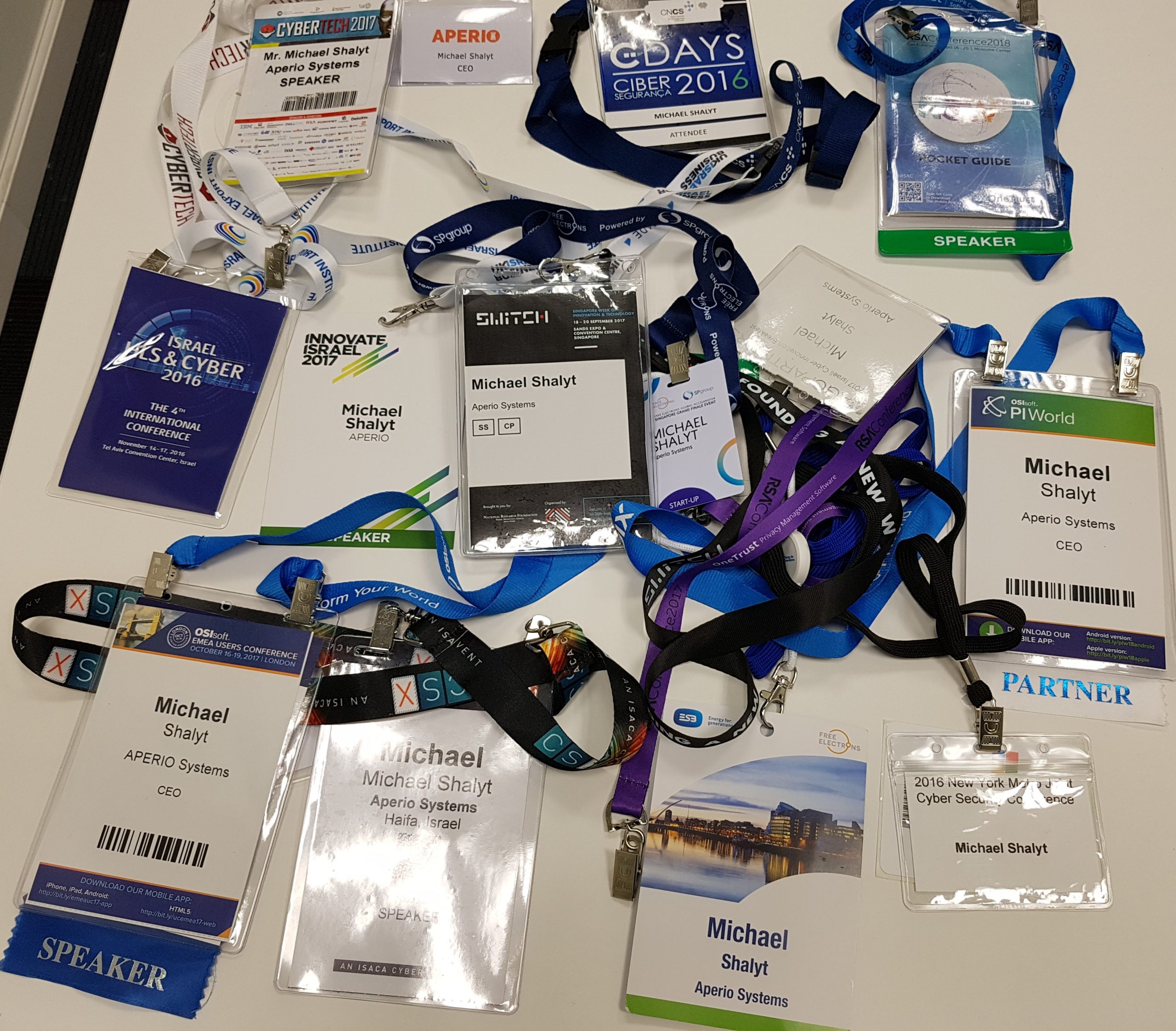
APERIO carried that scrutiny into industrial settings. Founded in 2016, it developed algorithms to validate sensor data against faults and malicious alteration. Shalyt served as a co-founder, product leader and CEO during 2016-2018. In an early description, he called the company “a lie detector for machines.” A useful phrase, because it begins with the operator’s predicament rather than the algorithm’s vocabulary.
By February 2018, APERIO had announced $4.5 million in seed funding, including investment from energy company EDP. The utility had also piloted the technology. A customer’s willingness to try a product and then invest gave the industrial-security proposition a concrete test beyond the presentation stage. The machinery existed. So did the people responsible for keeping it running.
Selling to large power companies introduced a different kind of complexity. Technical merit had to travel through a purchasing process involving multiple people. Shalyt later credited a book on enterprise selling with helping him organize that process. Even a product concerned with the integrity of machine data had to find its way through human decisions.
Give the bot a goal
In mid-2018, Shalyt left APERIO’s CEO role to build Evo.Do with Nataly Bendersky Shalem. The proposal drew on reinforcement learning: software agents could learn how to test games. Instead of spelling out every action in a fragile script, a developer could define an outcome, such as picking up a key, and let a bot learn how to get there.
The distinction mattered when games changed. A scripted route could fail after an update even if the game still worked. An agent capable of adapting might spare developers the job of repeatedly repairing the test. Evo.Do joined Tel Aviv University’s Xcelerator and Y Combinator’s Winter 2019 batch. For Shalyt, reaching YC fulfilled a goal he had carried for years.
It is an appealing engineering story: take a repetitive chore, describe the desired result, and build a system that figures out the route. It also contains an awkward business question. How much adaptation must a customer accept before a helpful tool becomes a new way of working? A bot’s ability to find a key is only one part of getting a studio to buy it.
The company he chose to close
In September 2019, Shalyt published a postmortem while Evo.Do was shutting down. Its title, “Good Idea, 10 Years Too Early,” captured his assessment of the timing. The account also examined technical difficulty, the gap between enthusiastic conversations and paid contracts, and the uncertainty of raising money around a young product.
He had expected simple game tests to be much easier to teach than expert-level play. Some parts were easier; other problems remained stubborn. He also described how much would need to change for the company to continue: leadership, team, product and approach to the market. His stated judgment was that the resulting risk no longer matched what investors had originally backed. He chose to close and give money back.
That decision belongs in the same career as the accelerator admission. It is tempting to make a founder’s story a procession of permissions: accepted, funded, invited. Here, the founder supplied a less comfortable milestone himself. He put the assumptions beside the outcome and left readers to examine the difference. The account gives the experiment an ending rather than an indefinitely postponed next chapter.
“We are a lie detector for machines.”
Michael Shalyt, describing APERIO in 2016
Some systems are supposed to be fun
Games have also been things Shalyt makes for people. With Nataly Eliyahu, he developed Fireside Tales, a collaborative card game for four to eight players. They spent about a year and a half revising and playtesting it before a launch at the Icon festival in 2015. The purpose was to make an enjoyable story together, using cards to introduce unexpected turns.
His portfolio wanders cheerfully from game-economy analysis to workshops building tabletop catapults and pencil crossbows. These projects sit beside the formal research without needing an apology. A card game has rules. A catapult has mechanics. Both provide prompt feedback when a designer’s assumptions encounter other people, or gravity.
The professional game work became more extensive. From 2021 to 2024, he worked on systems and economy design for Crushers! at Redemption Games. His work included an initial Python prototype and progression systems. During overlapping years he also led an algorithms program at CyCognito. A résumé puts those roles in rows; the overlap shows how little his interests respected the dividers.
How a formula approaches the answer
Since 2023, Shalyt has led the Ramanujan Machine group at the Technion under Professor Ido Kaminer. The group develops computational approaches to finding mathematical formulas and conjectures. Shalyt’s shorthand for the enterprise is “doing math like engineers.” It is an invitation to build tools, run searches and make the process of discovery something that can itself be investigated.
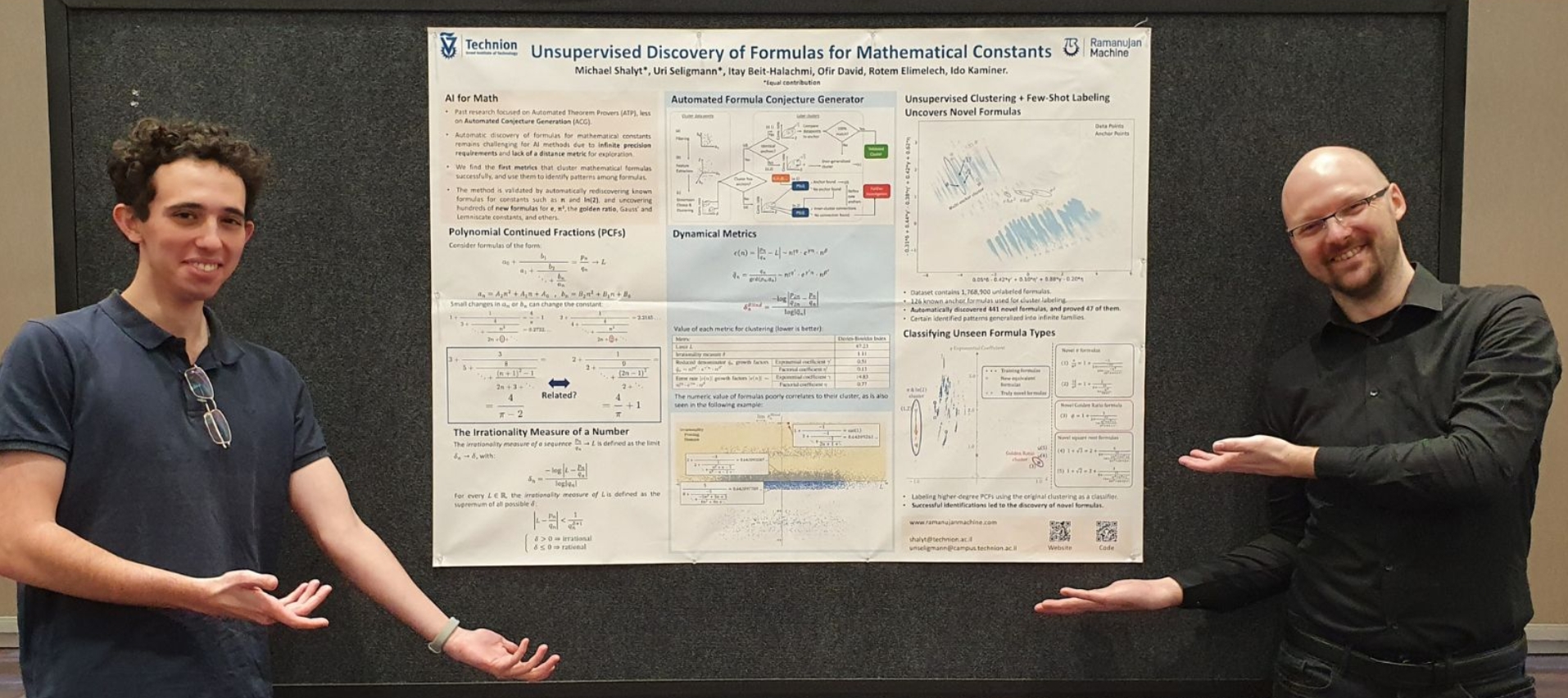
A 2024 paper he co-authored with Uri Seligmann and colleagues tackled a particular obstacle. When a formula is meant to identify a mathematical constant, merely coming close to the right number is insufficient. The team studied the dynamics of convergence: how formulas approach their limits. Those characteristics provided a way to organize formulas and search for relationships.
They tested the method on 1,768,900 polynomial continued fractions, recovering known formulas and finding previously unknown ones for several constants. Think of it as sorting journeys by their behavior rather than simply comparing the destinations written on the tickets. The comparison is an analogy; the research supplies the mathematical definitions. A large collection becomes useful when there is a principled way to find structure inside it.
Pi has relatives
Another collaboration, From Euler to AI, asks how formulas scattered across centuries of mathematics connect. Its pipeline searches research papers, extracts formulas involving pi and uses symbolic methods to uncover rigorous relationships. The project reports connections among 94 percent of the formulas in its collected set. That percentage describes the collection studied, rather than every formula for pi ever written.
The division of labor is revealing. Language models help gather and translate material. Numerical checks and symbolic algorithms take on other parts of the task. There is room here for several tools with different jobs, each carrying part of the burden. Discovering a promising connection and establishing it require different kinds of work.
The setting has changed from industrial sensors to mathematical literature, but Shalyt remains close to an old interest: extracting usable structure from a complicated system. His collaborators provide the other disciplines and perspectives. The result is collective research, with a workflow that can be inspected, extended and challenged. The romance of a formula still has an engineering department.
of the collected pi formulas were connected by the project’s methods.
Change the question slightly
The 2026 ICML paper ASyMOB, authored by Shalyt, Rotem Elimelech and Kaminer, returns to the problem of a convincing performance. Its published benchmark contains 35,368 validated symbolic mathematics problems. It varies seed problems through controlled transformations to examine how well models generalize. Integration, limits, differential equations and series all become material for a more searching examination.
The findings resist a single verdict. Many tested models lost substantial accuracy after small changes, while stronger systems showed greater robustness. Code tools helped stabilize performance. Some problems yielded to combinations of language models and computer algebra systems where either approach alone fell short. The useful question becomes which arrangement works, under which conditions, and how reliably.
There is a satisfying continuity in that question. At APERIO, a plausible reading needed an independent check. At Evo.Do, a test needed to survive a changed environment. In mathematical research, an answer needs to hold up when the familiar presentation shifts. These are connections between the projects, rather than a claim that Shalyt planned the whole route in advance.
His website carries the admonition “Yesterday You Said Tomorrow.” The portfolio underneath it contains plenty of evidence that he has acted on it. It also includes revisions, detours and a company he elected to stop. The next interesting answer, in this career, will have to endure the same treatment as the previous one: a closer look.
Validated symbolic math problems in the final ICML 2026 ASyMOB benchmark.
Follow the experiments
Projects, papers and the occasional detour.