A customer said he had bitten the head off a frog in an El Torito taco. The story had reached the late-night comedians. For a restaurant, this was an unfortunate moment to discover that amphibians had better name recognition than its menu. Michael Sitrick’s response was to ask questions. What did the company know about the customer? Could the allegation be checked? And what, exactly, had happened to the frog?
In Sitrick’s account, a university examination found no tooth marks, and the head was still attached. His team investigated the claim and the claimant. The damaging story lost its force. Recounting the episode in 1997, he described interrogating the company’s own people as a reporter would. Before anyone composed a reassuring statement, someone had to inspect the evidence.
There, in a small restaurant disaster, is the working life of Michael S. Sitrick: an argument over which facts deserve the public’s attention. He has spent decades advising companies and individuals at moments when their version of events risks becoming a footnote. His instrument is often a story. His first move is frequently an investigation.
The extra $35 a week
Sitrick’s professional choice had a wonderfully unromantic incentive. Early in his career, a journalism job offered $125 a week. A public relations job offered $160. “I liked journalism, but preferred eating.” The line is funny because it strips a consequential career decision down to the grocery budget. It also explains why he never entirely left the newsroom behind.
Born in Davenport, Iowa, and raised in Chicago, he was the oldest of three brothers. He later attended the University of Maryland, completing his degree in 1969. His education combined business administration and journalism, a pairing that would prove unusually practical. He learned to think about a company’s objective and about the questions someone outside the company might ask.
His early work included reporting for the Washington Star, the Baltimore News American and WSID Radio. He also served in Richard J. Daley’s Chicago administration, worked at Selz, Seabolt and Associates, and headed communications at National Can. These were different seats around the same table: government, business, journalism and the intermediaries trying to make them understand one another.
A bankruptcy with a story inside it
At Wickes Companies, Sitrick became senior vice president of communications and joined the senior management team. Chapter 11 put communications close to the machinery of survival. Employees, lenders and suppliers needed to understand what was happening to an enterprise whose financial condition had become public news.
He helped shape the company’s bankruptcy communications and worked through takeover attempts and litigation. A restructuring gives a communicator very little room for decorative language. The audience has questions about money, obligations and whether the business will still be there. A clever phrase cannot extend a credit line.
One consequential decision was to give Wall Street Journal reporter Stephen Sansweet extensive access to Wickes. The resulting 1985 account examined the company’s emergence from bankruptcy. Sitrick was taking a risk familiar to any executive who has invited a reporter inside: access can produce understanding, but it also means surrendering control over what the visitor notices.
When he established Sitrick And Company in 1989, he brought that experience with him. The firm’s work would include transactions, corporate disputes, restructurings and litigation support. Celebrity assignments supplied famous names. The underlying business was more often the less photogenic work of companies and their lawyers.
A newsroom on the other side of the call
Sitrick recruited former reporters and editors. The appeal was their ability to recognize news, investigate a claim and understand how a newsroom might respond. His colleagues have included journalists from the Wall Street Journal, New York Times, Bloomberg and other outlets. This is a personnel strategy with a built-in complication: knowing a reporter’s habits also helps you contest them.
David Churbuck, the founding editor of Forbes.com, joined the firm in 2018 to lead its Boston office and develop a technology practice. His account of the move described an attraction to crisis work and the chance to learn from Sitrick. The recruitment shows how the firm extended its approach into new industries by bringing in people who already understood their arguments.
The useful question is often what makes a development matter to someone beyond the client. In Sitrick’s vocabulary, ordinary reporting questions acquire two companions: “So what?” and “What’s the goal?” One asks why anyone should pay attention. The other asks what that attention is supposed to accomplish.
What happened?
Examine the facts before choosing a response.
Why should anyone care?
Find the news beyond the client’s concern.
What is the goal?
Connect the communication to an actual outcome.
When the camera turns around
The Food Lion dispute made the relationship between reporting and public relations especially uncomfortable. ABC producers had obtained jobs inside the supermarket chain and recorded undercover footage. Working for Food Lion, Sitrick obtained outtakes and challenged the journalists’ methods. The coverage itself became part of the controversy.
The episode subsequently became a journalism-school case study. Its enduring interest lies in the reversal. Reporters who arrived to examine a company found their own decisions under examination. That possibility belongs to journalism, too. A story can be accurate in some particulars and still leave its makers answering difficult questions about how they got it.
Another assignment, the campaign for Roy Disney and Stanley Gold against Michael Eisner’s leadership at Disney, required building an audience for dissent. SaveDisney.com gave the campaign a place to assemble its argument. A separate gathering before Disney’s annual meeting made the challenge visible beyond a private disagreement among powerful shareholders.
A website and a meeting sound modest beside the size of the company involved. Their purpose was concrete: make an alternative argument accessible and give its supporters somewhere to gather. Sitrick’s work here belonged to corporate governance as much as publicity. Communication helped organize a contest over who should lead.
The difficulty with two useful words
Sitrick has little patience for a reflexive “no comment.” His objection is practical. When an allegation circulates, silence leaves the available account in place. But he also argues against rushing out a statement before the facts have been established. The urge to appear decisive can manufacture a second problem: a correction.
His alternative allows a company to say that it is investigating and explain why a complete answer will take time. That requires discipline. People under pressure want the discomfort to end. The audience wants an answer. Acknowledging what remains unresolved can feel unsatisfying to everyone, even when it is the most accurate available response.
He set out his thinking in Spin, published in 1998, and The Fixer: Secrets for Saving Your Reputation in the Age of Viral Media, published in 2018. The interval between those titles spans a major change in distribution. An argument once negotiated with a relatively limited number of gatekeepers can now travel through countless accounts before the subject has finished reading it.
“If you don’t tell your story, someone else will tell it for you.”
Michael Sitrick
The client list asks its own questions
Sitrick’s assignments have included Roy Disney, Paris Hilton, corporate groups and the Daniel Pearl Foundation. They have also included Harvey Weinstein; the firm ended that representation in 2018. The contrast makes it impossible to treat the profession simply as a collection of clever recoveries. Skill at advocacy raises questions about whose interests it serves.
His stated position is that clients deserve an opportunity to present their side and that factual errors should be corrected. Critics have questioned whether that framework gives enough weight to the resources wealthy clients can bring against reporters and accusers. A corrected detail matters. So does the larger picture. Those judgments do not always arrive together.
His past work for Jeffrey Epstein returned to scrutiny in 2026. Sitrick has publicly defended that work. The renewed attention demonstrates a hazard built into his occupation: earlier assignments can become fresh subjects of judgment years after the engagement ends. The adviser’s reputation remains attached to the people he agreed to advise.
A microphone, then the keys back
In February 2025, Sitrick and senior partner Sallie Hofmeister launched The Intersection, a podcast about the court of law and the court of public opinion. Hofmeister’s background includes reporting and editing at the New York Times and Los Angeles Times. The pairing carries the firm’s recurring conversation into a format with room for follow-up questions.
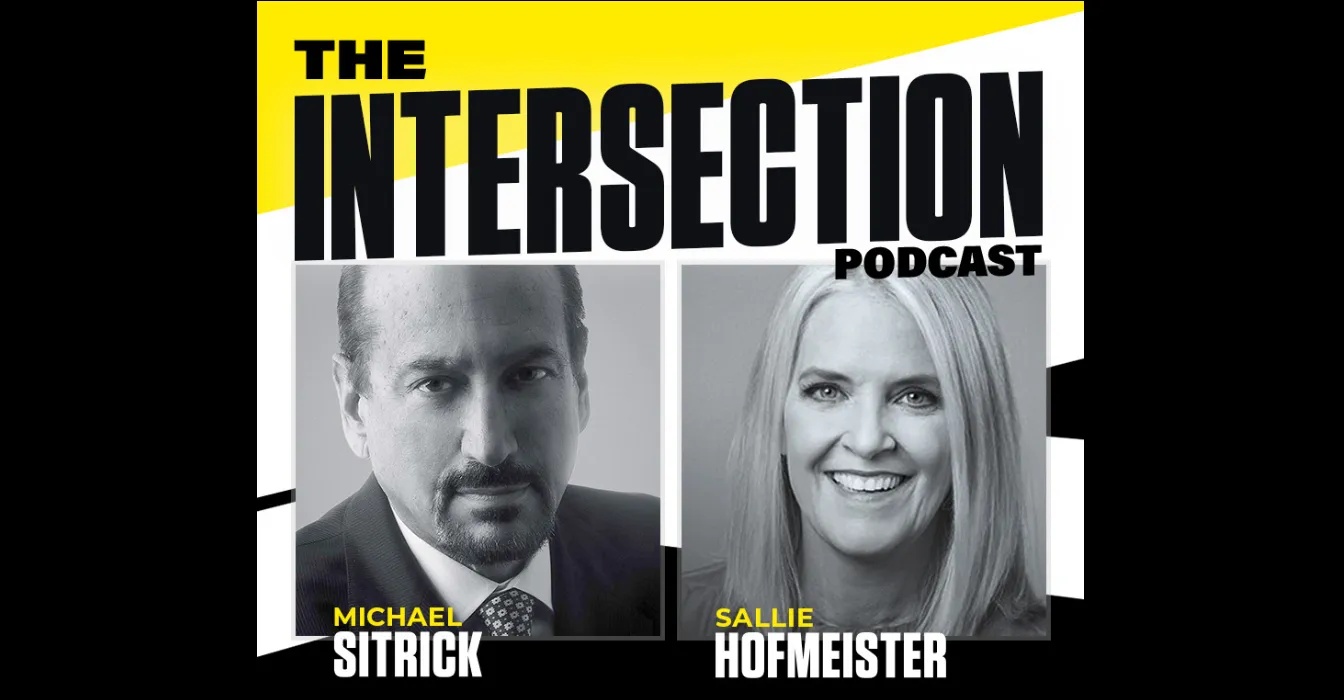
Guests listed on the show’s site include litigators Patricia Glaser, James Brosnahan, Martin Singer and Daniel Bergeson. The subject is familiar territory for its hosts: what happens when a legal dispute develops a public life of its own. A proceeding may follow a formal calendar while reputational consequences unfold immediately.
Then came an ownership change. Resources Connection had acquired the business alongside Brincko Associates in 2009. In May 2026, it completed the sale of Sitrick Group to an entity owned by an original founder, returning the firm to founder ownership. Sitrick’s stated preference remained a boutique where he could continue practicing.
- 1989Establishes Sitrick And Company
- 1998 / 2018Publishes Spin, then The Fixer
- 2025Launches The Intersection with Hofmeister
- 2026Firm returns to founder ownership
There is still a guitar
Outside the disputes, Sitrick has spoken about family time, vacations in Hawaii and returning to the guitar. His 2026 profile still lists guitar playing among his pastimes. His favorite film is The Blues Brothers. For someone whose working days involve carefully managed statements, a fondness for that particular musical rampage is an agreeable detail.
Asked in 2024 about a bucket list, he said he did not really have one. Asked about Los Angeles, he picked the beach. These are modest answers from a person whose profession makes nearly every answer potentially consequential. They also leave a recognizable life around the job: music to play, somewhere to go, people to spend time with.
The frog story remains a useful place to leave him. Before the briefing, before the argument about reputation, before the carefully selected words, there was a claim that needed checking. Someone had to ask whether the evidence supported the story everyone was already enjoying. Sitrick made a career out of being willing to interrupt.
Keep the conversation going
Interviews, public profiles and the conversations behind the feature.
- Official biography ↗
- Michael Sitrick on LinkedIn ↗
- The Intersection: episodes and guests ↗
- Listen on Apple Podcasts ↗
- The 1997 interview and the El Torito account ↗
- The Master of Spin: a critical profile ↗
- A conversation about The Fixer ↗
- On hiring, judgment and client relationships ↗
- LA500: the 2026 profile ↗
- Sitrick’s 2026 response about his Epstein work ↗
- Resources Connection’s annual report on the sale ↗