In advertising, a year is enough time for a platform to rise, a format to expire, and a solemn prediction about the future to become faintly embarrassing. Michael Pavone has been running the same independent company since 1992. The apparent contradiction is the point. Longevity in his business has not meant sitting still. It has meant becoming several things on purpose.
From its Harrisburg roots, Pavone Group has grown into nine agencies and companies operating across Harrisburg, Philadelphia, New York, and Atlanta. Their names remain distinct because their assignments are distinct. quench lives in food and beverage. Vigor works with restaurants and hospitality. Varsity focuses on the mature market. WildFig handles data and analytics. Elsewhere in the group are research, shopper marketing, content production, design, and the flagship Pavone agency.
A conventional holding company can feel like a cupboard full of labels. Pavone's version is closer to a row of specialist counters that share a stockroom. Clients meet people fluent in their category, while the agencies borrow reach and capability from the larger group. The organizing idea is not size for its own sake. It is useful specificity.
Chapter oneThe advantage of a narrower lens
Pavone began with the broad, perilous job of starting an agency. Over time he kept finding reasons to narrow the lens. Varsity became the home for work involving older consumers. In 2014 he founded quench around food and beverage, a category he had already studied through consumer trend reports and essays. The next year, he took the CEO role at WildFig, putting analytics beside the group's creative work.
The pattern accelerated in 2020. Pavone Group acquired Eastwest Marketing Group, a New York agency known for shopper marketing and point-of-sale work. A month later came Vigor, an Atlanta shop focused on restaurant and hospitality brands. The two deals did more than add pins to the map. Each brought an existing practice, staff, client knowledge, and point of view. Their names survived the transaction.
“Our independence allows us to chart our own path and make decisions and investments in order to compete nationally.”Michael Pavone
That line explains both the appeal and the burden of remaining independent. There is no distant owner to blame for a timid decision. Freedom arrives carrying its own invoice. Which capability deserves investment? Which agency belongs in the group? When should the company create a new specialty rather than stretch an old one? Pavone's answer has been cumulative, visible in the portfolio rather than proclaimed in a manifesto.
One group, several dialects
Specialization can become tunnel vision, of course. The group's countermeasure is circulation. People, research, technology, and ideas cross agency lines. A restaurant problem may need the appetite of Vigor, the data of WildFig, and the production abilities of a content studio. The trick is to share the machinery without sanding away the character that made each shop worth having.
Chapter twoThe founder changes jobs
Founders sometimes preserve their original role long after the company has outgrown it. Pavone chose a clearer break. In 2023, the group announced that he would focus exclusively on being CEO, while longtime partner John Bassounas became president. Pavone's brief became portfolio growth: acquisitions, expansion, and the opportunistic creation of new companies. Bassounas took the operating view of clients, leadership, and the changing craft.
It was less a coronation than a redesign of labor. Amy Murray, another partner whose history with the company reaches back to 1992, continued building the family of brands and working on business development. The three-person continuity is unusual in a famously restless industry. So is the willingness to acknowledge that a 32-year-old agency needs different jobs than a young one.
The outside recognition supplies mile markers. Pavone Marketing Group appeared on the Inc. 5000 in 2019 and 2021. Pavone landed on Adweek's fastest-growing-agencies list in 2020. The founder was an Ernst & Young Entrepreneur of the Year finalist and served as an independent director of BM Technologies from 2023 to 2025. Awards offer evidence of motion. They are not, in his story, the plot.
Chapter threeA poll learns to predict
A better view of the plot comes from SpotBowl, the group's annual poll of Super Bowl commercials. It began as a way to ask the public which lavish little films actually worked. Twenty-three editions later, the ritual now carries a predictive layer built by WildFig. The model analyzes humor, emotional appeal, visual impact, and relatability before the votes settle.
In 2026, that model forecast four of the public poll's top five commercials. “Our predictive analytics tool takes the guesswork out of advertising,” Pavone said. It is a bold promise from a person whose trade has never suffered from a shortage of opinions. More interesting is the combination: the model does not replace the audience vote. It sits beside it. Instinct gets a measuring instrument; the measuring instrument still has to answer to people.
This is what adaptation looks like when stripped of keynote language. Keep a 23-year-old institution. Change what it can tell you. The durable element is curiosity about why one piece of communication sticks while another evaporates between the nachos and the kickoff.
Chapter fourStories before the fork
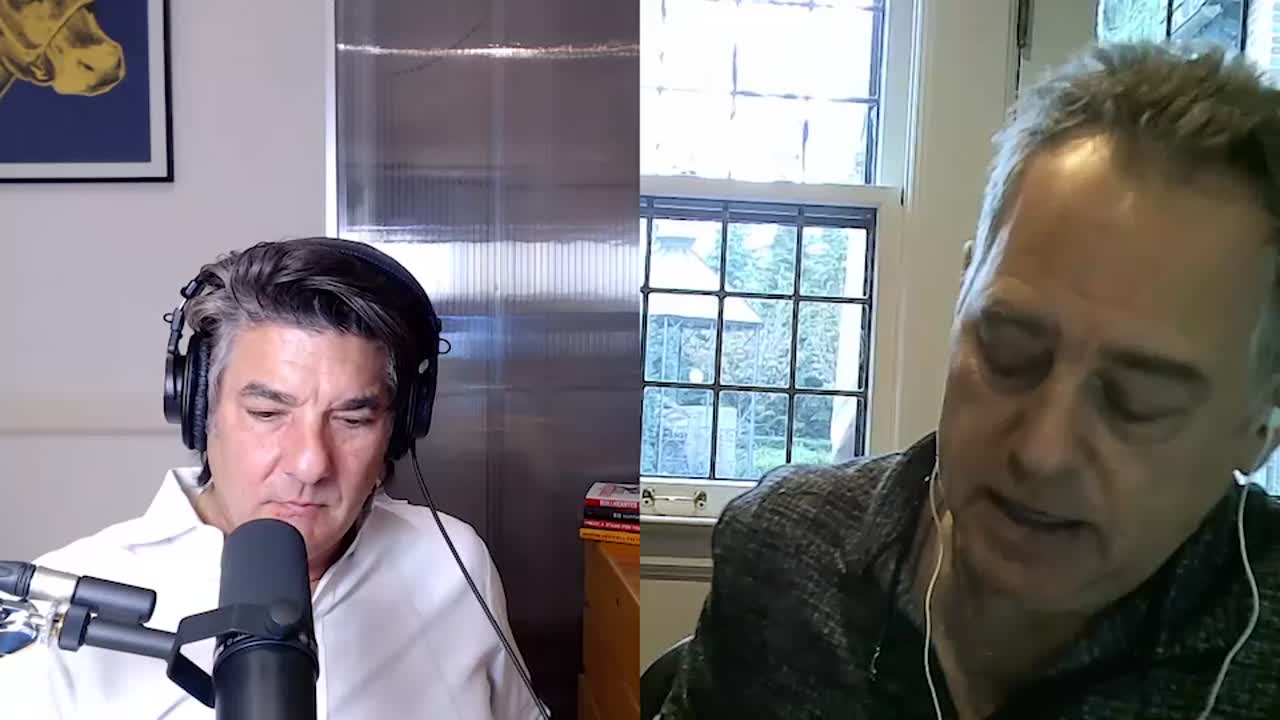
Pavone's other recurring experiment is more conversational. He hosts Forktales, a podcast devoted to the people behind food, beverage, restaurant, and hospitality businesses. The guest list ranges from chefs and authors to CEOs and entrepreneurs. The premise is delightfully nosy: before the fork reaches the table, somebody took a risk, survived a mistake, spotted a shift, or inherited a story worth retelling.
The role suits his public writing. Years ago, his Fast Company pieces examined food activism, changing attitudes toward meat, and the peculiar status symbolism of grocery shopping. More recently, his public commentary has focused on authenticity, flavor, consumer attention, and the difficulty legacy brands face when culture fragments. He approaches food as commerce, identity, and theater, often on the same plate.
He also appears to enjoy the human scenery around business. A Varsity biography reduces him to three brisk lines: “Business driver. Cheerleader. Fly fisherman.” The fishing is the useful surprise. It hints at patience, attention, and a willingness to stand quietly while nothing billable happens.
The company has a growth strategy, a predictive model, and a long-running position for an English bulldog. Sensible institutions leave room for one excellent absurdity.The Pavone office tradition
The bulldog deserves its paragraph. Hollywood, an English bulldog who came to work with Pavone from puppyhood, served as Director of First Impressions. She greeted visitors, wandered into meetings, and sometimes fell asleep under the table with the unembarrassed snore of senior management. The title outlived her. Pavone Group introduced Agnes as its newest Director of First Impressions in 2026, continuing a tradition more than two decades old.
It is branding, certainly. It is also culture made visible and slightly slobbery. The group's preferred adjective is “bulldogged,” meaning loyal, tenacious, and difficult to distract from the work. Most values statements vanish into conference-room wallpaper. A dog at reception is harder to ignore.
The long viewBuilt to keep becoming
Pavone now leads a company old enough to have watched the internet arrive, social media reorder attention, data science enter the creative meeting, and artificial intelligence volunteer for nearly every job. His response has not been to turn one agency into an all-purpose machine. He has assembled a group whose parts can become expert at different versions of change.
The wager is exacting. Specialist agencies must stay special. Shared resources must genuinely help. Acquisitions must add competence instead of decorative scale. Independence must produce sharper choices, not merely private ownership. Pavone has been testing that wager for more than three decades, one practice and one city at a time.
There is no tidy finish line for that kind of company. Every new capability creates another question about fit, and every new office tests whether a culture can travel without becoming corporate wallpaper. The work of building the group is also the work of keeping it legible.
Advertising tends to reward the new and forget the durable. Michael Pavone's career joins the two. His company endures because it keeps editing itself. The founder who started with an agency now tends an ecosystem, hosts other operators' stories, and still leaves room in the org chart for a bulldog. That is not nostalgia. It is a very particular method of staying in motion.