A tattoo is an awkward place to keep an investment thesis. In January 2022, Michael Novogratz showed off a wolf howling at the moon, with the word Luna beneath it. He had promised to get the tattoo if the cryptocurrency reached $100. It did. He obliged. A few months later, the Terra ecosystem collapsed, leaving the ink considerably more durable than the investment.
Novogratz addressed the wreckage in May, describing the tattoo as a permanent lesson in the humility that venture investing requires. For a financier accustomed to changing positions, this one came with unusually inconvenient paperwork. There would be no quietly deleting it from a slide deck.
The episode contains much of what makes him interesting: enthusiasm expressed in public, a willingness to make himself part of the wager, and consequences that outlast the excitement. It also raises a harder question. When an experienced investor becomes an evangelist, how clearly can everyone else see where the conviction ends and the selling begins?
Now the founder and CEO of Galaxy is making another substantial commitment. His company works in digital assets and is building data centers for artificial intelligence. The next chapter involves land, power, construction and long leases. For someone known for talking about the future, an increasing amount of the work is stubbornly physical.
The wrestler before the trader
Novogratz grew up in Alexandria, Virginia, the third of seven children. His father, Robert, had played football at West Point. Competition was available without leaving the family. At Fort Hunt High School, Mike captained the wrestling team and finished runner-up in the state. At Princeton, he became captain again, earned All-Ivy recognition twice and qualified for two NCAA championships.
These details matter because his athletic story has actual limits. He was accomplished, and he was beaten. There is something useful about a résumé that preserves second place. The wrestling mat offers little room for the elaborate explanations that finance can accommodate. Someone else has your leg; the market commentary can wait.
He graduated from Princeton in 1987 with an economics degree and served as a helicopter pilot in the New Jersey National Guard. Years later, the National Wrestling Hall of Fame recognized him as an Outstanding American. Wrestling stayed in his life through Beat the Streets, which develops opportunities for young wrestlers in New York City.
Around the time Fortress went public, he received a pitch about expanding wrestling in city schools. The practical requirements were appealingly direct: a mat and a coach. He helped support the effort. In 2012, international wrestlers competed in Times Square at a Beat the Streets event. It was a very Novogratz combination: a sport he cared about, money put to work, and absolutely no shortage of spectators.
- 1987Princeton economics graduate
- 1998Goldman Sachs partner
- 2015Fortress macro closure announced
- 2018Galaxy begins operations
- 2026Helios Phase I delivered
A partner, then an exit
Goldman Sachs hired Novogratz in 1989. He started in money markets, then spent much of the 1990s in Asia, working in Tokyo and Hong Kong. He became a partner in 1998. Before crypto gave him a new vocabulary, he had learned the established language of currencies, bonds and risk.
He joined Fortress in 2002 and built its liquid markets business. The firm went public in 2007, putting a public valuation on years of private success. Novogratz became one of the recognizable faces of an industry whose preferred public expression was often a closed office door.
The clothes helped. At a 2021 conference, he appeared in a purple flowered jacket and torn white jeans. His own term for this kind of display was “peacocking.” The wardrobe was doing a job: you remembered him. In a profession devoted to finding differences in prices, he seemed comfortable allowing differences in trousers.
Then came an ending that the bright clothes could not soften. In October 2015, Fortress announced it would close its macro funds and return capital. Novogratz acknowledged two extremely challenging years. His departure from the firm followed. The person who had helped build the business had to watch one of its defining activities wind down.
That episode gives the later crypto career its stakes. He already knew that sophisticated research, talented colleagues and personal confidence could coexist with a decision to stop. Galaxy would be built by someone with experience of both institutional acceptance and an institutional exit.
Building a company around a belief
His crypto involvement began in 2013. By 2018, Galaxy was operating with a clear purpose: bring institutions into a financial world that had largely developed outside them. Novogratz could speak to both sides. He knew how a trading desk worked, and he was willing to take digital assets seriously before many established firms were comfortable doing so.
That position required more than a bullish television appearance. Institutions needed trading services, asset management, financing and infrastructure. Building those capabilities gave Galaxy activities that could continue beyond its founder’s next forecast. It also exposed the company to the operational responsibilities that come with handling other people’s business.
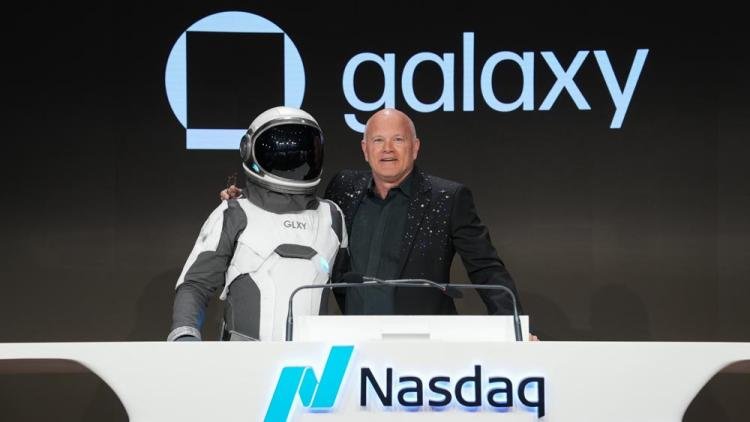
In May 2025, Novogratz rang Nasdaq’s opening bell as Galaxy began trading there. Beside him stood a figure in an astronaut suit. Even the arrival at a conventional stock exchange had room for a costume. There was a serious point under the spectacle: Galaxy had obtained a place in the American public market while keeping its identity rooted in crypto.
The cost of being heard
Luna left a more serious record than an embarrassing tattoo. In March 2025, Galaxy agreed to a $200 million settlement with the New York attorney general over its investment, trading and public statements concerning the token.
The attorney general’s findings described Galaxy acquiring Luna at a discount, promoting it through Novogratz’s public statements and selling large quantities without disclosing those sales to the audience hearing the enthusiasm. Galaxy neither admitted nor denied the factual findings. The agreement also imposed rules concerning public communications and disclosures of financial interests.
The distinction matters. A wrong prediction can be ordinary investment failure. Public promotion alongside undisclosed selling raises questions about what listeners were being allowed to understand. The settlement belongs alongside the successful deals and exchange ceremonies because the same public voice runs through all of them.
His candor can make him engaging. It cannot settle questions of disclosure on its own. A founder’s personality can attract attention to a market; a company still needs procedures for what it tells that market. The tattoo became a lesson about humility. The settlement made the lesson institutional.
“My tattoo will be a constant reminder that venture investing requires humility.”
Michael Novogratz, May 2022
Money that gets used again
Another strand of his life concerns people for whom access to capital means something much more immediate than entering an asset class. His daughter Anna’s work with the Bronx Defenders helped draw him toward criminal justice reform. He became a major supporter and board chair of the Bail Project, founded by Robin Steinberg.
The organization’s revolving fund pays bail for people who cannot afford it. When cases conclude and bail money returns, the fund can use it again. For an investor, the mechanics are easy to grasp. The outcome being sought is a person able to return to family and work while a case proceeds.
In 2019, he also helped found REFORM Alliance, joining a group that included Meek Mill, Jay-Z and Michael Rubin. Its focus is probation and parole reform. His connections made it possible to move between financial circles, philanthropy and entertainment without starting every conversation from scratch.
His sister Jacqueline founded Acumen, which uses investment to address poverty. Their careers put a recurring family question into different settings: what should money make possible? Mike’s answers include wrestling opportunities and changes to the justice system. Those commitments have their own history; they do not erase the obligations attached to his investment business.
The next bet needs electricity
In December 2022, Galaxy agreed to buy the Helios bitcoin mining facility in Dickens County, Texas, from Argo Blockchain for approximately $65 million. It was an infrastructure purchase during an industry retreat. The asset came with something that would become useful beyond bitcoin: access to power.
In 2025, Galaxy signed a 15-year agreement to host CoreWeave’s AI and high-performance computing infrastructure at Helios. Further commitments expanded the relationship. By the second quarter of 2026, Galaxy had delivered the first phase: 200 megawatts of gross power, providing 133 megawatts of critical IT load.
Critical IT load delivered to CoreWeave
200 MW gross power in total. The balance supports facility requirements; gross power and IT load measure different things.
In August 2025, Galaxy closed a $1.4 billion project financing facility for Helios. The difference in scale tells its own story. Buying a former mine was an opening move; converting it for a demanding tenant required another level of capital and execution. Novogratz’s talent for spotting a possibility now had to be matched by a team’s ability to deliver the building.
Novogratz’s current ambition joins digital financial services to the physical capacity needed for AI. In August 2026, he described the underlying idea simply: “the economy is increasingly running on code.” His company wants to provide parts of the machinery on both sides.
The accounts keep the ambition in perspective. Galaxy reported a second-quarter 2026 GAAP net loss of $85 million, even as Helios began generating lease revenue. A working data center adds another business to the mix; it does not make the rest of the balance sheet disappear.
There is a fitting change in the unit of measurement. Much of Novogratz’s public career has been discussed in prices: a token’s target, a share’s valuation, a fortune’s changing size. At Helios, progress also arrives in megawatts and delivered data halls. The former wrestler still likes a substantial commitment. This one has a construction schedule, a tenant and an electricity bill.