Michael Holdmann begins his account of a life in technology with cable. Not a metaphorical cable, nor a whitepaper diagram full of elegant arrows, but the ordinary kind that had to be pulled through buildings. In 1978 he was installing telephone systems, learning networks from the blunt end: a connection either worked or it did not. Nearly five decades later, he is still occupied by connections. Only the nouns have changed.
Telecom led to networking. Networking led to an internet service provider. In the mid-to-late 1990s, he opened an application service provider, the category that would later acquire the airier name of “cloud.” Then came Internet of Things platforms, smart-city work and international standards. Today Holdmann is the founder and CEO of PraSaga Foundation, where the connection problem has expanded to a rather more immodest scale: how should the internet represent, move and govern the things people actually own?
This is PraSaga, his fourth startup. Its principal project, SagaChain, is a Layer 1 blockchain built around a first-class object model. In plain English, Holdmann and his co-founders, CTO David Beberman and CMO Jay Moore, want an asset to exist on-chain as a persistent, programmable object with its own identity and state. They do not want it to be merely a token pointing toward a bundle of contracts and off-chain records. Crypto has many arguments about speed. Holdmann’s argument starts one floor below, with the data model.
One problem, several costumes
Holdmann’s career makes more sense as one long research program than as a sequence of fashionable pivots. The recurring subject is interoperability: unlike machines, software and institutions should be able to exchange information without forcing everyone into the same vendor’s garden.
In 2013, writing about an enterprise service bus for connected devices, he described a system that could connect devices, applications and people in real time. ConnectingYourThings, the IoT venture he founded in 2015, promised dynamic relationships among those participants based on need, capability and availability. The company’s mission spoke of bridging legacy systems, commercial software, operational technology and the cloud. The vocabulary is pure IoT-era enterprise architecture. The instinct underneath it is recognizably the same one now driving PraSaga.
Before that, there were years inside telecom and internet businesses. A 2023 podcast profile records that he built and profitably exited an interconnect telephone company in Las Vegas while attending college. His public work history later included strategic alliances at Zayo Group, a senior strategy and marketing role at messaging company Coversant, leadership around the UPnP Forum, and board and executive posts connected to an international smart-city research institute. LinkedIn lists marketing studies at the University of Nevada, Las Vegas from 1982 to 1986. The engineer’s systems appetite arrived by way of an operator and evangelist.
“I started a mission to create a ubiquitous, decentralized, open, equitable, technical foundation that would allow all everywhere to participate on a global playing field.”Michael Holdmann, 2020
It is an unfashionably large sentence. Holdmann traces its first implementation to his application service provider in the 1990s. Shared computing infrastructure was supposed to widen access. The cloud eventually did become ordinary, though not always open and seldom anonymous. IoT promised billions of communicating devices, then produced enough incompatible standards to keep a conference hotel busy for eternity. Blockchain offered a new set of rails and a fresh supply of complications.
The grocery store with too many registers
Holdmann got into blockchain through the desire to decentralize IoT and smart-city platforms. The route matters. He did not begin with a coin in search of a use. He began with fleets of devices and organizations that needed reliable identity, data and permissions across boundaries.
His most useful explanation of PraSaga’s design involves groceries. Imagine, he says, a store where every register is dedicated to one product. Bread goes through register one. Broccoli requires register two. A shopper with a full basket performs a little pilgrimage across the checkout floor. That is his caricature of a smart-contract architecture: the data and behavior for different assets are enclosed in separate programs, and complex activity requires orchestrating them.
PraSaga’s programmable smart assets are meant to let the basket move through one register. Each asset is a first-class object, living in an account container and able to inherit standardized classes. A property, for example, could carry its title status, jurisdiction, valuation and transfer rules as part of one governed object. Python is the scripting language at the client layer. Shards are designed to add parallel capacity. The ambition is less “faster coin” than a distributed operating environment.
There is a founder’s trick worth borrowing here. When everyone is optimizing an established system, inspect the abstraction that made the system necessary. PraSaga’s thesis may prove correct, partly correct or magnificently overbuilt. But it is at least asking a more interesting question than how to shave another fraction from transaction time: what if the industry chose the wrong basic unit?
Patience as an architecture
PraSaga was founded in 2017. The following years brought white papers, AMAs, conference appearances and code, but also the long timetable familiar to anyone attempting base-layer infrastructure. In 2022 the foundation was awarded a patent covering its first-class object model operating-system architecture. Holdmann called it a building block in scalability, connecting the design lineage to object-oriented systems such as Smalltalk and IBM’s OS/2.
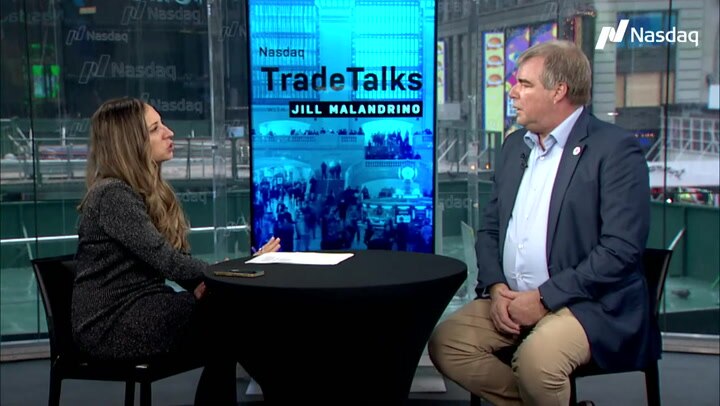
That October he appeared at the Nasdaq MarketSite with host Jill Malandrino. Asked about blockchain’s foundational problems, he did not begin with speculative markets. He began with utility outside crypto’s existing audience. It was the enterprise operator speaking: technology becomes infrastructure when people use it to get something else done.
PraSaga opened a public development testnet in May 2025 with four shards and four nodes per shard. Holdmann’s writing that year became increasingly architectural, describing a shared global class tree and sector-specific uses. By 2026 his public posts were moving between asset verification, enterprise tokenization, AI governance and ontology tools. SagaOntology Designer, announced in closed beta in August, is intended to let teams sketch and inspect SagaPython class hierarchies before submitting them to the network. After years of theory, the emphasis is turning toward workbenches, registries and things a developer can touch.
The organizational wrapper is part of the argument. PraSaga is structured as a nonprofit foundation. Its stated job is to maintain an open, permissionless network, taking an operating fee from transaction fees rather than owning equity in applications. Holdmann and Beberman hold permanent founder seats on the SagaStandards governing board, with provisions for successor representatives. The arrangement attempts to reconcile continuity of architectural intent with standards stewardship. Governance, in this telling, is not a page added after the product. It is another layer of the product.
The salesman in the standards room
Holdmann is not presented publicly as the solitary coder. His own description emphasizes strategy, business development, evangelism and vision. Recommendations on his LinkedIn profile call him driven, attentive to clients and creative in finding solutions. That is useful context for a founder selling a technical rethink that can take half an hour merely to name.
He compensates with analogies, historical continuity and repetition. The grocery basket returns. The cloud origin story returns. So does the claim that enterprise adoption will carry blockchain to ordinary users, just as businesses carried internet services into daily life. In his preferred future, a trusted brand introduces an application and the customer never needs to know a blockchain is underneath. Radical plumbing; familiar tap.
“Our focus [is] on long term sustainability, not short term pumps for few to gain over retail.”Michael Holdmann, 2024
There is also an insistence on community that borders on constitutional. “We do not exist without a community,” he said in a 2024 AMA. PraSaga describes its principles as purpose, people, planet and philanthropy. Holdmann’s aspiration is an open technical foundation broad enough to support global participation while preserving individual sovereignty. The rhetoric is lofty; the implementation work is unglamorous: class dictionaries, data models, consensus, standards, governance and developer tooling.
That contrast is the essence of his story. The ambition is planetary. The daily labor is plumbing. It began with copper and telephone switches, passed through racks and hosted applications, and arrived at object trees spread across nodes. Holdmann has spent his career at layers most users would prefer never to notice.
He has also had the peculiar advantage of watching revolutionary vocabulary become boring infrastructure. “Application service provider” became cloud. Connected things became a normal condition of appliances, factories and cities. Whether persistent on-chain objects make the same journey is unknown. PraSaga’s test is still in progress.
But the founder lesson does not require a verdict on SagaChain. Holdmann chose a problem sturdy enough to survive several technology cycles, then kept approaching it with the tools each cycle provided. Most careers are narrated as a ladder. His is closer to a spiral: each turn returns to interoperability, but with a wider radius. After nearly five decades, he is still pulling cable. It is simply invisible now, and meant to connect almost everything.