In 2014, Michael Grupp had a business helping other people finish their dissertations. He was still working on his own. The subject brought law together with computer science: whether legal knowledge could be formalised for practical use. Meanwhile, his startup, Thesius, was trying to give doctoral researchers something surprisingly elusive in a country full of universities: a way to discover who else was working on the same thing.
There is a pleasing inconvenience in this beginning. A lawyer, trained to locate the right answer, had found a problem with locating the right people. His early entrepreneurial work involved databases, research topics and introductions. Years later, as co-founder and CEO of BRYTER, he would be selling tools that let lawyers distribute their expertise through software. The questions changed. The difficulty of making knowledge available persisted.
A dissertation acquires a business plan
Thesius began as a hobby among students at Johannes Gutenberg University Mainz in 2012. In July 2014, Grupp described its original ambition as listing Germany’s dissertations. The project grew into a research database, a network for people writing theses and a place where universities and businesses could propose topics. Searching for work and describing your own became part of the same exchange.
In an early interview, he was candid about the less photogenic work. Explaining and selling the service had taken time, effort and frustration. Recruiting good people was another difficulty. The team’s size varied with employees, interns and students. An office full of activity was good for the company, he joked, and rather less helpful to his personal productivity between nine and six.
His advice to other founders was correspondingly practical: contact customers early. He did not present entrepreneurship as an exercise in guarding a precious idea until the unveiling. The unglamorous conversation with a possible user belonged near the beginning. This was advice from someone discovering that a useful database still needed an explanation, a sales effort and people to keep it working.
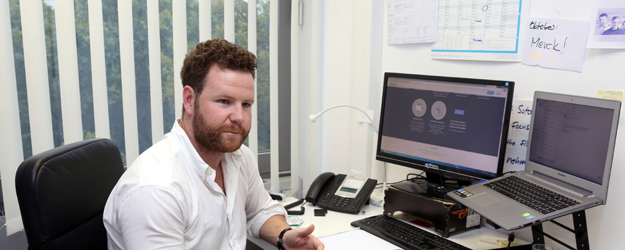
By October 2014, Thesius listed nearly two million dissertations, according to Grupp’s account at the time. The company had received the Mainzer Wirtschaftspreis for best startup that year. Its office was in the Bonifazius towers beside Mainz’s main station. He could remember the precise day they first unlocked the door: 20 August 2013. For all the scale implied by a database, a business still begins with a room.
The lawyer takes the machinery apart
Grupp’s legal education took him through Germany and France. His professional training included Frankfurt, London, Seoul and New York, followed by work in commercial law firms in dispute resolution. Public biographies describe a career in international litigation and arbitration, with experience at firms including Hogan Lovells and Freshfields. He had seen legal work from inside the institutions that bought it and sold it.
His interest in technology developed alongside that work. Lexalgo, co-founded with Markus Knittig and Florian Weiland, explored decision automation. Weiland dated its founding to 2012 and connected the idea to Grupp’s research on rule modelling. Legal questions often have conditions and branches. Capturing those branches in software offered a way to repeat a structured assessment without starting the explanation again.
The distinction mattered. In Weiland’s account, the early team favoured rules because suitable legal data for machine learning was scarce. They developed a rules engine with the European Space Agency and support from the state of Hesse. That is an unexpected connection for a legal technology business: the route from a lawyer’s recurring question included people more often associated with spacecraft.
In January 2017, Grupp joined the executive faculty of the Bucerius Center on the Legal Profession, working on legal technology, digital business models and data protection. The teaching ran beside the building. Later biographies also record his lectures on legal technology and innovation in Frankfurt and his co-directorship of the BRYTER Center for Digitalization & Law at EBS Law School.
Three Michaels, one extra letter
Thesius was sold to persona service in 2017. Lexalgo was acquired by BRYTER in June 2018. Grupp’s next company brought him together with Micha-Manuel Bues, another lawyer with technology experience, and Michael Hübl, whose background included the ridesharing service flinc. The founding team required more care with first names than most meeting agendas allow.
There was also a small problem with the company name. An investor’s account recalls a June 2018 soft launch under “Ryter”. Within days, the founders chose BRYTER instead. In the same account, Cavalry’s relationship with Grupp stretched back to 2014. The new venture arrived with earlier experiments, working relationships and previous companies behind it. Its apparent beginning had a substantial preface.
BRYTER offered a visual toolbox for turning expert reasoning into applications without programming. Grupp’s 2020 explanation used gift and hospitality compliance: employees needed to know whether they could accept something, while the compliance team had to answer the same kind of question repeatedly. A guided application could put the relevant rules within reach. Office diplomacy had found a software specification.
He also described a discovery made through customers. Professional services firms wanted to build applications for their clients as well as for themselves. The product could become part of the service they sold. By May 2020, he said, a user in India had built the platform’s two-thousandth application. Knowledge designed in one place could be used somewhere far beyond the original desk.
The money comes with a destination
In April 2021, BRYTER announced a $66 million Series B led by Tiger Global, with existing investors Accel, Dawn Capital, Notion Capital and Cavalry Ventures participating. The company said total funding had passed $90 million. The intended use included international expansion, particularly the United States. The size of the cheque made a headline; the work it was meant to fund involved entering another market.
Grupp’s account of that expansion was more physical than the cloud-software vocabulary suggests. Building for the world required travelling after the business. Starting in a smaller city was possible, he explained, but founders still had to spend time where they hoped to grow. Frankfurt, Mainz and Berlin belonged in his story alongside London and New York. Geography had survived the invention of remote software.
He paid attention to what happened after purchase, too. Discussing legal technology adoption in 2022, he linked ease of use to the fact that software was now in lawyers’ hands. Design had become consequential to whether people used the tool. A product can satisfy a procurement process and still lose an argument with someone’s daily habits. For Grupp’s business, that second argument mattered.
When the assistant has to do something
Generative AI gave BRYTER a new set of tools. In May 2025, it launched BEAMON AI, with assistance, Microsoft Word-based drafting and document review capabilities. Grupp’s stated ambition centred on completing tasks through the combination of AI and workflows. An answer on a screen was one part of a process that might also require a document, an approval or a database update.
“We want to offer the option to solve some tasks end-to-end.”
Michael Grupp, on the 2025 BEAMON AI launch
In August 2025, BRYTER announced Hybrid Agents. The proposed division of labour was explicit: AI could read, reason and write; workflows could handle approvals, business rules and thresholds. Templates covered areas such as commercial contract review, claims processing and billing guidelines. Human oversight remained part of the design. The rule-modelling questions from Grupp’s earlier work had acquired a new companion.
A conceptual view of the combination BRYTER describes, rather than a measured performance claim.
By June 2026, Grupp was describing another measure of adoption: time spent with the assistant. In an interview, he said BEAMON users averaged about an hour a day, comparing its place in their routines with Word or Outlook. This was his reported usage figure. It also made his ambition concrete: software that becomes part of a lawyer’s ordinary working day.
A July 2026 announcement with Septeo CNEE brought that ambition into insolvency administration. Septeo added BEAMON AI to its offering, while the companies described developing a connection for documents and case context. The intended destination was familiar work: locating information, preparing drafts and handling files without repeated manual transfers. After the grand debate about AI, there remained a document somebody needed to move.
The founder picks up a microphone
Grupp also hosts Bots & Billables, moving between interviews and conversations from legal technology conferences. In 2025, his guests included PAXA’s Konstantin Heilmann, discussing legal services built around AI, and SEAL Software founder Ulf Zetterberg, discussing contracts and returns on investment. Other episodes took him around ILTACON and Legal Geek, asking people what they were actually seeing.
Those conversations give his public work a social dimension. The former litigator now spends part of his time asking lawyers, founders and investors to explain themselves. His career has moved through research networks, decision engines, teaching and enterprise software. At each stop, the practical question returns: how does what one person knows become useful to somebody else? The answer still requires a conversation. Grupp has built several businesses around making the next step easier.