At conferences about poverty, Michael Faye heard a joke that had a habit of spoiling the atmosphere. People were staying in pleasant hotels, eating pleasant meals and discussing the lives of people who could afford neither. Someone would ask what might happen if the money spent on the conference went directly to poor people. It was an awkward question, conveniently dressed as a joke. Faye, whose first job after school was at the United Nations, kept thinking about it.
He initially shared the doubts around direct cash. Would it work? Could anyone deliver it at a useful scale? The idea had the disadvantage of sounding almost embarrassingly straightforward. A conference can accommodate a complicated theory with ease. A proposal to give people money risks making the coffee break feel rather expensive.
Faye’s subsequent career has followed that question through several different institutions. He helped co-found GiveDirectly, the nonprofit that sends unconditional cash transfers to people living in poverty. He co-founded Segovia, which built technology for institutional payments. He now leads Taptap Send, helping people send money across borders to family and friends. Each venture deals with a different sender. Each has to get the money through.
The conference joke that survived the conference
At Harvard, Faye studied mathematics and classics before completing his doctorate in Business Economics. The combination is a pleasing detail for a future payments founder: numbers, ancient languages, then the daily business of moving funds. His work became concerned with a very contemporary question, the effectiveness of efforts to reduce poverty.
He entered graduate school in 2004, as development economists were increasingly using randomized trials to test interventions. That change mattered to his thinking. Programs could be judged by what happened to people who received them, compared with people who did not. Familiarity and good intentions could no longer do all the argumentative work. Cash transfers emerged as an option worth taking seriously.
The beginnings of GiveDirectly were small. Faye, Paul Niehaus, Rohit Wanchoo and Jeremy Shapiro were graduate students thinking about where to give their own money. Other people asked them for advice too. They wanted a way for an individual donor to send money directly to a person living in poverty. They looked for that option and struggled to find it.
Meanwhile, mobile money was changing what delivery could mean. Kenya’s M-Pesa connected people to electronic payments without requiring a conventional bank account. A donor’s question and a new payment network met at an unusually useful moment. The group began with their own money and contributions from friends and family. The giving circle grew into an organization.
“Trying to build things that matter.”
Michael Faye’s description of his work
A roof with its own economics
Giving someone an unconditional transfer requires the donor to surrender a familiar pleasure: deciding what the recipient ought to buy. Faye has acknowledged how difficult that can be even after years of doing this work. He has caught himself wondering why someone chose a particular purchase. The people receiving the money have then explained the circumstances he missed.
Tin roofs supplied one memorable lesson. Looking at a roof upgrade from outside a Kenyan village, he wondered whether he was seeing the local equivalent of a marble bathroom. The recipients supplied a less glamorous explanation. Thatch needed replacing repeatedly. A metal roof could reduce that recurring expense. It could also collect rainwater.
There was another consideration that did not fit neatly into a calculation of financial returns: parents wanted their children to stay dry when it rained. Faye’s account is unusually useful because he includes his own mistaken first impression. The economist had questions about the purchase. The household had been living with the roof.
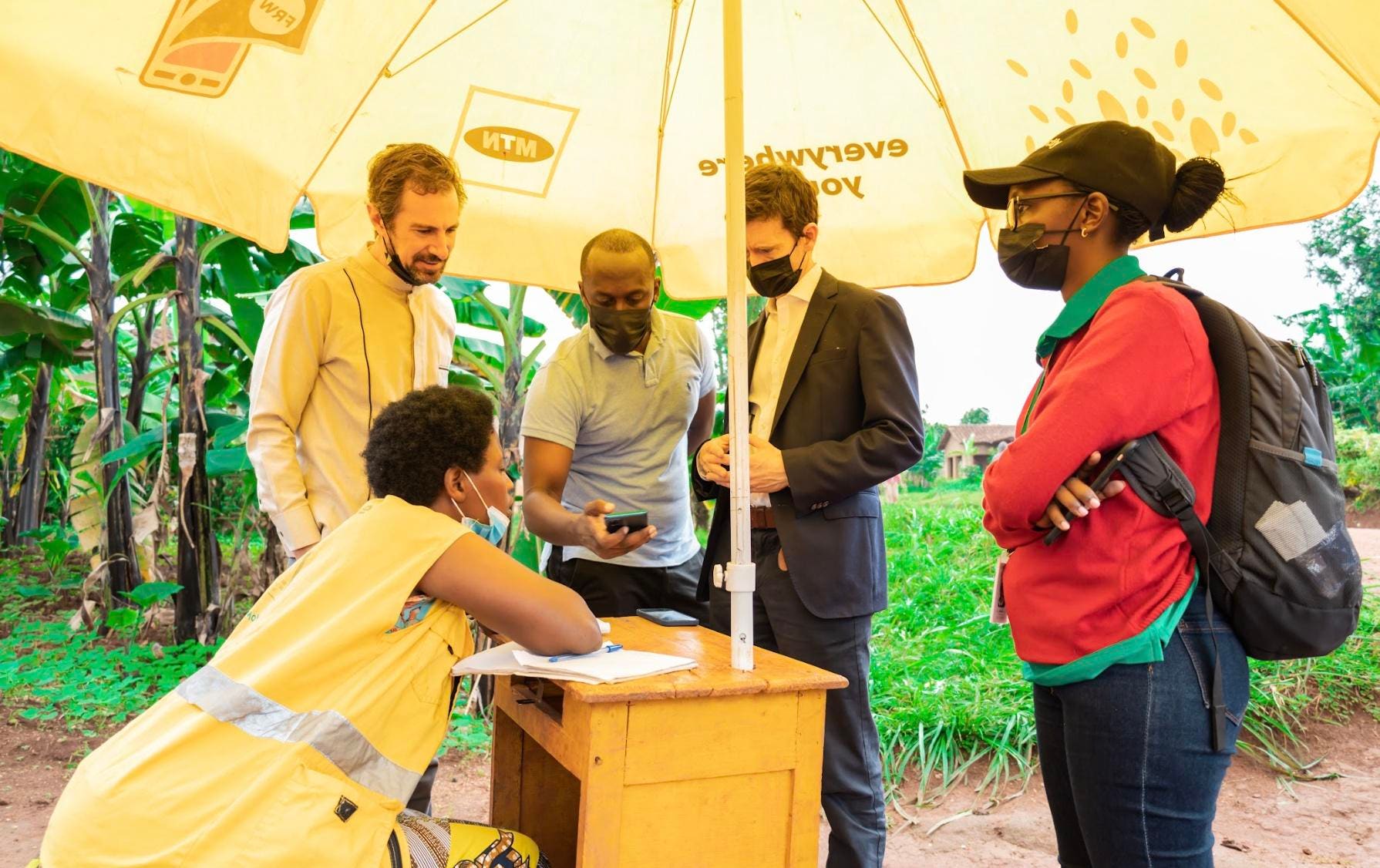
Choice also produces things an aid planner might never put on a shopping list. A GiveDirectly retrospective described William Owegi using his transfer to start a band, hiring musicians and dancers and earning money from performances. The group recorded an album with a GiveDirectly theme song. A program that leaves decisions to recipients must make room for an occasional soundtrack.
When the spreadsheet became the business
The proposition was simple enough to explain in a sentence. Running it created a growing collection of operational problems. GiveDirectly’s early payments were processed by one person with a laptop, handling a few hundred transfers each month. As the organization expanded, spreadsheets and scripts multiplied. Approval processes and payment records needed something sturdier.
Segovia, co-founded in 2014, grew out of that problem. It developed technology for organizations moving money into emerging markets. Governments, nonprofits and other institutional customers had their own reasons to want more reliable payment systems. A tool built around one charity’s delivery challenge could serve a wider group of senders.
The overlap between a charity and a commercial company also called for rules. GiveDirectly disclosed their relationship, including its shareholding and the need for independent decisions on contracts. Directors connected to both organizations recused themselves from relevant votes. An attractive mission did not eliminate the ordinary obligations of governance.
In July 2019, Crown Agents Bank acquired Segovia’s payment technology. The remaining part of the business formed a separate Taptap Send company. That history makes the progression easier to understand: Faye had worked on the purpose of a transfer, then on its institutional machinery. Consumer remittances brought the same practical concerns into the hands of a different kind of sender.
Money has family commitments
At Taptap Send, the person moving money is often someone working away from home. Their transfer belongs to an existing relationship. Someone knows whose rent is due, which school payment is approaching, or which relative is waiting. The transaction carries information that the payment company does not need to supply.
Faye has argued that remittances deserve attention from anyone concerned with inequality and capital reaching emerging markets. For many of the markets Taptap Send serves, he points out, those transfers exceed aid and foreign investment combined. It follows that improving the cost and convenience of sending money can matter well beyond the company’s own balance sheet.
The Philippines offers a particularly concrete example. In early 2025, Taptap Send’s Philippine corridor was reported to have reached a billion-dollar annualized transfer run rate in 21 months. That describes the pace of transfers, rather than company revenue. The distinction matters: the large number represents money people are sending, much of it with family obligations attached.
Behind that corridor is country launcher Faye Sta. Ana Corpuz, whose mother worked in Dubai to support the family. She has described the difficulty of delayed remittances, including having to give a school registrar promissory notes. Her experience gives the product’s promises a specific meaning. Speed is something a family may need before the school office closes.
The UAE is now another focus of the business. In July 2026, Taptap Send announced three Central Bank of UAE licenses covering stored value, retail payments and exchange business. Its customer guidance describes an AED wallet that can hold funds, support international transfers and send money to other UAE customers. The company’s job has expanded from getting a transfer abroad to handling more of the sender’s everyday payments.
The F-word in the meeting room
Faye’s interest in who gets to decide also appears in an unexpected place: the vocabulary of office conversations. In 2021, he published an essay with the title Please stop using the F* word. The offending word was feedback. Corporate life contains worse language, although few words receive quite so many calendar invitations.
He had previously recommended Thanks for the Feedback to colleagues. His objection was to the way one vague term could gather several different kinds of statement. A preference for later meetings, an observation about a presentation and a manager’s expectation carry different authority. Calling all of them feedback blurs what the listener is being asked to do.
He proposed speaking more precisely about what one prefers, notices or expects. The essay reveals a concern with the power hidden in ordinary phrasing. A colleague’s taste can become an apparent rule if delivered with sufficient managerial confidence. Naming the statement clearly lets both people understand what is actually on the table.
The next test is the size of a country
In 2022, Faye moved to Executive Chair at GiveDirectly as Rory Stewart became President and CEO. He remained connected to the organization he had helped start while continuing to lead Taptap Send. The titles changed; the wider ambition to reduce extreme poverty remained part of his work.
GiveDirectly’s partnership with Canva illustrates the scale now involved. Canva began supporting the organization in 2021 and later announced another $100 million commitment over four years, following $50 million already donated. Its next phase aimed to reach an additional 185,000 people. The commitment also included research and variations on the approach, keeping questions about effectiveness inside the expansion.
In August 2026, Faye and Homi Kharas co-led a working-group proposal through the 17 Rooms initiative for a national-scale cash-transfer test. It called for seed financing of $1 billion annually for five years, a willing government, clear success criteria and independent advice. Those figures describe a proposed experiment, rather than money already committed.
The proposal returns to the question that has followed Faye since the conference hotels: what happens when money reaches people directly? The scope has grown from a giving circle to a possible countrywide program. The need to evaluate it has grown too. A national test would have to examine effects that a village program cannot settle by itself.
There is a useful modesty in the roof story to carry into such an ambition. Faye had an interpretation. The recipient had a better explanation. Across his ventures, the work keeps coming back to the transfer and what it allows someone else to do. The money arrives. A family replaces a roof. A business gets started. Somewhere, a band begins to play.