On Opening Day in 2024, Michael Arougheti had a useful answer to the question of how a new baseball owner should introduce himself. He went to Pickles Pub, near Camden Yards, and helped buy the fans a round. There are more elaborate ways to announce a change of ownership. Few come with such immediate feedback.
The gesture suited the occasion. Arougheti had joined the Baltimore Orioles’ ownership group with people who had spent years being his friends and colleagues. They were entering a relationship with a city, complete with its own expectations. For once, the people assessing an investment could express their views from a bar stool.
His working life has involved much quieter transactions. As co-founder and chief executive of Ares Management, he helped build a business around lending to companies. The connection between that work and baseball goes back further than the Orioles deal. It begins with a teenager sitting behind a table of trading cards, deciding what something was worth.
The schoolteachers’ son
Arougheti grew up in New City, in New York’s Rockland County, in a household of educators. His mother taught French and Spanish. His father was a high-school assistant principal who also taught at Baruch and NYU. The family put a premium on education, effort and service. Ambition had company at home.
As a teenager, he started Four Corners Sports Cards. His parents supported the venture and required the paperwork: a tax identification number, a budget and a business plan. A collection had become an enterprise. The customers might care about batting averages; the adults wanted to know whether the arithmetic worked.
The useful discovery was that a succession of modest trades could be preferable to waiting for an elusive, valuable card. Turning over inventory offered something repeatable. Hunting a rarity offered the possibility of a story to tell. Arougheti would eventually make a career in a part of finance where repeatability matters rather more than a spectacular anecdote.
He graduated from Yale in 1993, with a degree in ethics, politics and economics, cum laude. The combination deserves a moment’s attention. Lending requires an assessment of incentives, institutions and money. His degree put those subjects in the same room before his career did.
An apartment with too many keys
At Kidder, Peabody, his early career acquired a very small geographical footprint. His apartment was across the street from the office. He remembers working more than a hundred hours a week, and other analysts and associates using the conveniently placed apartment to rest. Colleagues had keys. Proximity had turned a private convenience into shared infrastructure.
It is a funny little property story with an unglamorous explanation. The workload was enormous. Living close to work made it manageable, at least logistically, and helped the group around him. Looking back, he has described those years as training in discipline, effort and attention to detail.
He moved to Indosuez Capital in 1994 and to RBC in 2001. At RBC Capital Partners, he became managing partner of the Principal Finance Group. His work involved originating and managing investments across loans, subordinated debt and equity. He learned the business from several positions in a company’s capital structure, where different claims on the same cash flow can produce very different experiences.
Ares was already operating when he arrived in 2004. The firm had been established in 1997; his co-founder title and his later arrival belong to the same biography. He helped build the private credit platform that became central to its development. Ares Capital Corporation, the publicly traded lending company, completed its IPO that year.
The appeal of the ordinary loan
Credit offers an unusual sort of ambition. An equity investor can imagine an investment multiplying many times over. A lender generally starts with a more bounded hope: receive the agreed interest and get the principal back. The opportunity lies in doing that well, repeatedly, across a portfolio.
By the end of 2022, Ares managed $352 billion, including $214 billion in credit. Its customers included pension funds, insurers and other institutions looking for income. Arougheti’s card-trading education had found a much larger setting: many transactions, a disciplined approach to value and an interest in what accumulates over time.
“People are gravitating toward durable yield.”
Michael Arougheti · 2023
That preference helps explain the firm’s identity. A steady stream of contractual payments can be attractive to an institution with obligations of its own. The business still requires judgment about who can repay. A coupon is an agreement, and agreements remain dependent on the people and businesses behind them.
In January 2026, Arougheti argued publicly for understanding private credit through those fundamentals. He emphasized direct relationships with borrowers, flexible financing and the incentive created when a lender expects to hold a loan over time. In his account, companies seek this capital because their needs do not always fit standardized bank products or public markets.
His argument also describes the executive he wants to be: involved, patient and informed by an ongoing relationship. It is a case made by someone whose business benefits from the model. Its practical test remains the quality of the underwriting and the eventual repayment, however comfortable the relationship feels.
The longest-running team in the room
In 1998, Arougheti and friends started a fantasy baseball league. An early draft took place in a bank office, with pizza and beer on a conference table. Selecting players occupied roughly twelve hours. A leisure activity had found a way to reproduce the working day, then extend it.
The league lasted 26 years. Michael Smith and Mitchell Goldstein were part of that circle, and also became close Ares colleagues. Their shared baseball life survived changing jobs and growing responsibilities. In 2024, the three invested through Charm City Sports Partners in the Orioles ownership group led by David Rubenstein.
Arougheti had to give up fantasy baseball when he became an MLB owner. His collection of cards survived the transition, including a Cal Ripken Jr. rookie card. The hobby had delivered a peculiar promotion: less freedom to manage an imaginary team, an actual interest in a real one.
The Orioles investment is personal. Ares also has a separate institutional sports investing business. Keeping the distinction clear makes both more interesting. A fan can want his team to win; an investment manager has to consider the broader economics of a league, a venue or a service that supports the sport.
A personal stake in the Orioles, alongside long-standing partners.
Ares invests institutional capital across the sports economy.
Arougheti dates Ares’ involvement in sports investing to years before it formalized a dedicated strategy in 2020. He describes owners’ appetite for flexible capital and the importance of establishing trust with leagues and franchises. The money arrives inside an existing community of interests. Understanding that community is part of the work.
Baseball also gives him a language for collaboration. A season brings repeated decisions, narrow margins and a dependence on other people’s execution. Analytics help, but a team still has to perform together. Anyone who has watched a promising roster lose a winnable game can appreciate the limits of a handsome spreadsheet.
The economics of showing up
Arougheti identifies a consequential early partnership decision: dividing the initial economics equally. He credits that arrangement with helping establish shared interests and trust. It gives a concrete foundation to his talk about culture. People can read a statement of values; they can also read the agreement that determines who benefits.
He has watched junior colleagues become leaders, and describes mentoring as a rewarding part of his work. In 2025, he hosted University of Virginia student Kamel Barghouti through the Jeff Ubben Posse Fellows Program. The schoolteachers’ son had become someone a younger person could question about how a career gets built.
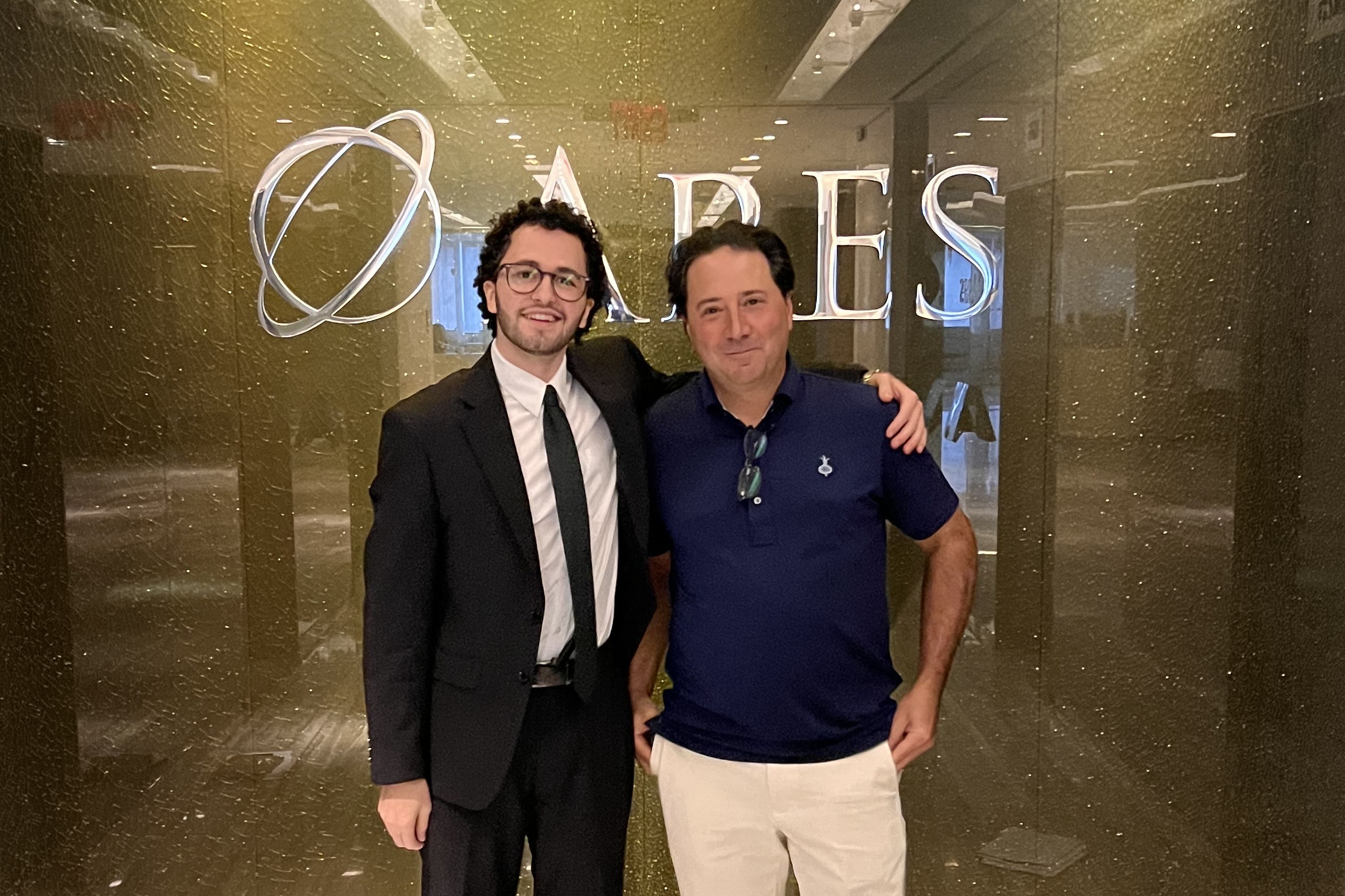
His public work extends to Operation HOPE’s board and the Ares Charitable Foundation. In his foundation writing, he has emphasized career preparation, reskilling, entrepreneurship and personal finance. These are practical interests for someone whose own upbringing treated education and work as connected responsibilities.
There is an art-world detail, too. With Nelly Bly, Arougheti donated Jean-Michel Basquiat’s Famous Negro Athletes to Yale University Art Gallery. The work appeared in the gallery’s spring 2024 magazine. Even here, in a gift to his university, athletes enter the picture.
A bigger balance sheet, the same calendar
Arougheti became Ares CEO on January 1, 2018, succeeding Tony Ressler, who continued as executive chairman. He had already spent years in senior operating roles. Even so, he has described the promotion as bringing a deeper responsibility to the people around him. Familiarity with the work did not make the appointment weightless.
By June 30, 2026, Ares reported more than $671 billion in assets under management. Second-quarter inflows exceeded $36 billion, and available investment capital, known as dry powder, stood at $170 billion. Those are firm figures, covering a platform that extends well beyond its early lending business.
Scale changes the number of people involved. It also makes the original habits harder to maintain: knowing a colleague, understanding a borrower, remembering why a partner trusted you. The annual report grows longer. The obligation to make good decisions keeps arriving at the same speed, one decision after another.
The baseball purchase has its own continuing calendar. Buying a stake provided an announcement and an Opening Day introduction. Ownership brings subsequent seasons, more decisions and fans who remember what was promised. A round at the pub is an agreeable beginning. The relationship carries on after everyone has gone home.