The most consequential screen in mental health may be the one nobody remembers. It asks for a member number, confirms a benefit and produces a list of therapists. Behind that plain exchange sits a tangle of provider contracts, clinical rules, call-center scripts, claims routes and human judgment. For millions of people, MHN has been part of that tangle - useful, regulated and mostly invisible.
MHN is Managed Health Network, LLC, a behavioral-health company inside Health Net, which itself belongs to Centene. Its work has included mental-health and substance-use benefits, employee assistance programs, crisis response, provider access and care management. The customer roster is broad: health-plan members on one side; employers, government agencies, multi-employer funds and affiliated plans on the other. MHN says it has served more than 1,200 client accounts.
This is old-school health technology, where “technology” means a portal plus a national mesh of licensed people who agree to answer the phone, submit the right claim and work within a benefit design. The product is a successful handoff. A member arrives with anxiety, grief, a substance-use problem or a workplace crisis. MHN verifies what the plan covers, helps locate care and manages the expensive or intensive parts according to clinical rules.
The product is the path, not the therapy
MHN does not employ every therapist a member might see. Its operating model has relied on contracted clinicians and facilities. Historical Health Net filings described psychiatrists, psychologists and other clinical categories commonly paid on discounted fee-for-service terms. MHN arranged the network, steered members toward participating providers and applied medical-necessity review where a plan required it.
For ordinary outpatient appointments, MHN materials told many members that prior approval was unnecessary. Higher-intensity care - residential treatment, partial hospitalization, some testing and other procedures - could require authorization. That division is the business in miniature: make routine care easier to enter while applying more clinical and financial review as intensity rises.
The employee assistance program widened the aperture. A 2020 provider manual described 3.4 million enrolled members through more than 700 employer groups. Therapy referrals were only part of the menu. Eligible households could ask for guidance on legal and financial questions, childcare, eldercare, identity theft, pre-retirement planning and daily errands. Yes, even help finding a pet-sitter or mechanic. Sometimes the shortest route to a calmer employee is fixing Tuesday.
MHN's real product was coordination under pressure - a member, a benefit and a clinician reaching the same conclusion before the member gives up.The operating thesis
The moat was a phone book that could answer back
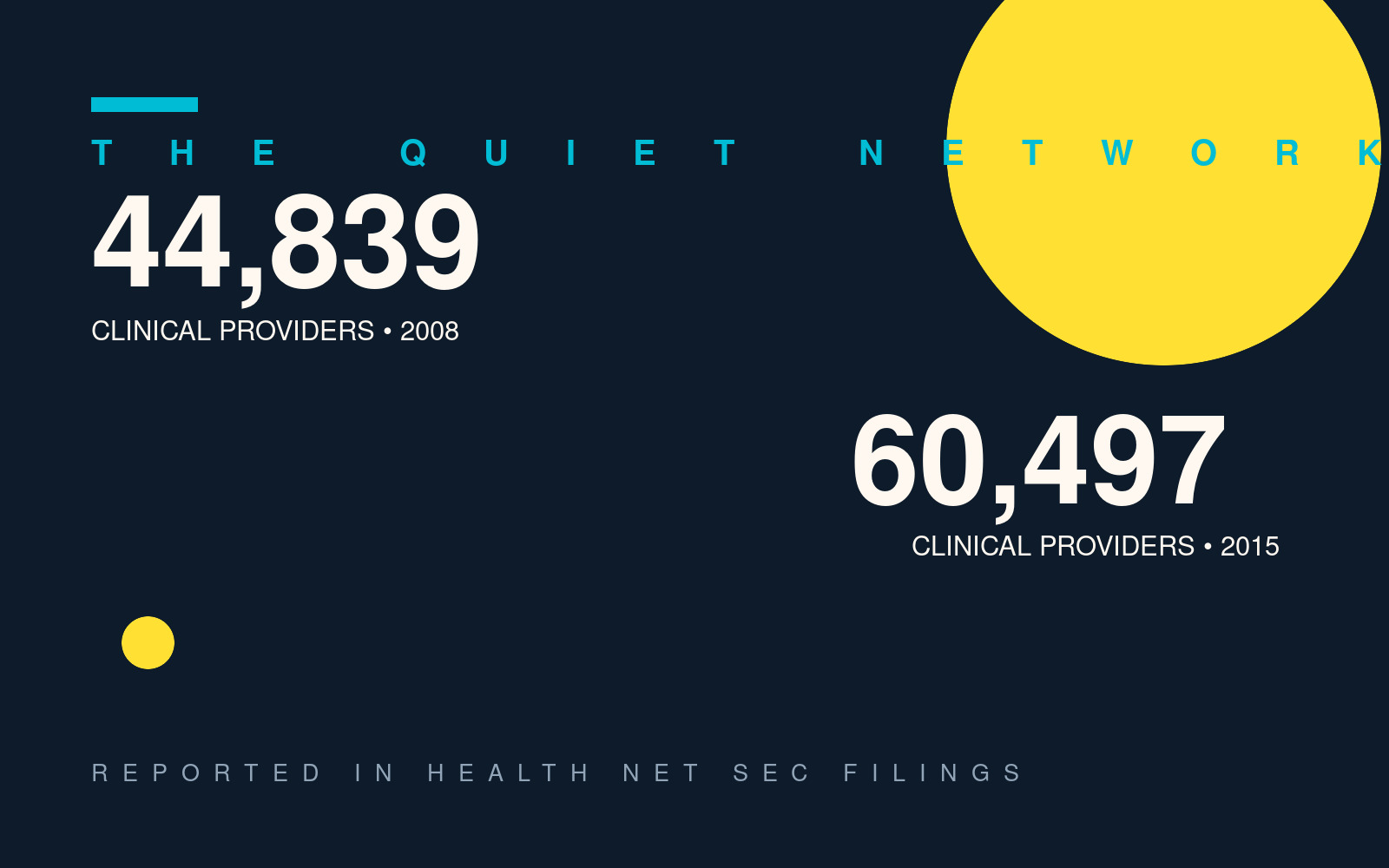
Network size became a visible measure of MHN's reach. A 2008 Health Net filing counted about 44,839 psychiatrists, psychologists and other clinical providers, plus 1,197 facilities. By 2015, the reported clinical network had reached approximately 60,497 providers nationwide. A big directory does not guarantee a timely appointment, but it gives a benefit manager more raw material for matching geography, specialty and language.
MHN also offered something app-first competitors sometimes rediscover later: humans on escalation. Customer-service representatives and licensed clinical care managers were available around the clock in benefit materials. They could explain coverage, help find a provider, schedule when a member struggled and respond to a crisis. The same capability shows up in Health Net's disaster notices, where MHN offered coping support after fires and storms.
Its alternatives span two generations. Magellan, Carelon and Optum operate in the established managed-behavioral-health world. Spring Health and Lyra package employee mental health around digital intake, navigation and a modern user experience. MHN's differentiation is less glamorous: decades inside insurance operations, plan integration, regulatory licensing and an employer-support catalog that extends beyond clinical treatment.
What it cost - and why there is no clean price
MHN has no public sticker price. An employer contract is not a streaming subscription, and a member's bill depends on the plan, the provider's network status, the care setting and whether authorization is required. Some EAP services are offered to eligible employees without a separate charge at the point of use. Covered clinical care can still carry a copay, coinsurance or deductible. Out-of-network treatment may cost more or may not be covered at all.
There is one large number nearby, but it needs a name tag. Centene paid roughly $6.8 billion for Health Net in 2016. That was the price for the parent company and its broad insurance business, not a disclosed standalone valuation for MHN. Treating it as “what MHN cost” would be tidy and wrong.
The more interesting cost is operational. Every extra portal, payer identifier and directory creates another place for a stressed person or busy clinician to make a mistake. In 2024, Health Net moved administration of specified behavioral-health services from MHN to Health Net. Members were told their benefits would not change. Providers received new instructions for claims, authorizations and portal access. By August 2025, the legacy MHN provider portal and an email claims route were scheduled to close.
What failed first was governance
The first documented crack after the Centene deal was not a therapy outage. It was an org chart. California approved the acquisition subject to commitments that key MHN management remain based in the state. MHN's California-based chief financial officer resigned after the deal, and a Missouri-based Centene executive took the role. In 2017, the Department of Managed Health Care ordered MHN, Health Net and Centene to put the CFO function back in California.
The episode sounds bureaucratic until you see the lesson: in a regulated healthcare company, headquarters, leadership and records can be part of the service architecture. The state had bargained for local accountability. The parent company centralized a key job. The regulator made the local promise binding.
California license startsMHN, formerly California Wellness Plan, becomes a specialized health care service plan.
Scale reaches millionsHealth Net reports MHN services for roughly 5.4 million people.
Centene buys Health NetThe $6.8 billion parent-company deal changes ultimate control of MHN.
Regulator corrects the mapCalifornia orders the MHN CFO function to return to the state.
The front door changesSpecified administration moves to Health Net while benefits are meant to remain intact.
The old portal closesLegacy provider workflows yield to Health Net and Availity channels.
What changed their mind?
The public transition notices explain the mechanics, not a boardroom epiphany. They point toward a simpler administrative front door: behavioral-health claims and authorizations handled through Health Net systems alongside other plan work. The brand-level tradeoff is clear even without a dramatic quote. A specialist name can signal expertise; one parent portal can reduce workflow switching.
MHN did not entirely disappear from public use. Health Net continued to mention MHN in provider search guidance and disaster-support announcements. That makes the transition less like a shutdown and more like plumbing rerouted behind a familiar wall. The capabilities - provider access, telephone support, clinical knowledge - still matter even as the interface and payer instructions change.
Five things an operator can copy
- Borrow distribution. MHN reached people through health plans and employers instead of buying every customer one at a time.
- Build the supply side early. A useful care navigator needs contracted providers, not a beautiful empty search box.
- Keep a human escape hatch. High-stress journeys need a person who can schedule, explain and escalate.
- Package adjacent relief. Legal, family-care and daily-living referrals address the mess surrounding a clinical problem.
- Migrate benefits and workflows separately. Preserve coverage while giving providers a dated, explicit operational cutover.
Where the playbook breaks
MHN's model works best when the buyer already owns demand: a health plan with members, an employer with enrolled workers or a public agency with a defined population. It is weaker for a direct-to-consumer startup that has no contracting leverage, no stable eligibility file and no reason for thousands of clinicians to accept its terms.
Do not copy this when...
You need rapid national launch without state-by-state compliance; your users pay cash and value a specific therapist over network breadth; your provider directory cannot stay current; or your human support model cannot handle nights, weekends and crises. A large network with stale availability is a brochure, not access.
The other limit is organizational. Integration can simplify claims and still confuse users if names, cards, phone numbers and portals change at different speeds. MHN's transition is a reminder that back-office consolidation becomes front-office behavior the instant a clinician submits a claim or a member searches for help.
MHN fits in the market as a managed behavioral-health operator rather than a therapy brand. Its expertise is the unromantic middle: matching, benefits, utilization management, provider relations, crisis support and workplace services. That middle can frustrate everyone when it is slow. When it works, it becomes nearly invisible.
That invisibility is both achievement and risk. Consumers rarely thank the entity that made a benefit legible. They remember the therapist, the employer or the logo on the insurance card. MHN spent decades making those encounters possible, then watched more of the administrative identity move under Health Net. For an infrastructure company, being forgotten may be proof that the handoff worked. It also makes the company easier to fold into the wall.