When Adnan Asar's wife finished cancer treatment, the next medical challenge arrived quietly. She had become dependent on a benzodiazepine prescribed during her illness. Finding a way off it required a team of doctors and behavioral health therapists, regular check-ins and roughly nine months of careful adjustment. The treatment had ended; the work of leaving a treatment had only begun.
Asar knew how to build technology for chronic care. He had been the founding chief technology officer at Livongo, a digital diabetes company. Yet his family's problem resisted the usual software pitch. A dose could be reduced on paper, but pain, anxiety, sleep and withdrawal would change in real life. The question was whether ordinary patients could get the coordinated attention his family had managed to assemble privately.
- Lucid Lane offered telehealth support for medication tapering, pain and substance use, working with prescribing clinicians.
- Its early care happened over Zoom before the dedicated app was built.
- A $16 million Series A in 2021 helped extend services across more than 35 U.S. states.
- A later small spine-surgery study reported promising tapering results, with limits that matter.
A treatment plan after the treatment
Asar and anesthesiologist Ahmed Zaafran founded Lucid Lane in Los Altos in 2017. Their target was specific: people who had been prescribed opioids or benzodiazepines, sometimes after surgery or cancer treatment, and then needed help to reduce or end use safely. The company also served people already living with chronic pain or substance use disorders. It was closer to a remote care service than a meditation app, and closer to a clinical handoff than an online therapy marketplace.
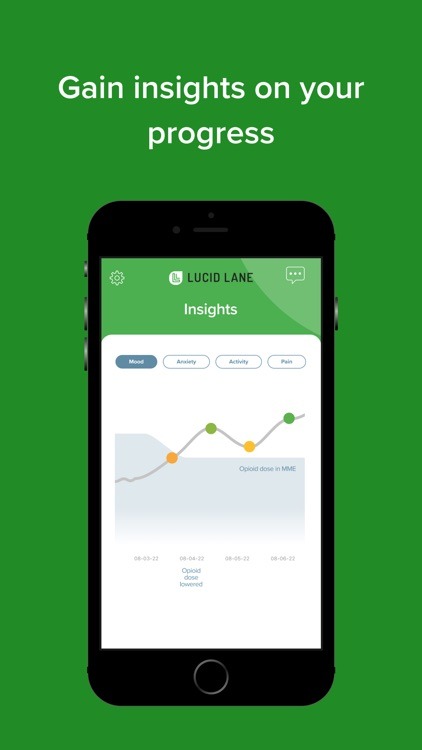
The service joined three jobs that often land in different places. It measured how a patient was doing, made a personalized plan with a clinical team, and intervened when symptoms called for attention. A licensed therapist could work on pain coping, motivation or anxiety. A prescribing physician retained the medication relationship. Lucid Lane's software gathered patient-reported signals such as pain, mood, stress and withdrawal effects, helping the team decide when to continue, pause or change a taper.
Pain, mood, activity and withdrawal are checked repeatedly.
The therapist and prescriber use the signals to revisit timing and support.
Chat, sessions or groups give patients contact between office visits.
That third job is easily overlooked. An elegant chart can show a line descending. It cannot answer a patient at a difficult hour. Lucid Lane advertised daily messaging, virtual support groups and access to on-call counselors, with the clinical team able to flag patients who needed help. This is the distinctive piece: data used to route human attention, rather than to replace it.
The app was late to its own origin story
Morado Ventures, an early investor, reported that Lucid Lane's first patients received therapy over Zoom before the app existed. That small detail says much about the company. The first thing to prove was whether a coordinated service could help someone through a taper. The second was whether technology could make that service easier to repeat. The app, released in 2020, eventually let patients check trends, join a group, schedule or chat with a counselor, and bring better information to a session.
The model was designed to enter care through clinics as well as through patients. In a 2021 announcement, Lucid Lane said doctors paid nothing to collaborate with its team, and that the service worked with hospitals, pain clinics, primary care practices and recovery centers. Arizona Pain made the relationship tangible: it partnered with Lucid Lane on weekly virtual chronic-pain support groups. A patient could come for pain support, then encounter a broader conversation about medication and mental health.
“Doctors are equally frustrated because they lack the time, training and capabilities to adequately assist their patients on a daily basis.”Adnan Asar, Lucid Lane co-founder, in the 2021 Series A announcement
Who paid was part of the design. Lucid Lane said it was in network with large commercial payers and accepted Medicare and Tricare. A company submission reproduced in a mental-health resource guide listed insurance coverage for taper management and historical private-pay prices for some other services. Asar later gave founders blunt advice: “Figure out reimbursement.” A service that requires months of support cannot spread very far if it depends on every patient assembling and funding a private care team.
A number with a small denominator
Lucid Lane announced a $16 million Series A led by Accel in August 2021, after a reported $4 million seed round. By then it said it was operating in more than 35 states. The company also publicized strong tapering outcomes, including a claim that more than 90% of patients beginning its taper service had safely tapered off. Those were company-reported figures, and the public evidence worth reading more closely is a later study of patients having spine surgery.
Prospective, nonrandomized cohort; results posted as a 2023 preprint. These figures describe the study group, not every patient.
The study followed 86 participants in two groups and reported improvements in behavioral-health measures alongside tapering results. It offers a more precise picture than a sweeping success slogan: the cohorts were small, not randomized against usual care, and the reported version was a preprint. Even so, its design is revealing. Participants received regular behavioral telehealth support, including options such as therapy, cognitive behavioral techniques, mindfulness or peer support. Therapists sent weekly reports to physicians. The product was a schedule of contact as much as a schedule of dose reductions.
The useful distinction: medication dependence after treatment, substance use disorder and chronic pain overlap, but they are not interchangeable diagnoses. Lucid Lane offered taper support and, for some patients with substance use disorders, medication-assisted treatment. The path depended on clinical need.
What another clinic could borrow
The copyable move is surprisingly plain. Start before discharge or at the prescribing visit. Ask patients about pain, mood and functioning repeatedly, not once. Give the information to the people who can act on it. Offer a real human connection between appointments. And settle the reimbursement path early enough that the service can live beyond a pilot. Lucid Lane's early Zoom sessions suggest a further rule: test the care relationship before decorating it with software.
The conditions matter. A service like this depends on licensed clinicians, willing prescribers, patients who can engage remotely and a payer or buyer prepared to support longitudinal care. A stand-alone tracking app would have a hard time reproducing a multidisciplinary team. A clinic that cannot act on incoming symptom reports would simply collect more data about someone it still cannot reach.
Lucid Lane occupied a narrow and useful place between general online therapy and traditional prescribing follow-up. It treated the exit from medication as a care episode in its own right. That may be the most durable idea in the story: the prescription is an event, but the leaving is a process, and somebody has to stay with the patient through it.