Meredith Fisher wanted to join a group. This was Harvard, in 2005, and she and two fellow graduate students, Sarah Boyer and Martine Zilversmit, were looking for a science organization for women. They discovered a vacancy where they had expected a community. So they started one. Before Fisher helped create companies, she helped create a place for people to meet.
The organization became Harvard Graduate Women in Science and Engineering, or HGWISE. Fisher served as its first co-chair. A decade later, the founders were back together at an anniversary symposium, discussing what the experience had made possible. A student organization had supplied an education of its own: how to bring people into a room, work with an institution, and make something continue after its founders leave.
That beginning offers a useful way into Fisher's subsequent career. Her titles include scientist, business development executive, investor and founding CEO. At Mediar Therapeutics, she helped establish the company, led its early financing and stayed as interim chief executive. The common activity is assembling the conditions in which someone else's expertise can become part of a working organization. A good idea has plenty to recommend it. It still needs colleagues.
A graduate student's first boardroom
HGWISE required Fisher to collaborate with senior Harvard administrators while she was still a graduate student. Years later, she connected that experience directly to her career in finance. Representing a new organization meant dealing with people who had authority, responsibilities and their own investment in its success. The learning happened through participation, with real people expecting the organization to do something useful.
There is a modest comedy in discovering that founding a club can be preparation for venture capital. The membership dues are rather different. Yet the practical questions have a family resemblance: Who needs to be involved? What will persuade them to participate? Which activities deserve to survive the first burst of enthusiasm? Fisher remembered the founders thinking carefully about events that could become lasting parts of the institution.
Her formal education also crossed disciplines. She earned her undergraduate degree at Mount Holyoke College, a doctorate in molecular microbiology at Harvard, completed in 2007, and an MBA at MIT Sloan. Those credentials span experimental science and business. The student organization added experience of a third kind: building an institution while living inside one.
“That always stayed with me.”
Meredith Fisher, recalling her work with Harvard's senior administrators
The seat between science and business
Fisher's early professional work included research scientist roles at Anadys Pharmaceuticals and Idenix Pharmaceuticals. She subsequently worked in technology and business development at Enlight Biosciences, associated with PureTech Ventures, and led business development at Ginkgo Bioworks. She then became director of private investments in Bracebridge Capital's private and family office, investing in young life science companies.
Each position put a different set of decisions in front of her. Research asks what can be established through experiment. Business development brings partners and commercial arrangements into view. Private investing adds the question of where to commit capital. Reading those jobs together helps explain the range of work her later role would require, without pretending that a career arrives with its final shape already pencilled in.
In September 2014, she appeared on a family office investment panel at the RESI conference at Fenway Park. The discussion covered direct investment, assessing early opportunities and building relationships with family offices. Bill Brah moderated; fellow panelists included Melissa Krauth, Christopher De Souza, Alejandra Paredones and Todd Holmes. The setting was a baseball ground, but the published questions were about access, judgment and relationships. The questions gave relationships a place alongside investment assessment.
It is an instructive stop in her career because family offices were already part of her working vocabulary before she joined an institutional venture team. She had occupied the research, commercial and investment sides of the conversation. The next move brought those experiences together at the point when companies were being formed.
An investor before there is much company
Fisher joined Partners Innovation Fund in 2015, according to her own account, as its second fund was getting started. The organization is now known as Mass General Brigham Ventures. Her work there focuses on early investments and company creation, a remit that reaches into the period before an enterprise has much of a public identity.
She described having access to technologies before publication or patent filing and participating in company formation as well as investment. The distinction matters to an understanding of her job. At that stage, the team, organization and financing may all be developing together. Choosing an investment can also mean helping establish the business that will receive it.
Her account of this work emphasized technical uncertainty and the need to plan for it. She also stressed selecting fellow investors whose tolerance for risk and interests were compatible. Early commitments have to hold together when the answers are incomplete. She wanted more corporate venture investors to work together in syndicates at the earliest stages of formation. The people behind the names have to be prepared for the same journey.
- 01Research
Experiments & evidence - 02Business development
Partners & agreements - 03Private investment
Capital & judgment - 04Company creation
People & organization
Mediar, before the handover
Mediar makes that work concrete. Fisher worked with its scientific founders, led the seed financing and helped bring in $20 million from a group that included Mission BioCapital, Ono and Pfizer Ventures. She remained interim CEO during the company's early development. One consequential recruitment was Paul Yaworsky, who joined as chief scientific officer and the first employee after financing, bringing a long career at Pfizer.
The sequence is worth lingering over. A founding team and an investment commitment were followed by someone who could take responsibility for the scientific organization. A company acquires substance through these appointments. A title on an organization chart becomes a person making decisions, hiring colleagues and carrying work forward. Fisher's contribution at Mediar included both raising money and finding leadership.
By March 2023, Mediar announced an $85 million Series A, co-led by Novartis Venture Fund and Sofinnova Partners, alongside its earlier seed funding. Rahul Ballal had become CEO. Yaworsky remained the scientific leader, and the investor group had expanded. The public financing announcement showed a business with an established executive team and a wider set of financial backers.
Fisher's current biography lists her as a Mediar board member. That is a different assignment from being its founding interim chief executive, and an essential distinction in her story. Starting an organization includes the possibility of handing its daily leadership to someone else. At Mediar, her record encompasses the first assembly, early financing, recruitment and a continuing place in governance.
A room full of introductions
Her activities outside the investment office give the story another scale. Fisher served as co-chair and board director of WEST, Women in the Enterprise of Science and Technology, from 2017 to January 2020. In April 2018, she joined a WEST panel on innovation and entrepreneurship alongside executives, an investor and a lawyer. More than 100 people attended the discussion.
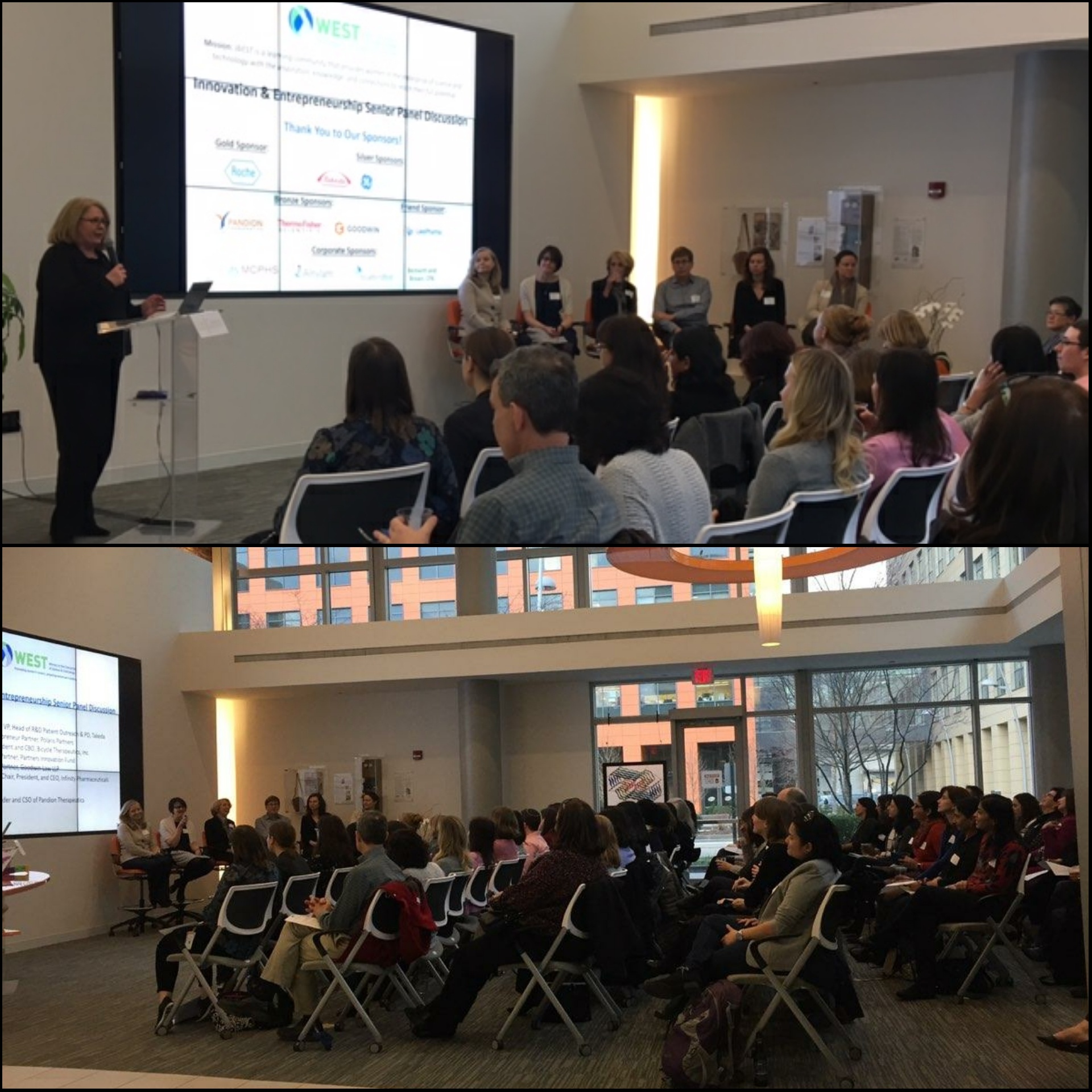
Jo Viney moderated that panel, which also included Kristina Allikmets, Alan Crane, Ros Deegan, Danielle Lauzon and Adelene Perkins. The gathering brought together people with different responsibilities in company building. Fisher's participation belongs alongside her mentoring and student leadership: repeated involvement in organizations where professional experience can be exchanged rather than kept inside one employer.
She had returned to HGWISE's mentoring program in 2012, years after helping found the group. In 2013, it named her Mentor of the Year. Her two mentees described practical help: introductions, professional events, conversations about career choices and access to people working outside academia. The account records eight informational interviews for one mentee. Another remembered invitations to a company CEO's lunch and a startup incubator tour.
Those are small, specific acts, with recognizable beneficiaries. A graduate student considering a different career can read about it, or meet someone who actually does it. An introduction makes the second option possible. Seen beside her company work, the mentoring supplies a more personal example of the same practical resource: knowing whom to call, then making the call.
The next organization, and the next beginner
The company-building work continued beyond Mediar. Violet Therapeutics identifies Fisher as a founding CEO, and her current biography credits her with co-founding multiple portfolio companies, including three as founding chief executive. In May 2026, Violet announced a $4.75 million seed extension led by Lifespan Vision Ventures, with participation from Mass General Brigham Ventures and other investors.
Her biography also lists previous investments in Amolyt Pharma, acquired by AstraZeneca in 2024, and Scorpion Therapeutics, acquired by Eli Lilly in 2025. These are later chapters in businesses she backed. Alongside them sits the earlier, less ceremonial work of formation: gathering a team, finding compatible capital and deciding who should lead the next stage.
There are lighter details, too. Fisher's interests have included marathon running, adopting older rescue dogs and taking guitar lessons. They offer glimpses of a life beyond board seats, without requiring every pastime to become a theory of management. Sometimes a guitar lesson is simply a guitar lesson. Executives are allowed to have an afternoon.
Still, the 2005 beginning remains an apt closing image. Fisher and her fellow students wanted an organization they could join. They made one that other people could join, lead and return to. Her later career enlarged the financial stakes and changed the institutions involved. The recognizable action remained: finding the people who could make an idea workable, and getting them together.