A biologist arrives with a pile of letters. Somewhere inside those DNA sequences is a recurring pattern, perhaps a clue to where a protein binds. The catch is that the pattern may change a little each time it appears. Search for an exact string and you can miss it. Read every sequence yourself and you have acquired a very peculiar full-time job. MEME Suite exists for this small, stubborn problem: finding repetition when repetition refuses to look identical.
- Discover recurring patterns in DNA, RNA and proteins.
- Compare those patterns with known motifs, then locate possible matches.
- Use the website or install the tools locally; commercial use requires a license.
The name belongs to an academic software project with a commercial licensing route. Its users are researchers investigating gene regulation, protein families and related biological questions. Its core asset is a connected collection of algorithms. The interesting part is how one question becomes the next.
A pattern, with room for disagreement
Timothy Bailey and Charles Elkan described the original MEME algorithm in 1994. A web server followed in 1996. The suite’s authors page credits Bailey and William Stafford Noble with developing the broader collection, with important input from Elkan and Michael Gribskov. This is a history of research software accumulating useful capabilities around an enduring question.
MEME represents a motif as probabilities for each letter at each position. Imagine a recurring six-letter pattern whose third letter is usually A, occasionally G. A rigid search must choose between them. A probability matrix preserves the disagreement. The colorful stacks of letters in a sequence logo make that distribution visible: conservation gets height; variation gets company.
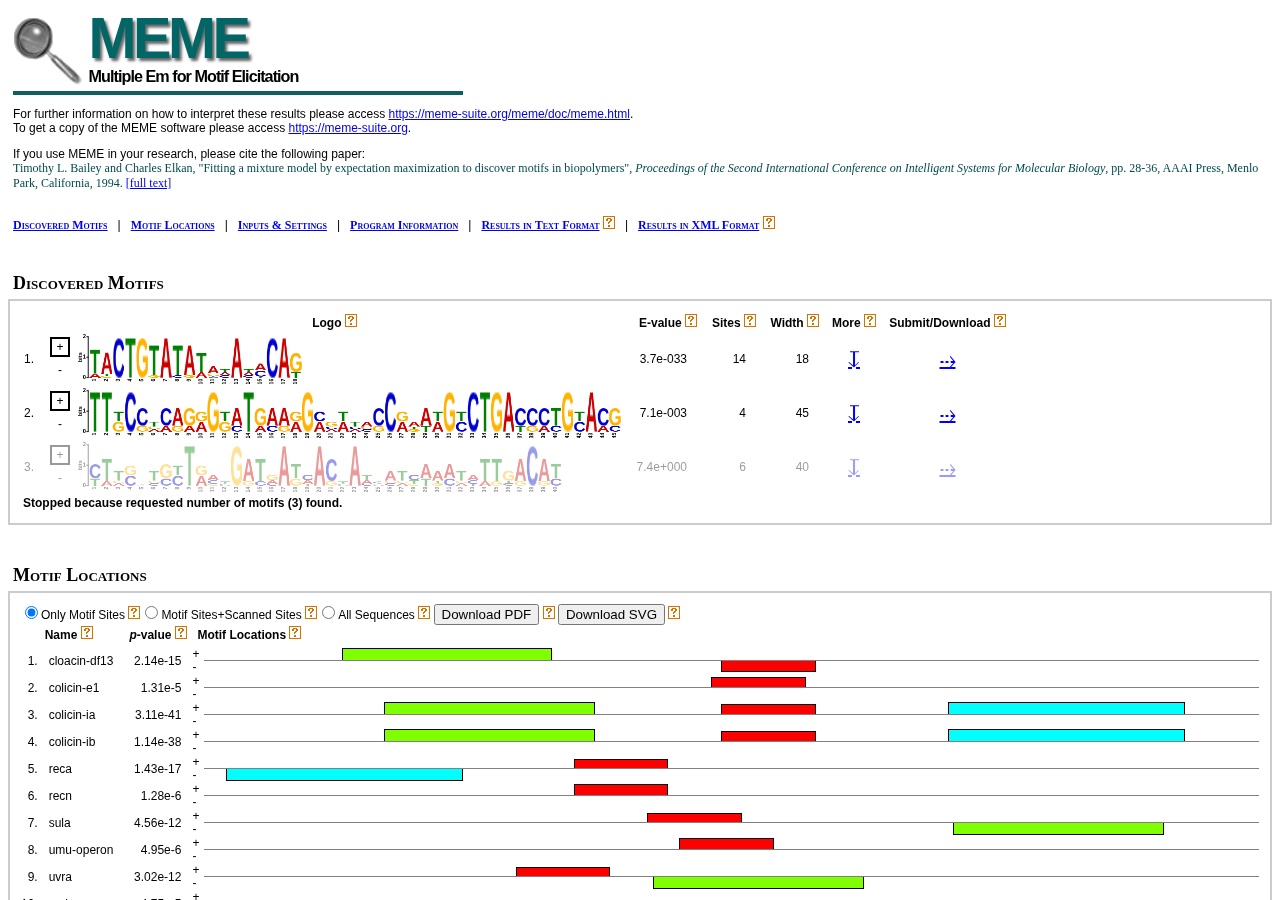
That distinction matters because biological sequences are variable. A useful motif can survive substitutions that would defeat exact matching. But even a convincing motif remains a computational result. It can help prioritize experiments; its appearance alone does not establish that a protein binds there in a living cell.
The next click is the product
Discovering a pattern is an opening move. What does it resemble? Where else does it occur? Is it unusually common in the sequences you care about? MEME Suite assigns those questions to different tools, then lets researchers pass results between them.
Tomtom compares a discovered motif with databases of known motifs, including JASPAR. FIMO looks for individual motif occurrences in sequences. AME tests motif enrichment. MEME-ChIP brings several analyses together for large nucleotide datasets such as ChIP-seq peaks. XSTREME handles broader discovery and enrichment workflows, including sequences whose motif sites need not cluster around the center.
- 01DiscoverMEME / STREME
- 02CompareTomtom
- 03LocateFIMO
The shared formats are part of the appeal. Outputs from discovery tools can become inputs for other programs without manually rebuilding the motif. Researchers can inspect interactive HTML and retain machine-readable results for scripts. That combination serves both the scientist using a browser and the bioinformatician stitching analyses into a larger pipeline.
The original tool had a blind spot
MEME discovers ungapped motifs. When a pattern contains variable-length gaps, MEME can split it into separate motifs. That is a limitation of its model, with practical consequences for anyone expecting one tidy answer.
The suite incorporated GLAM2 to discover patterns containing insertions and deletions. Its 2009 paper also cautioned that gapped discovery is harder because the possibilities multiply; the authors recommended running a simpler gapless analysis alongside it. Adding flexibility creates more places to look and more opportunities to fool yourself.
Scale brought another response. STREME, published in 2021, was designed for enriched motif discovery across datasets that can contain hundreds of thousands of sequences. Its paper compares it with MEME, HOMER and other algorithms on DNA and RNA data. The current website suggests considering STREME when a dataset exceeds 50 sequences. The old tool stays available; the choice depends on the question.
From the original algorithm to release 5.5.9. Three decades of additions, corrections and maintenance.
Free comes with a boundary
The copyright notice permits educational, research and nonprofit use without a fee, subject to its terms. Commercial users are directed to UC San Diego’s licensing office. The currently linked 2023 agreement template lists $2,500 annually for up to ten authorized users, with $225 for each additional user. Those are template terms, rather than a promise of any particular negotiated agreement.
That boundary has consequences for distribution. In a public 2021 exchange, a Debian contributor asked for licensing changes to make packaging easier. Developer Charles Grant replied that the team was retaining its existing terms. Source availability and permission to use software commercially are separate questions.
“for the time being we’re sticking with the current license for the MEME Suite.”
Charles E. Grant · Public mailing-list reply · 2021
The project’s institutional roots run through UC San Diego, the University of Washington, the University of Queensland and other research organizations. Its website credits NIH grant R01 GM103544 for development funding. Tutorials, documented methods and a public discussion group give the work a visible research community.
Copy the handoff. Check the assumptions.
The practical lesson is to make each result easy to use in the next investigation. MEME Suite’s linked tools do that. For software builders, the transferable move is concrete: agree on a useful intermediate format and make the next action available beside the result.
Researchers still have decisions to make. Control sequences and background models shape enrichment results. Gapped patterns call for a suitable model. The public server has queue and input limits; local installation offers another route through Docker, MacPorts or source builds. HOMER and RSAT’s Peak-motifs are alternatives worth comparing against the experiment’s requirements.
Release 5.5.9, dated November 22, 2025, added input validation and security-related container changes alongside fixes. There is something instructive in that unglamorous list. A pattern-finding algorithm becomes a usable research instrument through the surrounding work: checking files, keeping databases usable, and letting the next scientist pick up where the last tool stopped.