The first prototype in Meghan Easley-Park’s story was held together with tape. She was still in elementary school when her father asked for her pencil case, bundled several pencils, and declared that he had an idea. The crude model represented a portable oxygen tank, an alternative to machines so heavy that mobility could become a negotiation. His improvised sketch eventually became a product. For his daughter, the lasting artifact was less the machine than the method: see a constraint, refuse to worship it, make something testable.
That memory explains more about Easley-Park’s career than any tidy job title could. She calls herself a generalist operator with a knack for building zero-to-one companies that can scale. Generalist is sometimes corporate shorthand for a person surrounded by miscellaneous tasks. Here it means something more exact. Her specialty is crossing boundaries that a young company cannot afford to leave uncrossed: values and economics, product and paperwork, founder and team, possibility and Tuesday morning.
Today, she is Chief of Staff to the CEO at Armada, the San Francisco company building software, connectivity and modular data centers for places where the normal cloud is far away, slow or unavailable. Before Armada came a wearable e-reader. Before the e-reader came an accelerator for purpose-led founders. The products are wildly different. The operating question remains familiar: what has to be true for this promising thing to work outside the room where it was imagined?
A useful refusal to choose
Easley-Park began college at Azusa Pacific University, studying Biblical Studies and Youth Ministry. She entered Fuller Theological Seminary expecting that youth ministry might become her vocation. Then the route stopped feeling honest. The standard paths around her appeared to lead toward pastoral or academic work, and neither quite fit. A call with her sister supplied an unfamiliar phrase: social entrepreneurship.
The idea gave practical shape to questions she was already carrying. Business could be used to address poverty and inequity, not merely discussed from a safe distance. There was one comic inconvenience: the application deadline for USC’s program was two weeks away. She applied, was accepted, and declined the obvious either-or. From 2015 to 2017, she attended USC Marshall while completing her theology degree at Fuller.
Her course list reads like two browsers left open on the same laptop. Corporate finance sat beside theological reflection. New venture management met innovation and the church. At USC, she worked on an impact-investing pitch for Sevamob. At Fuller, she sharpened the larger question of why an organization ought to exist. She did not resolve the tension by flattening one discipline into the other. She learned to keep both in the room.
Founders, funders and the purpose underneath
After graduate school, Easley-Park moved to New York and joined Praxis, an organization that supports founders and funders motivated by their faith. Her work began around the accelerator and grew into venture lab and portfolio services. The job offered a close view of the distance between a founder’s story and an organization capable of carrying it.
Praxis also gave her a language for an instinct she had inherited from the pencil prototype: enterprise should leave people and places better than it found them. She was interested in leadership that did not postpone its values until after the important decisions were made. In 2019, she spoke about sustainable food systems and the stubborn reality of food deserts. Her point was characteristically operational. A broken system is not weather. It was designed by choices and can be altered by choices.
By January 2021, a trademark filing for Praxis Capital listed her as Chief of Staff. It is an almost perfect operator’s artifact. Strategy makes the announcement; operations signs the form. The lesson is not that administration is secretly thrilling. The lesson is that a mission becomes credible when somebody accepts responsibility for its least cinematic requirements.
Praxis
Support founders, shape programs and connect capital with purpose.
Sol Reader
Operate a hardware startup through demos, certification and shipment.
Armada
Help an edge-infrastructure company coordinate growth at larger scale.
When the idea has to pass a radio test
Sol Reader brought a different kind of constraint. The startup’s product was a lightweight headset built for reading, using e-ink displays to create a private, distraction-limited experience. In early 2024, Easley-Park stood before a packed San Francisco hardware meetup and demonstrated it. The memorable analogy was sharp enough to survive the room: the device was like nicotine gum for smartphone use.
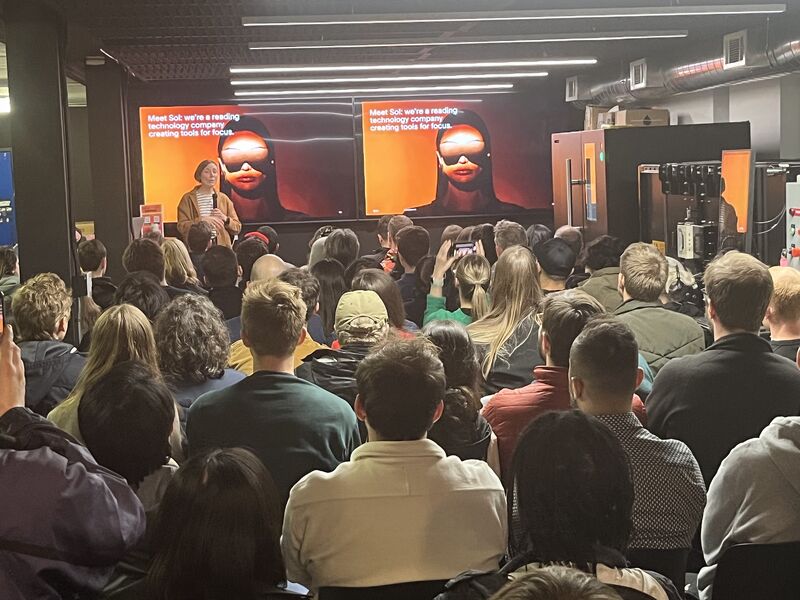
The phrase captured the product’s wager. Technology could help users step away from the more demanding technology already in their pockets. Yet a clever wager still had to become a physical object. Public records identify Easley-Park first as Head of Operations at Sindarin, Sol’s parent company, and elsewhere as COO. Her name appears on FCC documentation for the Reader and its page-turning remote. She was authorized to sign certification materials on the company’s behalf.
This is what zero-to-one looks like after the launch photo. A radio has to comply. A label has to be reachable in the interface. A device needs a manual, an address and a responsible human being. In late 2024, Sol marked a year of building and shipping Reader units around the world. Easley-Park celebrated the collective accomplishment in three words that operators rarely get to use without qualification: “building together.”
From a quiet screen to compute at the edge
At Armada, the hardware grew from something worn on the face to something placed on a ship, an industrial site or beside a remote source of power. Armada combines connectivity, software and rugged modular data centers called Galleons. The proposition is straightforward even when the machinery is not: process data closer to where it is created, especially when time, bandwidth, security or geography make a distant cloud impractical.
The company’s recent expansion makes the Chief of Staff role a coordination problem at industrial scale. Armada announced a $131 million strategic round in July 2025 alongside Leviathan, its megawatt-scale modular data center. It delivered systems for testing with the U.S. Navy, announced work with OpenAI on edge models, and in May 2026 unveiled a $230 million Series B and plans with Johnson Controls for a dedicated modular data-center factory in Arizona.
Those are company achievements, not a personal trophy cabinet. Easley-Park’s visible role is in the connective work around them. She has promoted a national-security hackathon partnership, helped recruit a senior people leader, and sought an entrepreneurial business-development director to manage strategic inbound. The pattern resembles her own résumé: find people who can move across boundaries, then give them a consequential problem.
Armada’s products are designed for environments where failure is expensive and assumptions about connectivity collapse. An operator lives in a comparable, if less dramatic, climate. Information arrives unevenly. Priorities compete. Every function has its own vocabulary and clock. The job is to keep the organization from becoming a collection of locally reasonable decisions that add up to nonsense.
The career inside the career
Easley-Park’s path is tempting to narrate as a tour of fashionable categories: impact, hardware, AI. The more useful reading is quieter. She has repeatedly chosen organizations trying to bring an abstract promise into physical life. At Praxis, the promise was that enterprise could serve more than its owners. At Sol, it was that a new device could create room for sustained attention. At Armada, it is that modern compute can reach the places where data and difficult work already live.
Her preparation was similarly connective. Theology supplied questions of ends. Business supplied questions of means. Accelerator work taught her how founders change as their ventures change. Hardware made every ambiguity expensive. Chief-of-staff work gathers those lessons near the center of an organization, where a vague sentence can become five conflicting projects by lunch.
The pencil bundle returns here, not as a grand origin myth but as a useful object. It was cheap, legible and incomplete. It made an idea discussable. Operators do this constantly. They turn the invisible into a draft, the draft into owners, the owners into a system. Their work often vanishes into the thing working as intended.
There is a modest ambition tucked inside that sentence. Possibility is not merely something to admire. It is something to take apart, understand and rebuild in a form that can travel. Easley-Park has done that across disciplines and companies, trading one industry’s vocabulary for another without changing the craft underneath. The stage may belong to the founder and the product. The messy middle belongs to the operator. When it is handled well, everyone else gets to call the result obvious.