Max Kolysh’s first company had a problem that an engineer could almost admire. Zinc could make an online purchase through an API. Some potential customers had no developer to use it. The engineering was an achievement; the missing entrance was a business problem.
That gap makes a useful starting point for Kolysh’s career. He would go on to co-found Dover, spend years as its CEO, and become a visiting partner at Y Combinator. Across those jobs, he kept working on the relationship between an automated process and an actual result. A system could find people. Someone still had to persuade them to join a company.
An elegant API meets an awkward customer
At MIT, Kolysh studied computer science and stayed for a master’s. The university years led into Zinc, where he became co-founder and chief operating officer. The company entered Y Combinator’s winter 2014 batch. His next company would join the same accelerator five years later, working on a very different kind of transaction.
Interviewer Andrew Warner later preferred a practical description of Zinc to a glamorous one. Kolysh answered, “I feel like you like the boring one too.” The checkout and the recruiting calendar do offer plenty of material for a builder interested in unglamorous work.
Kolysh described the API as roughly 80 percent of the product, with the remaining 20 percent needed to make it usable. That retrospective shorthand gives this story its title. A customer buys the ability to finish a job; the distance left to travel can matter more than the distance already covered.
Today, Zinc describes its work as programmable commerce infrastructure, with an ambition to let software automate purchases across the internet. That contemporary description puts the early problem in perspective. An API can become valuable infrastructure when the surrounding market has a use for it. Finding that use, and the people equipped to adopt it, is a business problem with its own timetable.
The recruiting arithmetic
Dover began in early 2019 with Kolysh, Anvisha Pai and George Carollo. They were second-time founders looking at their own recruiting experience. Their estimate was that strategic decisions took about 20 percent of the work; operations swallowed the other 80 percent. Finding candidates, arranging interviews and keeping a process moving had become a job assembled from too many separate tools.
It was an inviting problem for an engineer. Repetitive work appeared to be consuming time that could go toward deciding whom to hire and explaining why a candidate should care. Dover’s original approach put software around that operational work. The ambition was to give hiring teams a more coherent process, with less dependence on luck and improvisation.
By July 2021, the company announced a $20 million Series A led by Tiger Global, with Founders Fund, Abstract Ventures and Y Combinator also participating. The number belongs to Dover’s financing history. The more personal detail is the question beneath the product: what should a founder spend time doing when the machinery of recruiting has stopped eating the day?
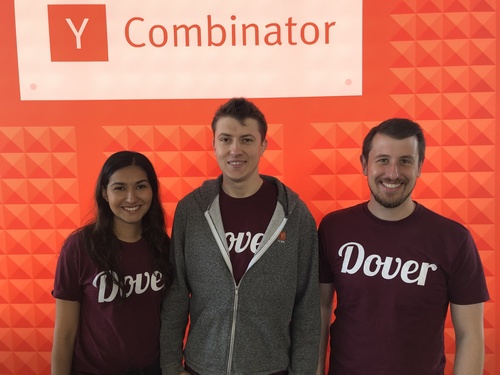
Kolysh’s early recruiting advice was already suspicious of simple comparisons. In 2020, he warned that different candidate sources produce differently shaped funnels. Judging them only by cost or speed could give a hiring team the wrong expectations. It is an engineer’s concern about what a number really represents. A referral and a cold approach may end at the same interview, having taken very different routes.
That distinction is easy to lose in an average. A candidate introduced by someone they trust arrives with context; a stranger contacted about a job needs reasons to pay attention. Each route asks something different of the hiring team. Looking at the funnel means looking at those intermediate steps, where interest can fade or a conversation can stall. Kolysh’s warning makes room for the actual experience behind the number. Before declaring one channel better, a founder has to understand what happened to the people who came through it.
When the hiring stops
A growing recruiting company depends on other companies wanting to grow. In April 2025, Kolysh published an essay about why venture investors dislike recruiting startups. It was an unusually direct subject for someone who had built one. He reported that Dover’s revenue had fallen by more than 70 percent from peak to trough in 2022. A hiring freeze travels quickly through a business paid to help with hiring.
Dover’s peak-to-trough revenue decline in 2022, as Kolysh reported in April 2025.
His analysis went beyond the cycle. A tool could perform its assigned task while a customer’s hiring process remained difficult. A founder might change the role, delay a decision or expect incompatible things from a search. Several agencies and products might be working on the same vacancy. Credit would go to whoever happened to deliver the eventual hire. These are uncomfortable conditions for anyone trying to demonstrate repeatable value.
The essay examines a market that had once looked obvious to him. Recruiting software operates inside other people’s businesses, where priorities and budgets change. Every delayed decision also creates work for the people waiting on it. The hiring manager is part of the process being improved.
The software gets some company
By September 2023, Dover had launched a free applicant tracking system. Kolysh explained the decision through the uneven rhythm of hiring. Companies need somewhere to organize applicants even during quiet periods. Expensive recruiting subscriptions are harder to justify when few jobs are open. The free system could remain in place, with additional services available when demand returned.
There was also a candidate on the other side of the screen. Kolysh wrote about applicants being asked to re-enter information already in their resumes, or being left waiting without an answer. Those annoyances are small enough to disappear in a product presentation and large enough to spoil someone’s afternoon. Designing around them gave the administrative software a purpose that was easy to recognize.
In October 2024, Dover introduced Recruiting Partners, connecting companies with experienced fractional recruiters. The arrangement addressed another uneven workload: a startup might need substantial recruiting help for a burst, then much less afterward. Human expertise could come in at the required scale, using software to keep the work organized. The recruiting company had followed the problem into a service.
Kolysh also kept returning to how recruiters get paid. His argument against contingency fees was about the incentives attached to a successful placement and the size of the eventual invoice. In an August 2025 explanation, he used a straightforward example: a 20 percent fee on a $150,000 salary produces a $30,000 bill. Hourly recruiting changes the calculation. The actual outcome still depends on the search.
“You don’t need a long brief; you need clarity.”
Max Kolysh, on managing a recruiter
His September 2025 management advice assigns plenty of responsibility to the buyer. Give the recruiter access to the team. Agree on the outcome and the hours. Review progress together. Make decisions quickly. If a search stalls, examine what is blocking it before demanding more activity. This is practical advice with a mildly inconvenient implication: purchasing help does not excuse the founder from participating.
Back in the room
When Kolysh announced his departure as Dover’s CEO, he credited Pai, Carollo and the team. He reported that the company had helped more than 2,000 businesses make hires. He also recalled nine company hack trips around the United States. The list brought a little texture to the corporate account: people getting together to build, alongside the product launches and difficult decisions.
Carollo took over as CEO. Kolysh’s public career record places his transition out of the role in 2025, with a continuing board position. By 2026, he was teaching at Y Combinator as a visiting partner. It is a return to an institution where both Zinc and Dover had been young companies, now with a different seat in the conversation.
His June 2026 Startup School lesson on finding the first ten customers begins with an observation about attention. A founder should understand where a buyer actually spends time before choosing an outreach channel. A person whose working day happens away from a laptop may be poorly served by another carefully automated email sequence. The proposed tactics include personal networks, showing up in person and earning a conversation through useful work.
Where does this person actually spend their time?
Watch Kolysh’s Startup School lessonThere are smaller glimpses of the builder on his personal website. Alongside Dover and Zinc sit a Learned League study guide, a fund carry calculator and Tesla street-cleaning alerts for San Francisco. The projects vary in audience and seriousness. They share the appeal of a specific job that might be made easier with a small piece of software.
Read together, these episodes suggest a continuing interest in the awkward handoff: from a technical possibility to a customer’s working day. Kolysh has approached it through commerce infrastructure, recruiting tools, human services and advice to other founders. The work becomes useful at the point where somebody can do something with it. That last stretch has supplied him with rather more than 20 percent of a career.