Matt Rosenthal called a sewer contractor with an unusual shopping list. He needed people who could watch inspection videos and label what they saw. How much would that cost? Billy Gilmartin had built a business cleaning and inspecting large sewer pipes on both coasts. He knew the work. He had never been asked that particular question.
Rosenthal had computer vision prototypes and a shortage of annotated examples. Gilmartin had experience with the people, equipment, and daily complications of inspection. The call connected an algorithm’s need for instruction with a contractor’s knowledge of the job. In 2019, the two founded SewerAI.
There is a pleasing lack of ceremony in that beginning. Before the fundraising announcements and the product names came the need to identify things correctly in a video. Someone had to draw boxes around defects. Even artificial intelligence has homework.
A different kind of screen time
Rosenthal’s route underground passed through the very visible world of hardware. He earned bachelor’s and master’s degrees in electrical and computer engineering at Carnegie Mellon University, finishing the latter in 2003. His career included chip design, touchscreen development, firmware work at Fitbit, and co-founding Centosette, which built tools to automate analysis of municipal water-system data.
That background matters because a sewer video is already a technical achievement. A crew has brought equipment to an access point, put a camera underground, and recorded a place people cannot conveniently walk through. Rosenthal’s contribution begins with the next question: what can be done with the resulting images?
A recording and an answer are different deliverables. The recording shows what the camera encountered. An answer has to identify the condition, attach it to the right asset, and reach someone who can act. The distance between those two deliverables is where his company has chosen to work.
His earlier wastewater software experience also makes the founding story less abrupt than its subject suggests. He was already working with infrastructure data before SewerAI. The new company gave computer vision a specific assignment inside a field he knew.
Two people looking at the same problem
Gilmartin’s account of the partnership is unusually concrete. Rosenthal asked basic questions about the volume of inspection work being done. Gilmartin sometimes could not supply the answer. The questions exposed something worth measuring, while his operational experience helped explain why the measurement would matter.
By March 2026, both founders were co-CEOs. Gilmartin described Rosenthal as the technical problem-solver and himself as someone who could connect a solution to its value for operators. Their partnership joins the person who can build a tool with the person who can explain what changes in a working day.
That is a useful arrangement in a business selling to contractors, utilities, and engineers. Those customers participate in the same work from different positions. A contractor needs to complete an inspection. An engineer needs information suitable for analysis. A utility needs to decide what to do with its assets and its money.
The founders spent their early years demonstrating that AI could do the job accurately and improve the process. Gilmartin has described that period as one of proving the technology. A clever presentation would still have to survive a customer's inspection footage. The pipe gets a vote.
The footage has a second job
AutoCode, SewerAI’s computer vision product, analyzes inspection footage and assigns standardized observations. Its work fits established NASSCO coding systems for pipes, laterals, and manholes. Customers use their existing CCTV equipment; the software processes the images that equipment produces.
The attraction is partly speed. SewerAI advertises analysis at six times the speed of manual coding. That is a company performance claim, rather than a promise about every individual inspection. Its practical meaning is straightforward: less time spent turning video into coded records leaves more room for the other work an inspection requires.
Rosenthal’s company has also offered prospective customers reviews of their existing inspection archives. It is a demonstration with a sensible burden of proof. Bring footage from the customer’s own world. Show what the system identifies. Let the discussion proceed from a recognizable problem.
There is a distinction here between recording more images and making better use of images already collected. Both can matter. The second is especially appealing when a customer already owns the camera, has already paid for the inspection, and still needs usable information from the result.
- 01CaptureExisting cameras
- 02CodeAutoCode observations
- 03SharePioneer records
- 04PrioritizeRisk & Rehab
A schematic of the work, from camera footage to a repair decision.
Pioneer is the shared environment around that analysis. It organizes inspection records, digital submissions, geographic information, and collaboration. Stakeholders can review and approve work through links rather than treating the completed recording as the end of the transaction.
This is the less photogenic part of an AI business. Someone has to know which asset a file belongs to. Someone needs to review it. Someone needs the right version when a project is planned. Those details determine whether a useful observation can travel beyond the person who first saw it.
Sewer3D extends the approach to manholes, generating three-dimensional models and flat views from inspection imagery. The company supports affordable cameras such as the GoPro 360. A model lets a reviewer examine shape and surface details from different angles, making the captured scene easier to interrogate.
Together, the products reveal the kind of business Rosenthal is building: software concerned with the whole path from collection to use. Recognizing a defect is one task along that path. Keeping the evidence accessible and intelligible is another.
The customer still needs to finish the day
Rosenthal’s public business advice stays close to the customer. He places the value a company provides at the center of his guidance to entrepreneurs. It is a demanding standard. Value has to appear somewhere outside the founder’s own enthusiasm.
At a 2025 enterprise AI discussion, he described a support choice that brings the principle down to earth. SewerAI favored fast, direct assistance over embedding engineers inside large customer software systems. Staff could get on Zoom, take remote control, and help solve a problem even when its underlying cause was outside their product.
The choice offers a glimpse of his priorities without requiring a personality test. A customer who cannot get the work moving needs help at the point of difficulty. The boundary between one vendor’s responsibility and another system’s fault may be technically correct and practically useless at that moment.
There is also a useful relationship between support and the product’s purpose. A company that sells smoother collaboration has an interest in removing friction from its own customer relationships. The promise is easier to believe when someone answers the call.
“Provide value to your customers. Everything else just follows from that.”
Matt Rosenthal · The Fundamental Molecule, 2024
What the money is meant to make possible
In June 2024, SewerAI announced a $15 million Series B led by Innovius Capital. Participants included Emerald VC, Epic Ventures, Suffolk Technologies, Bentley Systems, and Burnt Island Ventures. OpenGov founder Zachary Bookman was among the individual investors.
The announced uses of that money were practical: expand engineering and go-to-market teams, improve AI training, broaden the product offering, and scale operations. They describe the work of building and selling a system after the initial idea has survived its first encounters with customers.
Two years later, in June 2026, SewerAI announced a strategic investment led by JMI Equity, with continued participation from Innovius Capital, Epic Ventures, and Bentley Systems. The company reported that its customer base had tripled over the preceding two years.
2,000+Cities represented in its data
30,000+Miles of pipe managed
850,000+AutoCode NASSCO surveys completed
The new roadmap carries the company further into rehabilitation planning and program management. Those activities bring Rosenthal back to the reason inspection exists in the first place. Cities need to make choices about maintenance and repairs. Seeing more clearly is useful because it can improve those choices.
For a founder, expansion can become a collection of unrelated opportunities. This direction follows the customer’s work downstream. The footage becomes observations. The observations become a picture of the system. That picture can inform a programme of repairs.
The pipe that deserves attention first
Rosenthal has a dry way of explaining the fantasy of perfect maintenance: replace a pipe the day before it breaks. “I should probably be playing the lottery,” he says of being able to do that. It is a welcome joke in a subject capable of generating impressive quantities of solemnity.
The actual assignment is more complicated. Condition alone does not determine priority. A defect matters in relation to the likelihood of failure and the consequences if failure occurs. A camera can show damage; geographic information helps explain what surrounds the asset.
Risk & Rehab lets customers configure those factors, compare scores, and generate recommendations. Material, depth, traffic exposure, and location can influence the assessment. New inspection data updates the picture. The aim is a working list that reflects the network and the utility’s priorities.
That distinction is central to Rosenthal’s current work. The worst-looking defect and the most consequential repair need not occupy the same place on a list. A useful system has to preserve enough context for people to explain why money should go to one project before another.
The person who began by asking about labeling videos is now helping build tools around that larger decision. The thread is consistent: acquire usable evidence, put it in reach of the right people, and make the next task easier to perform.
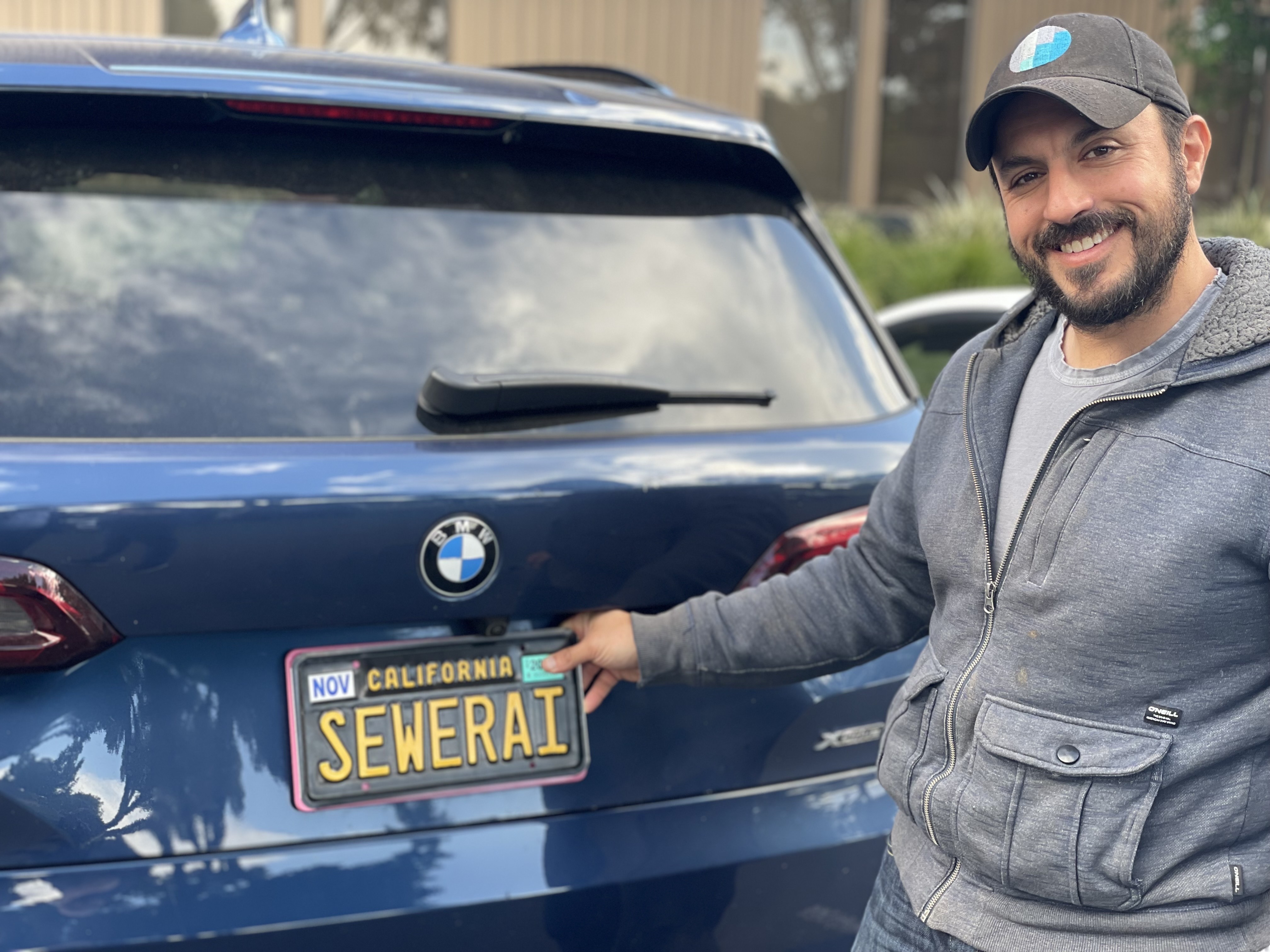
Rosenthal’s SEWERAI license plate supplies a lighter closing image. There he is beside the car, smiling, the company name committed to metal. An infrastructure business has found an unusually portable advertisement. Above the street, seven letters. Below it, plenty of work still to do.