Mathias Biilmann learned to program on a used Commodore 64. It greeted him with a blinking cursor and BASIC V2, an invitation with very little ceremony. Computer magazines supplied programs he could type in himself. Unfortunately, he was a sloppy typist. The programs broke. To make them work, he had to understand them. Years later, he would remember those errors as an education: a copying mistake could become a lesson that a perfectly pasted answer would never teach.
That is a useful place to begin with the co-founder and CEO of Netlify, a company built around making web publishing less cumbersome. Biilmann has spent much of his working life removing the chores between an idea and a working website. Yet his early advice to developers was to understand why something worked. Convenience and understanding have been travelling together in his career, occasionally arguing over the directions.
His university route took him through musicology and comparative literature at the University of Copenhagen, followed by graduate study in cultural studies. He worked as a music journalist for Danish radio. There were practical music courses along the way, including piano, singing and conducting, but the academic subject also concerned history and aesthetics. Building developer infrastructure was an unusual next entry on that particular reading list.
Madrid changes the assignment
Biilmann moved to Madrid after meeting a woman from Spain. The plan was to stay for three months and finish his thesis. The stay lengthened. The local market for articles about music written in Danish was, he recalled, rather limited. Programming, which he had pursued since childhood, offered another way to earn a living. A hobby suddenly had better commercial prospects than the profession.
He worked remotely for a US startup, then became a Ruby on Rails engineer at a Spanish company. He progressed through technical leadership to CTO. In 2010, he started Webpop with that company's founder: a cloud-based content management system giving professional developers room to build for their clients.
The folder that became a company
Webpop's customers kept asking it to do a simpler job. They wanted to put a landing page online, quickly, with a working form. Biilmann responded by building BitBalloon. Its first repository commit dates to May 20, 2013. The central gesture was wonderfully ordinary: drag a folder containing a website onto another website and receive a live address.
The small decisions were memorable, too. A June commit added the random name generator and turned the design blue. Over time, the little publishing flow became Netlify Drop. A folder and a URL were enough to get started; registration could follow. The product began with what users were trying to accomplish, rather than the full list of things a content management system was prepared to offer.
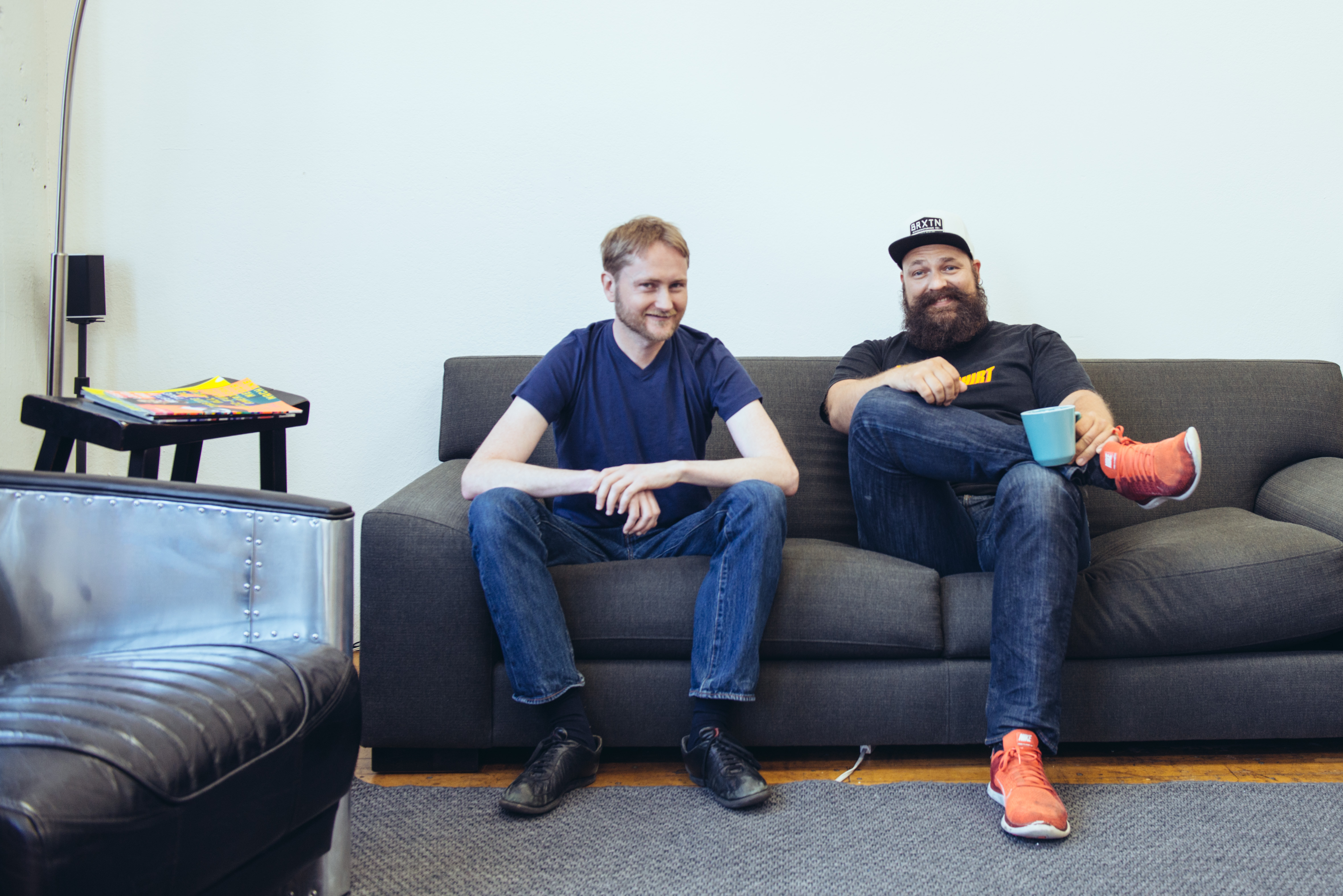
Netlify was founded in 2014 by Biilmann and Christian Bach. The two Danes brought different working histories to the same problem. Bach came from the creative-agency world; Biilmann was the developer. Their early office photograph shows them on a sofa, with a mug and a pair of emphatically orange shoes. The furniture makes a modest claim. The business they were building required a much larger one.

A new name for the people doing the work
When Biilmann took Netlify out of private beta in March 2015, he was its sole developer. His ambition was to give the frontend a larger role in web architecture. He saw developers working in browser-native technologies who were still treated as supporting players, expected to hand their work to someone responsible for the server.
He coined Jamstack to describe a decoupled approach. JavaScript, APIs and markup supplied the name. Separating the web experience from backend business logic gave frontend teams more independence. Netlify made that approach easier to publish and maintain. A category name also gave people a way to describe work they were already beginning to do.
In 2016, Netlify announced a $2.1 million round backed by founders of GitHub, Heroku and Rackspace Cloud. Its explanation pointed to a convergence: Git workflows, modern build tools and more capable browsers. These changes created an opening for a different deployment service. Biilmann and Bach were placing a business inside a technical shift, then asking other builders to join them.
The argument reached book form in Modern Web Development on the JAMstack, written with Phil Hawksworth. The 2019 report used Smashing Magazine as a practical case study. Commerce, membership and publishing made the discussion concrete. An architectural idea earns attention when people can see what it lets them do on an actual working site.
Five million builders, and a familiar question
In September 2024, Biilmann announced that more than five million developers had signed up for Netlify. He said the first million had taken five years and the next four million another four. The same announcement put the platform's reach at more than a billion unique monthly visitors across 50 million sites. Those were company-reported milestones, attached to a particular date, rather than a measure of his personal fortune.
The occasion sent him back to the questions investors had asked during the difficult first fundraising round. Why build for the web when mobile apps and social platforms seemed to be absorbing everyone's attention? It was an old objection with a fresh outfit. A builder could reach an audience through someone else's platform, or create something on the open web.
In January 2025, Biilmann returned to a personal blog, describing the appeal of having a domain of his own as being an owner rather than a tenant. He built it largely by prompting AI tools, beginning with Bolt and then making changes with Cursor and Windsurf. The website became both a place to write and a place to try his arguments out. A CEO's laboratory need not be particularly grand. Sometimes it is a blog that needs a few repairs.
Now the visitor can use tools
On January 28, 2025, Biilmann introduced Agent Experience, or AX. His proposition was that software companies should consider what happens when an AI agent uses their product on a person's behalf. An agent needs access, usable interfaces and enough information to act successfully. A polished dashboard alone will not answer those needs.
He had a working example. Netlify's ChatGPT integration could publish an ephemeral website, then let the human claim it. In that first AX essay, he reported more than 1,000 sites arriving directly from ChatGPT each day. The agent could complete the publishing step without making a new builder handle every piece of setup in advance.
A year later, he divided AX into four areas: access, context, tools and orchestration. The categories turn an airy discussion about intelligent machines into questions a product team can investigate. Can the agent enter? Does it know what to do? Can it perform the action? Can a person start the work with the information it needs?
By April 2026, he was describing agents moving earlier into the development process, helping create projects and provision services. The practical consequences extend beyond deployment. If an agent participates in choosing and assembling a product's infrastructure, the people supplying that infrastructure have another user to accommodate. The interface may be less visible to a human, but its quality still affects the human's result.
Access
Can it get in?
Context
Does it know enough?
Tools
Can it do the job?
Orchestration
Can we start the work?
The critic asks a machine for a review
Biilmann's personal experiments have a certain comic symmetry. In April 2025, the former music journalist built an MCP server for his blog and added a way for agents to leave feedback. His Agent Net Promoter Score asked how likely an agent was to recommend the blog's interface to other agents, with space for suggestions. A machine could now visit, read and submit its review.
He used the responses to improve the tools. The point was to learn what an agent encountered, through an experiment small enough to change over a weekend. The terminology borrowed from customer research is amusing; the test itself is quite direct. Give a visitor a job, observe the obstacles, then revise the experience.
That July, he described building a system to publish Notion documents to his blog without looking at the implementation code. He specified the architecture and desired outcomes while Claude Code handled implementation. For someone who had been programming for decades, this was an experiment in shifting attention. The work of deciding what should happen remained.
In April 2026, he went further into the frivolous and therefore revealing territory of personal design. From his phone, he asked for a reading indicator that moved and shrank as the reader scrolled. He also explored treating his blog's front page like a print magazine, redesigning it around each edition's content. These were changes he might previously have judged too time-consuming to justify. His interest was in making room for experiments that would otherwise stay imaginary.
“The web is unique in this regard: anyone can register a domain and be an owner, rather than a tenant.”Mathias Biilmann, January 2025
Keep the human in the picture
Biilmann has also answered the objection that making software friendly to agents could leave people out. In his February 2025 writing, he pointed to a game built by the eight-year-old son of Netlify colleague Sean Roberts, and a browser-based 3D scene editor created by designer Ian Curtis. His examples centred on people making things, including people whose previous tools would have limited what they could attempt.
He acknowledged that AI could pull interactions into closed platforms and reduce the web's role. His preferred outcome requires deliberate work: services that cooperate with the agents people choose, and a web where individual creators still have somewhere to put their creations. A prediction about what technology permits is only the beginning of that argument. What people build with it decides the rest.
His September 2026 essay added a sterner concern: human accountability. He argued that companies and the people running them should remain responsible for the actions of their AI systems. It is consistent with the insistence on understanding that runs through his earlier programming advice. However much execution is delegated, responsibility needs an address.
Meanwhile, the simple folder-drop survives. Netlify reported in July 2026 that more than 60 percent of users who signed up the previous month had made their first deployment through that flow. A thirteen-year-old idea had found a new role in an agent-driven world.
Biilmann's career keeps returning to the space between wanting to make something and being able to share it. The magazine program, the music article, the landing page and the prompted experiment each ask for a different kind of judgement. His company tries to shorten the journey to publication. The interesting question that remains is what the person at the beginning of that journey will choose to make.
Follow the work
Read Biilmann’s essays, see the early product history, or hear him discuss the shift from developer experience to agent experience.