A snowboarder who once wanted to beat Facebook now helps other people build their software. There is something pleasingly untidy about Matevž Petek’s career. The silver medal came first. Then came the photo app, the move to California, the accelerator, and a business that grew out of doing useful work for other founders. In 2026, Slovenian snowboarding elected him to lead its next four-year term. He has returned to his old sport with a rather different set of equipment.
Petek is the founder and CEO of Povio, the software design and development company with roots in Slovenia and a base in San Francisco. His earlier distinction was in big air, a discipline whose name offers the rare courtesy of explaining itself. In 2005, he won World Championship silver in Whistler. Four World Cup victories belong to the same sporting chapter. Plenty of careers would consider that a sufficient supply of plot.
Big air · Whistler
Winter batch · Povio
Slovenian snowboarding
Before the pitch, there was the jump
Petek comes from Celje, Slovenia. Long before there were product meetings, he was competing internationally for a country with a considerable appetite for winter sport. Big air gives a rider a jump and the judges a decision. The finished performance is brief; the preparation has the disagreeable habit of taking much longer. It is an interesting apprenticeship for anyone who will later have to demonstrate a product in a few minutes.
The results have dates and places. Winterberg, 28 January 2006: first. Milan, 4 February: first again. Stockholm, 11 November: another victory. These were three of his four World Cup wins. His competition record also stretches into halfpipe and slopestyle; at the 2011 World Championships in La Molina, he finished tenth in slopestyle. The medal is the convenient introduction. The repeated appearances tell more of the working story.
There was a less glamorous course of study alongside all that travelling: geodesy, the business of measuring the Earth. Petek completed his studies while still pursuing his sporting career. Technology drew his attention elsewhere. He learned online and worked with experienced mentors. A surveyor’s qualification and a snowboarder’s medal make an unusual pair of calling cards for a software founder, which may be one reason his biography resists the usual business shorthand.
His sporting interests extended beyond his own results. In 2007, he wanted more snow parks in Slovenia and had helped with advice on the park at Celjska koča. He also enjoyed motocross and kiteboarding. The wish for better places to practise matters in retrospect: the person eventually taking a leadership position in snowboarding had been thinking about its facilities while he was still using them.
A social app with the manners to ask
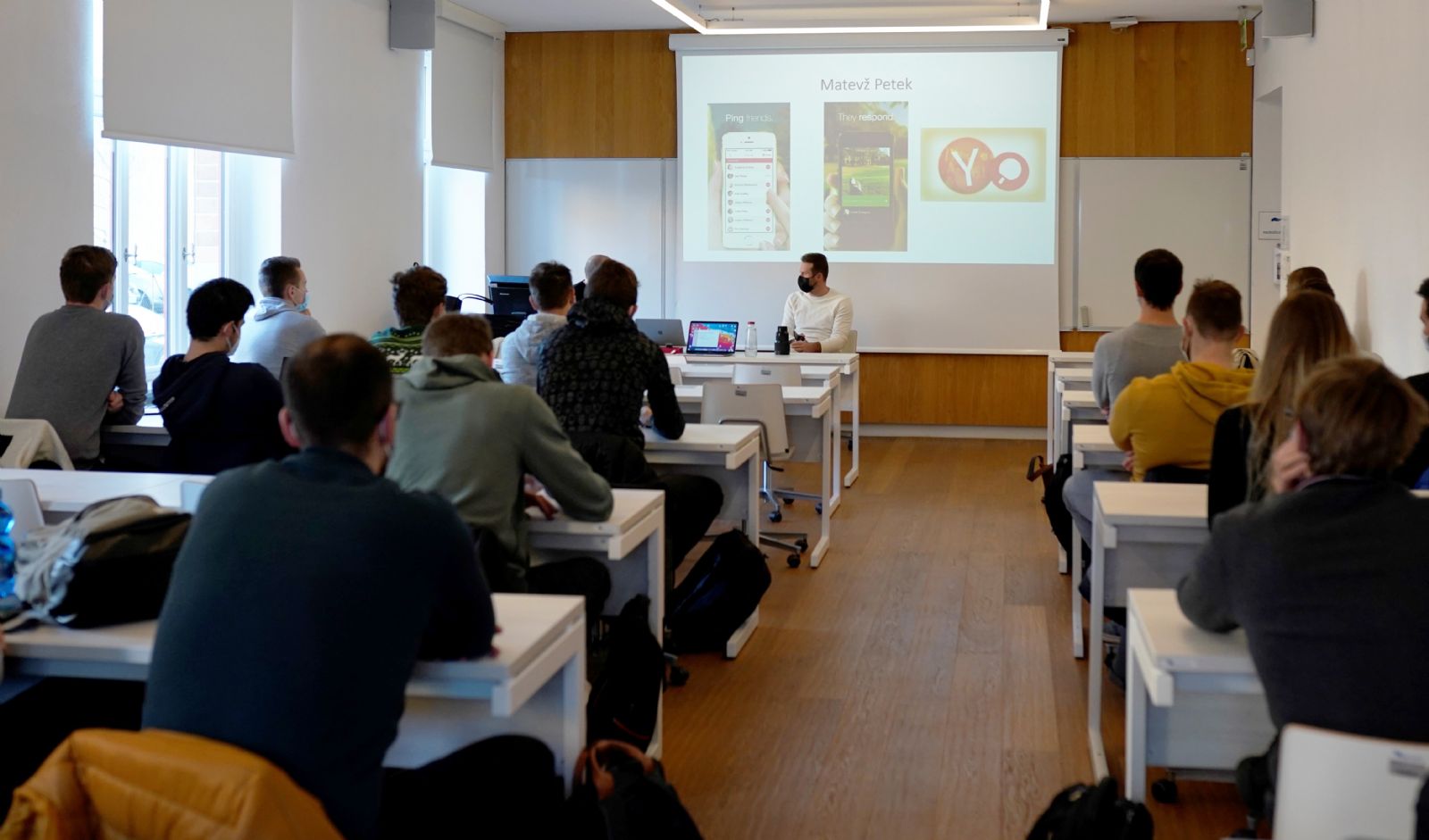
Early Povio began with a small reversal. Instead of posting a picture and hoping somebody cared, a friend could ask to see what you were doing. You sent a photograph of your present point of view. The exchange could go back and forth, a photographic ping-pong rather than another speech delivered to the internet. Even the name carried the idea: POV, for point of view.
The original impulse had a connection to Petek’s sporting life. Answering people with pictures felt natural when they wanted to know what he was up to. With Jugoslav Petković, the Slovenian entrepreneur associated with online retailer Mimovrste, he developed that habit into a product. By early 2013, the app was operating, and the founders were taking it to San Francisco. A familiar question had acquired a button.
An invitation before an image. A conversation before a feed.
The distinction was about permission as much as photography. A request supplied a reason to respond. A picture supplied an answer without the ceremony of composing an update. The camera faced everyday life rather than a demand to present oneself beautifully. For a social product, this was a modest piece of etiquette with substantial consequences for how a conversation began.
In 2014, Povio entered Y Combinator’s winter batch. Petek valued access to mentors who had already built companies and to founders whose own decisive early steps had happened there. The team spent its three months improving the product, its design and the ease of starting a conversation. Demo Day meant presenting to more than 500 investors. The immediate plan was to reach American universities, then expand further.
His ambition was considerably larger than a pleasant exchange of holiday photographs. By September 2014, he was openly describing Facebook as the company he wanted Povio to surpass. The team watched how people used the product and what they ignored, releasing new versions frequently. Ambition supplied the destination; behaviour supplied the corrections. The two are not always on speaking terms, but a product requires both.
The next customer changed the business
Povio’s durable business emerged in software services. The app had brought Petek into a community of founders with things to build. Engineering and design help became work the company could provide. By 2015, Povio Labs had taken shape around developing products for other businesses. The founder who had arrived with a single consumer app was finding a role in other people’s product plans.
It is tempting to treat such a change as a tidy revelation. The actual sequence was more practical. Founders needed help, a network of builders existed, and delivering useful work made the next piece of work possible. The customer changed from someone exchanging photographs to someone trying to get software made. That change alters almost everything about a business, even when some of the skills and relationships survive it.
“We didn’t plan to become an agency. We just wanted to build great products.”
Matevž Petek · on Povio’s beginnings
Today, Povio works across engineering, design and the jobs that keep a product moving towards release. Its customer range has included Volkswagen and work with Alexis Ohanian and Serena Williams. The variety is instructive. A founder with an early idea and an established organisation adding to a product may need different arrangements, but both must eventually turn intentions into something another person can use.
Nine years to lose four letters
For a company selling clarity, its own name supplied a small comedy. The original address, pov.io, suited the app: the ending was fashionable among startups, and its appearance suggested a camera lens. The founders also wanted povio.com. An early apparent purchase unravelled. A later attempt brought a $30,000 asking price that was beyond their budget. Digital real estate can be remarkably fond of behaving like the other kind.
The services business adopted Povio Labs in 2015. Customers then had opportunities to wonder how to write it, whether to separate the words, and what exactly these labs might contain. In 2021, the company finally negotiated the purchase of povio.com and dropped “Labs”. The journey from the original 2012 app to a simpler address had taken nine years. A shorter name had required an impressively long errand.
The unphotogenic work of keeping promises
There is another side to running an international software company that fits poorly into a victory montage: paying people. Povio’s customers and contractors operate across borders, with many contractors in Europe and many clients in the United States. A functioning business has to connect the two. Currency, timing and administration become part of the product’s invisible supporting structure.
Petek has publicly discussed using Wise alongside another payment solution, and the importance of contractors receiving money on time. The company also adapted a Wise API integration to its needs. None of this has the immediate visual appeal of a snowboard jump. It does, however, describe an executive’s attention moving from the exciting thing being built to the conditions that allow people to keep building it.
The return comes with an agenda
In March 2025, Petek became president of the snowboarding branch at the Ski Association of Slovenia. He described the position as an honorary responsibility and a challenge he welcomed. He had wanted to try such a role during his sporting career; now, he felt he had the leadership experience and energy for it. The appointment gave his experience in sport and business a shared place to work.
His interest had already been tested. In November 2023, he stood for the position, then withdrew his candidacy after objecting to the distribution of club voting power. His presentation emphasised teamwork, younger athletes and a useful legacy. That earlier episode gives the eventual appointment some texture. Returning to a sport as an administrator also means encountering its rules away from the competition course.
On 23 February 2026, the clubs re-elected him for the 2026–2030 term. In April, he was confirmed among the branch presidents on the federation’s executive board. The June meeting invitation under his name covered reports, financial plans, operating rules and the World Cup at Rogla. An athlete’s second act can involve a surprising amount of paperwork. The ambition now has an agenda attached.
The line through Petek’s career is less straight than a polished founder biography might prefer. He competed, built a way for friends to exchange photographs, learned to serve other founders, and returned to help run the sport that had first taken him abroad. Each chapter gave him a different audience. In the latest one, the useful result may be somebody else getting their chance to take off.
Follow the next chapter
WORK, WORDS & CONVERSATIONS