Matan Or-El wanted to play in the NBA. His father had a question about the plan. Or-El, then a child, had basketball practice twice a week. What, his father asked, did he think Michael Jordan was doing at that moment? The answer suggested its own correction. Or-El later recalled spending every day on the court until he was eighteen. It is a modest origin story for a cybersecurity founder: a boy, an ambition and an adult unimpressed by the distance between the two.
The NBA ambition makes a useful entrance to Or-El’s working life. The recurring subject is effort sustained after the exciting part has passed. At Panorays, the company he co-founded in 2016, that means paying attention to what happens between businesses long after somebody has approved the paperwork. A supplier changes. Its software changes. Its suppliers change. The signed form, meanwhile, sits perfectly still.
Or-El is building a business around that mismatch. As chief executive, he deals with a kind of exposure that ignores the tidy boundaries of a company chart. The organisation you hired may depend on another organisation you have never heard of. Somewhere beyond the purchase order, your business has acquired a supporting cast.
A career in the connections
His early ventures were closer to consumers than corporate procurement. A 2018 professional biography describes a media and entertainment website started at eighteen, followed by a mobile location service and an authentication security startup. There is a pleasing distance between an entertainment site and enterprise risk software. Both, however, require someone to notice a gap and persuade other people to care about it.
His technical formation included service in the Israeli Air Force’s software unit. He later worked at Imperva, moving through research and development into team leadership. The progression brought him into enterprise security, where the buyer, the user and the person responsible when something breaks may occupy different departments. An elegant piece of software has to survive all three conversations.
Alongside that engineering background came business education. Or-El completed an MBA at Tel Aviv University in 2015. His conference biography describes a concentration in entrepreneurship and innovation, as well as an undergraduate degree in computer science and bioinformatics. The combination helps explain his professional vocabulary: systems on one side, the organisation paying for them on the other.
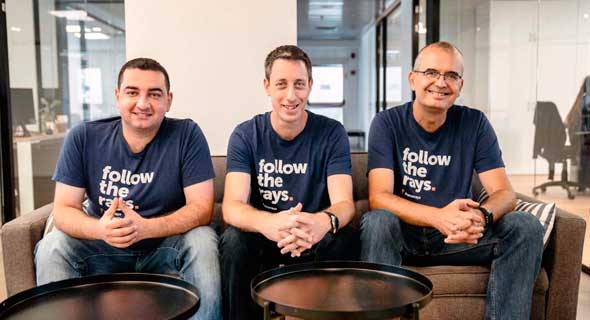
Panorays brought him together with Meir Antar and Demi Ben-Ari. The three had met through their work in the Israeli Air Force. They established the company in 2016, giving their shared technical background a commercial problem to work on. Or-El became CEO, Antar COO and Ben-Ari CTO. Those were the founding roles; Ben-Ari is now listed as chief strategy officer.
The form is finished. The relationship keeps changing.
The premise of Panorays is easy enough to understand over a purchase order. Businesses need other businesses. Before bringing a supplier aboard, they want to know whether its security practices create trouble for their own operations. Getting an answer can involve questionnaires, technical checks, follow-up questions and considerable waiting. Nobody has ever mistaken a procurement queue for a party.
Panorays combines information a vendor provides with assessments of its external digital exposure and the business context of the relationship. Its workflow can lead to a prioritised list of fixes, discussion with the vendor and reassessment. That last step matters. A finding is useful when someone can act on it and check the result. Otherwise it becomes another interesting document.
By June 2019, Or-El was taking that proposition to Cyber Week’s Startup Day at Tel Aviv University. Panorays was one of twenty-three participating startups. He described a platform already containing tens of thousands of companies and digital assets, and an ambition to keep mapping corporate cyber exposure. The event also offered something less technical and equally necessary: conversations with potential customers about how they actually worked.
The distinction between assessment and an enduring relationship runs through his later explanations. A company can look acceptable during onboarding and change afterwards. A subcontractor can become important without ever appearing on the original buyer’s radar. The administrative task has an ending; the dependency generally does not. Or-El’s business lives in the time between those two facts.
A round sized to the work
In September 2021, Panorays announced a $42 million Series B led by Greenfield Partners. The round brought its disclosed funding at that point to $62 million. Customers named then included Mixpanel, AppsFlyer and Payoneer. It was a substantial development for a company working on a problem that rarely announces itself in everyday business until something has gone wrong.
Or-El’s explanation of the fundraising was more revealing than the number. He described working out what expansion required and said the company had initially wanted to raise less. There were already hundreds of customers across the United States, Europe and Japan. The point of the money, in his telling, was to support a calculated next stage.
“We work in a very methodical manner, always thinking about what we really need in order to grow.”
Matan Or-El, September 2021
That is a useful sentence to place beside the familiar startup language of ambition. Growth has costs, sequence and obligations. A founder has to choose what comes next, then arrange the people and resources to do it. The same practical question appears in supplier security: among everything a team could investigate, which piece of work deserves attention first?
The company’s product development followed that question into automation. By 2024, Or-El was discussing tools for completing repetitive security questions, discovering supply-chain relationships and alerting customers to incidents. He also described the problem of limited resources: organisations struggle to catalogue their vendors, assess them and decide which ones matter most. A larger inventory helps only if the team can use it.
When somebody else’s outage becomes your queue
In September 2025, Or-El wrote about the ransomware disruption involving Collins Aerospace and its Muse software. His starting point was the people stranded in European airports and the airlines finding workarounds. It was a concrete way to explain supplier exposure. Somewhere inside an operational dependency, a technical failure had become a passenger’s delayed journey.
His response returned to continuous monitoring and the need to prepare for disruption. Vendors update applications, change configurations and add services. An assessment completed months earlier cannot describe every subsequent change. The airport example makes the time element plain: a business needs useful information while it can still make a decision, rather than a beautifully organised explanation afterwards.
By January 2026, the conversation had widened to the suppliers behind suppliers and the adoption of AI tools outside established controls. Or-El argued for tracing dependencies and checking the evidence behind automated answers. The risk in an apparently convincing answer is particularly awkward in a field built around assurance. A fluent response can travel through a process faster than a doubtful one.
reported full visibility across their supply chains
The company’s own research gave him a way to put a number beside that concern. In a survey of 200 CISOs at US-based companies, only 15 percent reported full supply-chain visibility. Sixty percent reported an increase in third-party incidents. Those figures describe the respondents to a vendor-sponsored study. Even within that defined group, they show the distance between depending on an ecosystem and being able to see it.
A seat in the boardroom, a place on the court
In August 2026, Panorays introduced a Cyber Risk Quantification module to estimate annual financial exposure from supplier incidents. The proposed translation is straightforward: take security information, business context and threat signals, then express the exposure in money. That gives a finance leader another way to discuss priorities with a security team. The result remains an estimate, with assumptions that deserve scrutiny.
For Or-El, the launch continues a career spent moving between technical systems and business decisions. Knowing that a supplier carries risk leaves a second question: what should the organisation spend to address it? A financial estimate can give that discussion a common unit. It also makes the reasoning easier to challenge. A number earns its place in a decision when people understand what produced it.
His stated ambition for the company includes the people doing this work. Panorays’ careers statement describes a workplace where employees can develop skills, advance their careers and enjoy the process. There is something refreshingly ordinary about that aspiration. Security software still has to be built by colleagues who want to turn up, solve difficult problems and remain interested in one another’s work.
Basketball has found its way into that professional world too. In 2024, Or-El invited the cybersecurity community to Panorays’ first Cybersecurity All-Star Basketball game at Black Hat in Las Vegas. For each participant, the company would donate to the Women’s Society of Cyberjutsu. A shared court offers a fairly efficient introduction. Titles remain on the badge; somebody still has to make the pass.
The childhood ambition and the adult business belong to different scoreboards. Yet Or-El keeps returning to work that has to be repeated: examining relationships, checking changes, deciding what needs attention. The first approval is only a beginning. There is another day to play, another dependency to understand, another reason to show up.