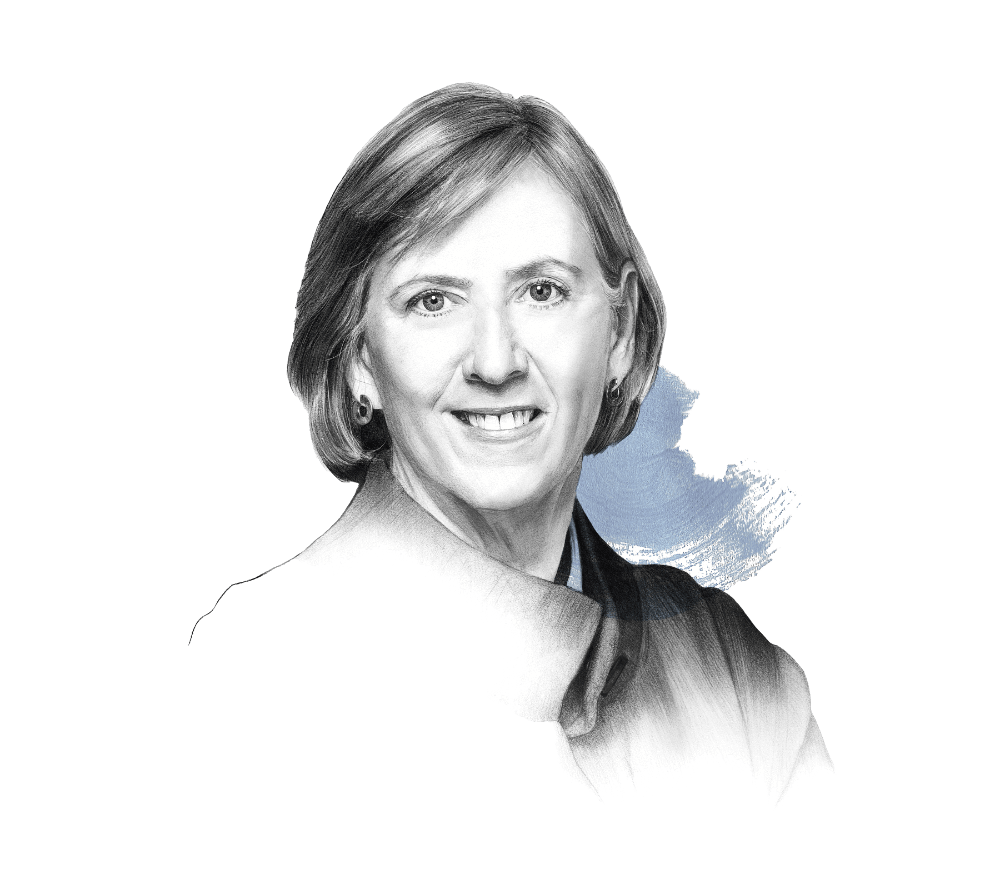
Profile
The Analyst Who Reads the Future
The spring ritual used to be predictable: sometime in May or June, a sprawling slide deck would land on the internet, and every tech executive, journalist, and VC in Silicon Valley would stop what they were doing to read it. Mary Meeker's annual Internet Trends report was not a presentation. It was a scorecard - for the industry, for the year, for anyone paying attention.
Then, in 2019, it stopped. No explanation. No farewell deck. The silence lasted six years.
On May 30, 2025, BOND Capital published "Trends: Artificial Intelligence." Three hundred and forty slides. The word "unprecedented" appeared fifty-one times. The tech press described it as a return. Meeker probably described it as the next report.
"Change, opportunity, and responsibility. We're living in a period of unprecedented change and unprecedented opportunity. Especially for the people in this room, unprecedented need for responsibility."
- Mary Meeker, Code Conference, 2018
This is what Meeker does. She watches. She measures. She waits until the data tells a story worth telling, and then she publishes it at a density most people wouldn't attempt. In 1995, she published the first version of what would become the most anticipated report in technology. In 1996, she and Chris DePuy co-authored "The Internet Report" - a book that the dot-com era used as a bible and that is now a collector's item on Amazon. In 2004, she served as the research analyst when Morgan Stanley managed the Google IPO.
None of this came from Wall Street breeding. Mary G. Meeker grew up in Portland, Indiana - population somewhere around six thousand, home to Portland Forge, and not much else that would predict a career on Sand Hill Road. Her father Gordon worked his way to the number two position at the forge before the factory was acquired. He built a personal golf fairway and green in the backyard. He discussed stocks at home. Meeker was golf team captain at Jay County High School. Small-town competitive, Type-A by inheritance.
She studied psychology at DePauw - not finance, not computer science - graduated in 1981, spent a year as a stockbroker at Merrill Lynch, then went back for an MBA in finance at Cornell. The psychology background shows. Her reports are not just about the numbers. They are about behavior - how people adopt new technology, how quickly, and what the adoption curve means for the companies serving them.
"I've made my best personal investments when I've been a user of the product. Like Apple. The epiphany for me came when I purchased my fifth iPod and I hadn't unwrapped my fourth."
- Mary Meeker
Nineteen years at Morgan Stanley produced a reputation that preceded her everywhere she went after. The Netscape IPO in August 1995 kicked off the commercial internet era - Meeker was on the team managing it. Bill Gurley, now one of the most prominent VCs of the next generation, was a colleague on that same desk. Morgan Stanley's involvement in the Google IPO in 2004 added another landmark to her resume. Between those two moments, she published her annual reports without fail, covering advertising, e-commerce, mobile, China, search - always a year or two ahead of where the market's attention would eventually land.
The dot-com bust brought scrutiny that followed every Wall Street analyst who had been bullish in the late 1990s. Meeker was questioned. She was never charged with anything. Morgan Stanley settled separately with regulators. She kept working.
In December 2010, she left to become a partner at Kleiner Perkins Caufield & Byers - at the time, still the most prestigious address in venture capital. The Internet Trends reports continued, now under Kleiner Perkins branding. The investments followed: Airbnb, Slack, Spotify, Stripe, Uber. Late-stage, growth-oriented, large positions in companies that were already clearly becoming platforms. She joined boards at DocuSign, Square, and LendingClub. In 2015, she testified as a defense witness in the Ellen Pao gender discrimination trial against Kleiner Perkins - a moment that made headlines and exposed the industry's awkward internal dynamics.
Then, in 2018, she left Kleiner Perkins and founded BOND. Not a new name for an old firm - a genuinely new entity, built around the thesis that growth-stage technology investing deserved a dedicated shop with a distinct approach. Fund I raised $1.25 billion in April 2019. The first investment was $70 million into Canva. That position is now worth multiples of what it cost.
By March 2021, Fund II closed at $2 billion. By April 2022, Fund III reached $2.5 billion. The portfolio now spans 176 investments across 130+ companies, with fifty-one unicorns. The firms range from Applied Intuition (autonomous vehicle software) to Substack (backed at a $1.1B valuation in July 2025) to ElevenLabs (AI voice synthesis, among the most recent additions).
The 2025 AI report is worth reading not just for the data - though the data is considerable - but for what it signals about where Meeker is placing her attention. ChatGPT reached 800 million users in seventeen months. Google's AI developer community grew five times over in twelve months. The Big Six tech companies spent $212 billion on AI infrastructure in 2024, up sixty-three percent year-over-year. These are not observations. They are setup.
In parallel with the AI work, she has been watching the U.S. government's balance sheet. "USA Inc." in 2011 applied the lens of public company analysis to federal finances - a document cited widely by policymakers and economists. "USA Inc. Revisited," published in March 2025, carries a bleaker conclusion: entitlements and net interest payments are on course to absorb all federal revenue. The report's central question - "Which generation will be left holding the bag?" - is not rhetorical.
Mary Meeker's Twitter account is set to private. She rarely appears in profiles. Her annual slide decks are the closest thing to a public diary she produces. Three decades in, the output is still coming, and it is still landing before the conversation catches up with it.