On September 15, 2008, Marketing Technology Solutions appeared to have found its exit. WebMD announced an agreement to buy the owner of QualityHealth.com for $50 million in cash, with up to $25 million more tied to performance. Two months later, the acquisition was off. The companies substituted an advertising agreement and a minority investment. A business that seemed ready to disappear into a larger health publisher remained on its own.
That detour makes the company more interesting. Its eventual destination was Sharecare, in 2014. But the useful story lies between the announcements: a health marketing business getting increasingly specific about the moment when information becomes action.
- MTS became QualityHealth in 2010, specializing in healthcare marketing.
- Its programs combined audience profiles, patient education and targeted offers.
- The commercial promise: pay for consumer responses delivered.
- Sharecare acquired the business in November 2014.
A reader is not yet a patient prospect
Consider a familiar advertising problem. Someone reads about a condition, sees a treatment message and leaves. The impression was delivered. The circumstances behind the departure remain obscure. Perhaps the person has no appointment. Perhaps their insurance excludes the brand. Perhaps they need help knowing what to ask a physician.
QualityHealth’s proposition was to investigate those circumstances. Founded as Marketing Technology Solutions in 1999, the company connected health-conscious consumers with advertisers through content, patient education and targeted acquisition. Its network included QualityHealth.com, HealthPages.com and Nubella.com. Pharmaceutical companies, medical-device makers and consumer-products brands were the commercial audience; consumers arrived for health information, tools and offers.
The distinction matters. A health publisher sells access to attention. QualityHealth also offered to help an advertiser identify people with a relevant need and encourage a measurable response. Its position sat between consumer publishing, audience data and campaign services.
The product was the obstacle course
In April 2010, MTS adopted the QualityHealth name. Its platform, Acquire2Convert, emphasized details that ordinary audience categories can miss: formulary coverage, the timing of doctor visits and the conversation inside the examination room. Those details gave the company a more precise commercial argument than simply having a large health website.
The accompanying programs made the argument tangible. Ask Your Doctor addressed physician conversations. Focus on Formulary brought insurance coverage into the marketing equation. Ask the Pharmacist added education and prescription support. They treated acquisition as a sequence with practical barriers along the way.
- 01UnderstandCondition, interest, circumstances
- 02ReachA relevant message and offer
- 03SupportEducation before the next decision
- 04MeasureThe agreed consumer response
The underlying insight is portable. If coverage prevents someone from accessing a product, another advertisement does little to remove that obstacle. If an appointment creates an opening for a discussion, timing becomes part of the product. Relevance depends on what the person can actually do.
Delivering that approach required several kinds of expertise in the same room. In 2011, QualityHealth hired Chris Mancini as executive vice president and general manager and Malcolm Smith as chief technical officer. Mancini brought experience from online marketing company QuinStreet and pharmaceutical company Eli Lilly. Smith had led technology at social networking platform Ripple6. Their backgrounds fit the assignment: combine marketing operations, healthcare knowledge and a platform able to deliver the programs. The work needed people who understood both a campaign’s economics and the machinery behind it.
The contract changes the conversation
QualityHealth described programs in which clients paid for actual consumer responses delivered. That is a consequential choice of unit. It makes an advertiser ask what action a campaign should produce, then makes the provider organize around delivering it.
It also demands careful reading. A response can be valuable without proving that a prescription was filled, a treatment was appropriate or someone became healthier. For a buyer, the practical work begins with defining the response, checking its quality and deciding what evidence connects it to the business objective. That is an analytical lesson from the model, rather than a reported clinical result.
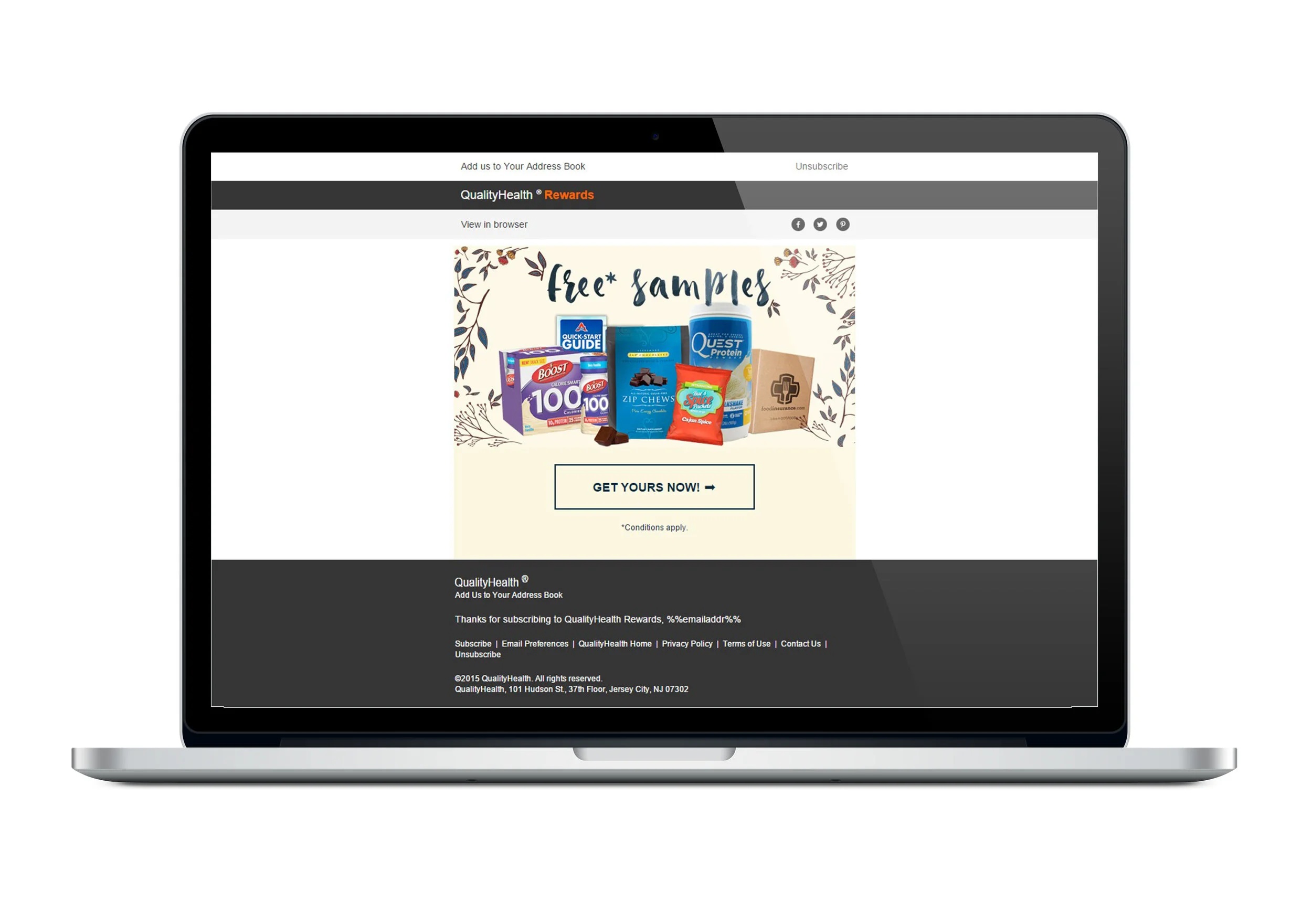
The consumer side could look pleasantly ordinary: an email offering samples, a recipe collection, something useful to read. Designer Yomna Emara’s public portfolio preserves those Rewards campaigns. The friendly surface helps explain how a specialized marketing operation could also be a consumer publishing business.
The deal that changed shape
The 2008 WebMD proposal supplies a rare financial snapshot. MTS generated approximately $21 million in 2007 revenue and was roughly at break-even on the adjusted earnings measure disclosed in the announcement. The proposed purchase price was a transaction figure, not the cost of running a campaign.
The later investment and advertising agreement replaced the purchase.
When the acquisition was terminated that November, WebMD agreed to represent part of QualityHealth’s media inventory and provide limited access to its own. The relationship survived in a different form. Treating the original proposal as a completed sale would erase the most revealing part of the episode.
Closer to the appointment
In January 2014, QualityHealth announced a partnership with MD On-Line. Through its Instinctive Data program, the companies planned to deliver relevant condition education, brand information and offers to physicians and patients. The partnership moved distribution closer to the provider’s existing workflow.
By November, Sharecare was buying QualityHealth. The acquisition announcement reported more than 50 million registered members, monthly reach of 100 million health consumers and coverage of 175 health, wellness and therapeutic categories. Membership, reach and treatment outcomes are different measures; none should be quietly substituted for another.
Sharecare paired that acquisition capability with its health engagement platform. QualityHealth’s CEO, Rob Rebak, became Sharecare’s president of consumer solutions. The strategic fit was straightforward: finding an interested consumer and maintaining a useful relationship with that person are connected jobs.
The next step still needs people
The thread continues through the workforce. In an April 2025 Sharecare spotlight, Sue Mizglewski recalled joining QualityHealth in 2006 and described the acquisition as expanding its content and capabilities. By then she co-led Life Sciences account management, working on implementation and campaign delivery.
“We were known primarily for lead generation”
Sue Mizglewski, recalling QualityHealth in 2025
Altaris had acquired parent Sharecare in October 2024. QualityHealth’s history now belongs inside that larger ownership story. Its useful lesson remains small enough to copy: map the obstacles before buying more attention. The approach depends on permission, accurate information and a next step worth taking. When those conditions disappear, greater targeting precision has little useful work to do.