At three in the morning, the university president was playing Valorant. In October 2025, Mark Naufel confirmed a Reddit story about a player encountering him in the game. He had recently taken charge of the University of Silicon Valley. The resulting attention prompted him to join Reddit and arrange an AMA about gaming, esports and higher education. University outreach had acquired a rather different admissions lobby.
Naufel was happy to meet the community there. His invitation addressed players curious about returning to college and explained that an esports scholarship at his university did not require being a top-tier competitor. Here was a president talking to prospective students in a place they already spent their time. The exchange was informal, a little funny, and useful. It also offered a glimpse of a career spent asking what happens when an institution takes students’ interests seriously.
By then, Naufel had founded an invention lab and an education company. Axio now lists him as its founder and a board director. USV lists him as president and CEO. The titles make for a tidy biography. The route between them is more interesting: a child with a computer, a finance student who wanted to keep making things, and an educator willing to hand students responsibility before their diplomas arrived.
Finance was the scenic route
His first audience was a school. In third grade, Naufel built its website with Netscape Composer. His father, an engineer who spent much of his career at Motorola, had introduced him to a personal computer early. The machine was something to use and build with. Years later, the school website remained a detail he remembered when explaining how he got started. Even before education became his profession, it had become a client.
He entered adulthood with an unexpected academic turn. A month before starting at Arizona State University, he changed his intended major from mechanical engineering to finance. Coming from a family of engineers, he wanted to explore something different and leave room to get involved on campus. Technology remained an interest. Student government offered him a technology internship when his degree label made other opportunities harder to obtain.
That combination eventually became a substantial education: a finance bachelor’s degree in 2013, a business analytics master’s in 2015, another master’s in systems engineering, and a doctorate in human systems engineering in 2020. The qualifications cover money, data, technical systems and the people who use them. They also describe the territory he would later work in. A university, like a software platform, has to accommodate all four.
He served as ASU’s Tempe undergraduate student government president in 2012-13. The election had an unglamorous detail: just 843 students voted for him. During his term, he welcomed the university’s response to student criticism of a redesigned Sparky mascot, including a vote on alternatives. A syllabus, a ballot, a mascot’s face: student life supplies plenty of reminders that institutions are experienced through particulars.
Give the students the keys
Graduate school brought a larger view of the machinery. Appointed by Arizona’s governor, Naufel served on the Arizona Board of Regents, helping govern ASU, the University of Arizona and Northern Arizona University. He encountered education at the scale of three public universities. Later, he would return to a much smaller unit: a team of students with enough freedom to choose a problem and enough support to attempt a solution.
ASU president Michael Crow challenged him to develop a different approach to project-based learning. Naufel founded the Luminosity Lab in 2016. Students would take responsibility for projects from conception through development, drawing on faculty expertise as they worked. The change was in who held the initiative. Students could bring the question, assemble the skills and lead the work, with experienced people available when they reached the limits of what they knew.
When Luminosity joined the Fulton Schools of Engineering in 2022, the arrangement gave its members access to more than 370 faculty members for advice. Its corporate research portfolio included work for Adidas, Starbucks, Kimberly-Clark and Axon. Agency came with a network. Being allowed to lead meant having somewhere to turn when a design failed, a technical question grew difficult, or a promising concept needed more than enthusiasm.
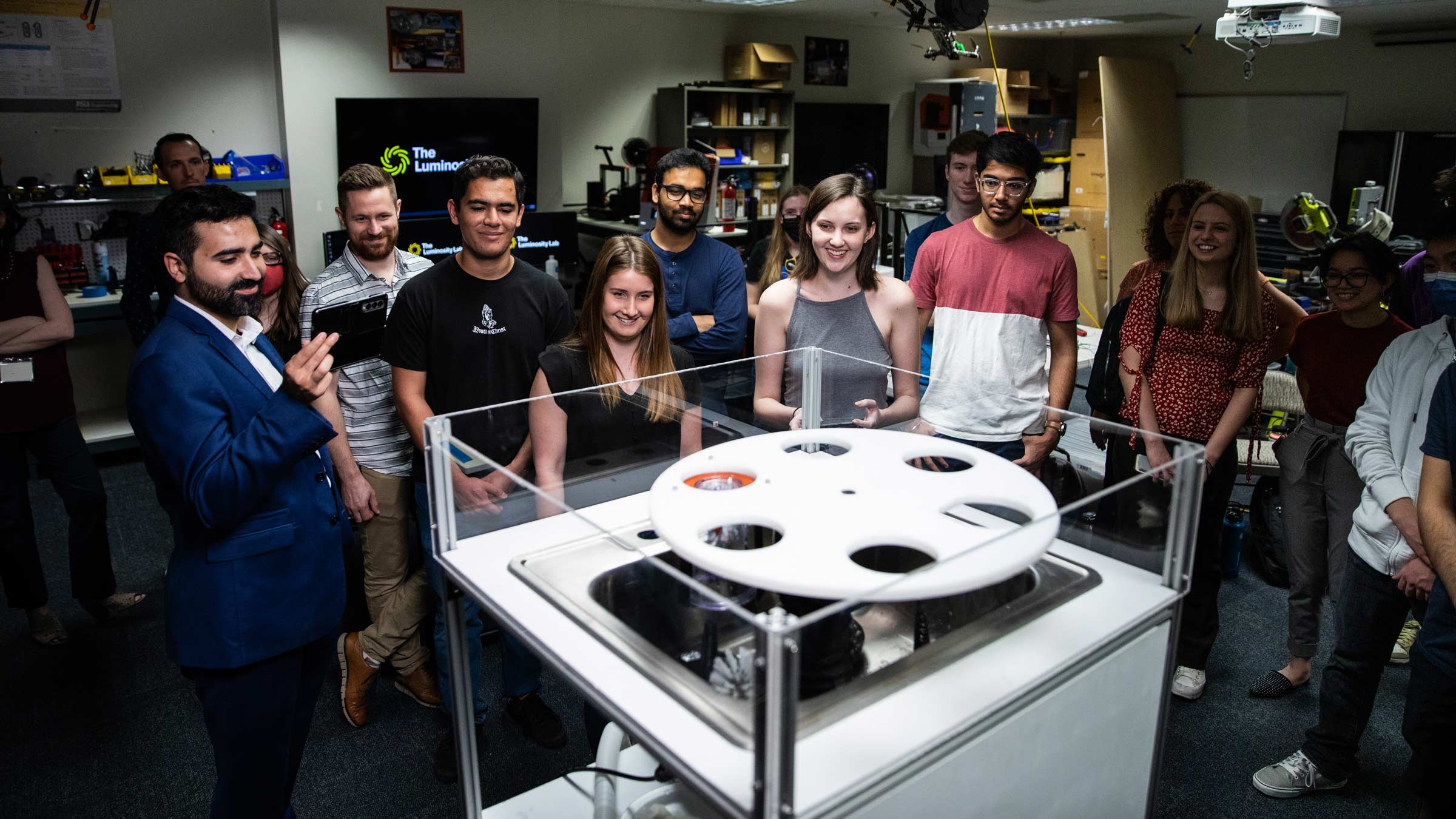
The lab’s name might suggest something hushed and luminous. The daily proposition was hands-on: design, build, test, try again. Across its projects, students had to deal with colleagues whose expertise differed from their own. A designer and an engineer could both be right about different parts of the same object. Naufel’s model made those encounters part of the education, rather than a complication to be scheduled around.
A good idea needs time on the clock
One example began with an exhausted student and an unwieldy study guide. Brinlee Kidd spent 11 hours preparing for a computer information systems test, then brought her roommate Sylvia Lopez an idea at one in the morning. They developed Jotted with funding and support from Luminosity. The problem was familiar enough to require very little explanation: notes can consume a student’s attention without turning into useful revision.
Jotted organized uploaded notes by class and generated flashcards and quizzes. Kidd, an informatics student, and Lopez, an industrial engineering student, won the Red Bull Basement global competition. They deserve their names beside the invention. For Naufel, their success showed what the lab could make possible. Two students had treated a difficulty in their own education as a product problem and built something in response.
Participation has a price, however. In 2022, Workiva CEO Marty Vanderploeg donated $15 million to endow the Vanderploeg Luminosity Scholars Program. The first 20 scholars were to receive $5,000 each. The money was intended to address unmet financial need and release time for the lab. Scholarships could renew for a second year. Juniors and seniors already had opportunities for paid work on sponsored research; the new support opened more room for younger undergraduates.
Endowment gift for the Vanderploeg Luminosity Scholars Program.
The arithmetic matters. Time spent earning money elsewhere is time unavailable for a prototype, a meeting or an afternoon of learning an unfamiliar tool. Naufel described the scholarship’s purpose in terms of giving students financial breathing room to learn research and development. Encouraging someone to pursue an idea is easier than arranging the conditions that let them do it. The scholarship put resources behind the invitation.
An idea travels 1,500 miles
The model also attracted people beyond Arizona. After visiting Luminosity, Lane College president Logan Hampton wanted a similar student-driven environment at his historically Black college in Jackson, Tennessee. Lane and ASU students collaborated on proposals to turn a vacant former gas station beside the college into a campus hub for innovation. The institutions were about 1,500 miles apart. The work gave them a common problem to consider.
The collaboration exposed a practical reason to connect institutions. Lane did not offer civil engineering, architecture or design; ASU students could bring those skills into the project. Lane’s students brought their connection to the place and community. Naufel wanted Luminosity’s approach to extend beyond a single university. The partnership made that ambition concrete, through a piece of unused land and students who could work together on its future.
Lane instructor Greg Emery had begun with an internship program in which six Lane students worked remotely with ASU students. He also considered a think tank whose outputs might include policy proposals and conference papers. That possibility widened the definition of building. A useful student project could be software, a physical design or an argument developed well enough to influence a decision. The common requirement was a problem that mattered to someone.
“A lot of internships have low-level, repetitive tasks.”
Mark Naufel, on giving students complex work
From a lab to a learning platform
Axio grew out of a longer-running interest in an AI companion for learning. In 2023, Naufel explained that Primer had previously used AXIO as an internal codename and represented more than six years of research and development in Luminosity. His public launch announcement introduced Primer as a personal companion for learning and life. The company subsequently took the Axio name. A startup launch date captures only part of that history.
His later description moved from an individual companion toward institutional infrastructure. In a 2025 LinkedIn announcement, he described work on an integrated education platform spanning enrollment, records, learning management and student success. His aim was to reduce fragmented systems, provide personalized learning paths, and give faculty more time for mentoring. Those were the founder’s stated goals. They explain the problem he wanted the business to address.
Today, Axio describes itself as an Interactive Learning Experience platform built for teaching and learning, combining AI learning experiences with institutional programming and human expertise. Its current board page identifies Naufel as Board Director and Founder. That gives his company chapter a different shape now: he remains connected through the board while his university presidency places him directly inside an institution responsible for educating students.
- 2016LuminosityStudent teams take on applied R&D.
- 2023Primer / AxioThe learning project becomes a company.
- 2025USVA university becomes the working setting.
The lab gets a campus
Naufel became USV president in October 2025. The institution, formerly Cogswell College, dates to 1887. Its creative and technical fields give his interdisciplinary interests a place to meet: games, animation, software, audio and entrepreneurship. At his appointment, he stated his frustration plainly: “It takes too long, costs too much, and prepares too few for the realities of a world that changes faster than ever before.”
In March 2026, he announced plans for a new North San Jose campus, with an April 1 opening date, and the Cogswell Center for Innovation & Entrepreneurship. The plans included animation and game development labs, collaboration spaces and an upgraded Dolby Atmos audio studio. The center, led by Robert Vera, was intended to bring founders, industry partners, faculty and students into a working environment built around making and testing.
USV also appointed Jon Relvas to lead corporate and industry relations. Naufel had worked with him at ASU, where they developed research partnerships with companies including Zoom, Procter & Gamble, NASA, Adidas and Starbucks. Bringing a former collaborator into the university joined the campus plans to another requirement: people who could connect students with external teams, applied projects and professional expectations.
The agenda can be read in ordinary terms. A student needs tools, time, knowledgeable colleagues and work worth doing. Naufel has approached those needs through a lab, scholarship support, software and now a university. The late-night gaming encounter fits into that story because it began with students’ interests rather than an official occasion. The president was already there, playing. The conversation about education followed.