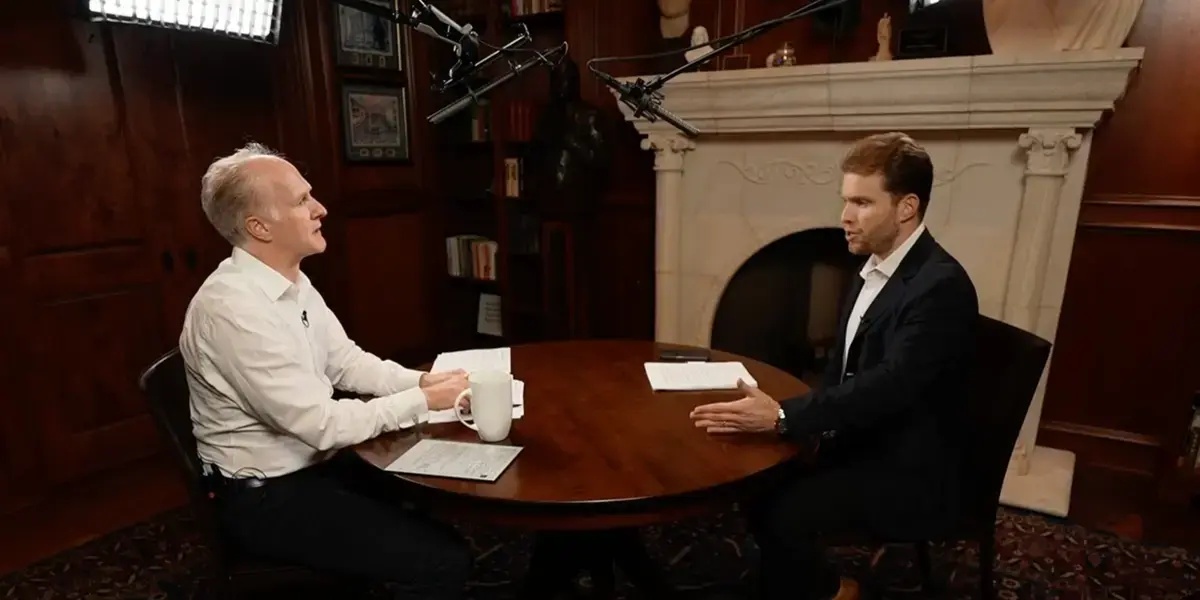
In an October 2022 conversation, Mark Machin sits across a round wooden table from Joe Lonsdale. There are mugs, papers and microphones, and a fireplace substantial enough to suggest that somebody has already done reasonably well. The discussion is about private investments: who gets access, who does the homework, and how long the money has to stay put. It is a fitting setting for a business concerned with getting more people through a rather selective door.
Machin had spent years on the other side of that door. As president and chief executive of the Canada Pension Plan Investment Board, he worked with a pool of capital, specialist teams and international relationships that an independent financial adviser could scarcely reproduce. When he co-founded Opto Investments, that difference became the starting point for a company. A pension institution could investigate private funds at scale. An adviser serving individual clients needed help with the investigation and the machinery around it.
The interesting part of his story is what he chose to carry from one job to the next. A contact book is useful. So is experience. But his public explanations keep returning to the conditions that let an investor make a considered decision: time, information, appropriate incentives and people who can be trusted for years. Taken together, those conditions help explain the path from international banking to pensions, software and now an investment firm focused on artificial intelligence.
Twenty years before the pension job
Machin joined Goldman Sachs in London in 1991, working in European corporate finance. His career took him to Asia, where he worked in capital markets and investment banking and eventually became vice chairman for Asia excluding Japan. He ran the region’s investment banking division for six years. By the time he moved to CPPIB in March 2012, his Goldman career had lasted two decades. Beijing and Hong Kong belonged to his working geography long before Toronto did.
Those roles placed him in the business of connecting companies with capital across markets. The subsequent pension job changed his position in that transaction. Rather than arranging finance for a client, he would help decide where an institution should invest. CPPIB hired him as its first president for Asia. He became head of international in 2013, with responsibility for international investment activity and global advisory relationships. His appointment as chief executive took effect on June 13, 2016.
There is a smaller, more revealing detail from the Asian years. Machin began studying Mandarin in 2012. His stated aim was conversation and the ability to read relevant Chinese-language articles. That is an unusually practical ambition for a senior financier: enough understanding to hear something directly, without waiting for it to be repackaged. It also offers a glimpse of how an international career can remain a learning exercise after the impressive titles have arrived.
The language work had a professional use. A November 2016 governance programme for senior executives from Postal Savings Bank of China included a working session with Machin in Mandarin. The setting was an investment relationship, with workshops intended to support the bank’s development. Language study had travelled from the lesson into the meeting. For someone managing cross-border relationships, that is a more meaningful milestone than a certificate on an office wall.
London, then Asia
Asia and international
President & CEO
Public launch
Co-founded
A pension fund has a different clock
Taking charge of CPPIB meant accepting a responsibility with a very long tail. The institution invests money that the Canada Pension Plan does not immediately need to pay benefits. Its portfolio is managed separately from government funds. The people whose retirement depends on it are not a sales pipeline; they are the reason the institution exists. That distinction gave Machin’s work a public purpose alongside its commercial demands.
In his parliamentary testimony in 2016, he described a fund that had experienced both an annual loss of more than 18 percent in 2009 and a gain of more than 18 percent in 2015. His point was the danger of treating a single year as the whole verdict. Independent governance and a clear mandate allowed the institution to look past short-term pressure. Patience here was an organizational arrangement, backed by rules and responsibilities, rather than a pleasing word in a presentation.
His later conversation with Joseph Reilly returned to the attraction of a dependable pool of investment capital. He described the absence of fundraising and redemptions as an advantage for people who wanted to build an investing career. That helps explain why the pension model matters to his subsequent businesses. The asset manager’s talent and judgment operate inside a system. Change the system, and the work changes with it.
The same long view appeared in his work with FCLTGlobal, where he served as board chair. In December 2020 the organization launched a dashboard tracing savings, investments and corporate spending to examine long-term behaviour in capital markets. There is something quietly bracing about that choice of subject. Finance can celebrate a long horizon while rewarding a short one. Following the money through the chain makes the contradiction harder to hide behind a polished speech.
Patience here was an organizational arrangement, backed by rules and responsibilities.From the story
Why a giant needed to look at small companies
One decision from Machin’s pension tenure points directly toward his current work. He pushed CPPIB into venture capital. His explanation began with a defence of the institution’s earlier reluctance: funds had been small, the possible allocations could be modest relative to the pension portfolio, and the historical reward for additional risk had been uncertain. A large investor could spend considerable effort on an investment that barely altered the total fund.
Then the conditions changed. Venture funds became larger and the return history looked different. Machin also saw another issue: a portfolio of established businesses could be exposed to disruptive innovation without understanding it properly. Watching new companies mattered because they could affect investments already owned. The unfamiliar startup was part of the environment around the familiar asset.
That argument is less romantic than the usual venture-capital origin story, and more useful. There is no need for a sudden conversion to entrepreneurial glamour. An investor responsible for existing holdings needs to understand what might change their economics. Curiosity becomes part of the job. His pension tenure included an expansion into technology investing, a San Francisco office and relationships with venture firms and the Creative Destruction Lab.
A meeting in Quebec, a company called Opto
Machin met Lonsdale at an event in Quebec with technology investors and operators, roughly six years before Opto’s public launch. They stayed in contact. Discussions about advisory work and a larger role developed over time. It is a recognizably human route into a new venture: an encounter, a continuing conversation, and eventually something substantial enough to commit to. The finished company announcement arrived much later than the first introduction.
Opto emerged from stealth on September 20, 2022, with US$145 million in Series A financing led by Tiger Global. Machin was co-founder and CEO; Lonsdale was co-founder and chairman. At launch, the business said it had more than 80 registered investment adviser partners and a 45-person team. Those numbers describe a company already assembling relationships and operations before stepping into public view.
Machin also invested personally. “This is something I believe in,” he said at the launch. The remark gives the venture a personal stake without requiring an invented account of his private feelings. His own announcement on LinkedIn explained the ambition: extend the kind of private-investment access he had experienced at CPPIB to a broader group of investors, working through their advisers.
The proposition included the tasks that rarely make a founder’s origin story: finding funds, investigating managers, subscribing, monitoring investments, tracking capital calls and reporting. An invitation to invest is only one piece of the work. Somebody still has to process the documents and keep the information straight. An adviser’s calendar can fill up with those obligations long before a client sees a polished portfolio report.
“This is something I believe in.”Mark Machin, on investing in Opto, 2022
The paperwork deserves its close-up
Opto’s 2022 description of manager selection put numbers on that hidden labour: 17 requested documents, a 96-question diligence document and an estimated 2,700 data points per fund. Machin appeared alongside investment-management head Matt Malone to explain the process. Their account covered the manager, strategy and operational structure, with external providers supplying second opinions. Those were the company’s stated procedures at the time, rather than a promise that a checklist could eliminate uncertainty.
The numbers are memorable because they puncture the idea that access alone finishes the job. A fund can be available and still require extensive investigation. An attractive strategy can come with operational weaknesses. Software may organize the questions and documents; somebody must assess the answers. The administrative burden and the investment decision sit next to each other, with different kinds of work on either side.
Machin’s discussion with Lonsdale gives the human counterpart to the paperwork. He talks about checking the experiences of other institutional investors and assessing whether a management team can stay together through difficult periods. The commitment may run for years. The person receiving the money must invest it, manage it and eventually return it. That sequence is a useful antidote to a pitch that ends at the moment of subscription.
The next investment is in the system itself
Machin is now co-founder and vice chair of Opto, alongside a newer role as co-founder and managing partner of Intrepid Growth Partners. Founded in 2023 with Mark Shulgan and University of Toronto professor Ajay Agrawal, Intrepid formally announced the final close of its inaugural US$525 million fund on September 14, 2026. The firm operates from Toronto and London, investing across North America and Europe.
Its launch announcement named nine existing portfolio companies, including PhysicsX and StackAdapt. Its approach concentrates on businesses built around machine intelligence and on the changes those businesses can bring to an industry. The new partnership brings together institutional investment experience and an economist who studies AI. In that combination, the question of how technology changes a system becomes part of the investment process itself.
Machin also remains connected to large institutions. He sits on GIC’s International Advisory Board and advises its Investment Strategies Committee. At CVC Capital Partners he is an independent non-executive director and chairs the remuneration committee. Those responsibilities concern oversight, perspective and incentives. They make an apt companion to the founder roles: building a business and asking how a business should be governed are related occupations.
Across these chapters, the recurring subject is the distance between an opportunity and the ability to act on it. In Asia, it involved relationships and local understanding. At CPPIB, it involved patient capital and professional teams. At Opto, it involved translating some of that institutional machinery into tools for advisers. At Intrepid, it involves backing companies as they try to change the machinery of their own industries.
His latest fund gives that continuing inquiry a new budget and a new field of work. The pension investor who wanted a clearer view of disruption is now helping finance companies that may produce it. The next part of the story will depend on what those companies build, how they grow and what their investors learn along the way. For Machin, the invitation has again become the beginning of the work.
Continue the conversation
Explore the work and hear Machin discuss it in his own words.
Intrepid: current biography ↗Opto Investments ↗Mark Machin on LinkedIn ↗Watch: Machin and Joe Lonsdale, 26 minutes ↗YouTube interview with Joseph Reilly ↗Watch: the pension fund’s venture decision ↗Listen: The HPScast career interview ↗Read: Intrepid’s September 2026 announcement ↗Read: the Mandarin-learning interview ↗GIC: advisory responsibilities ↗