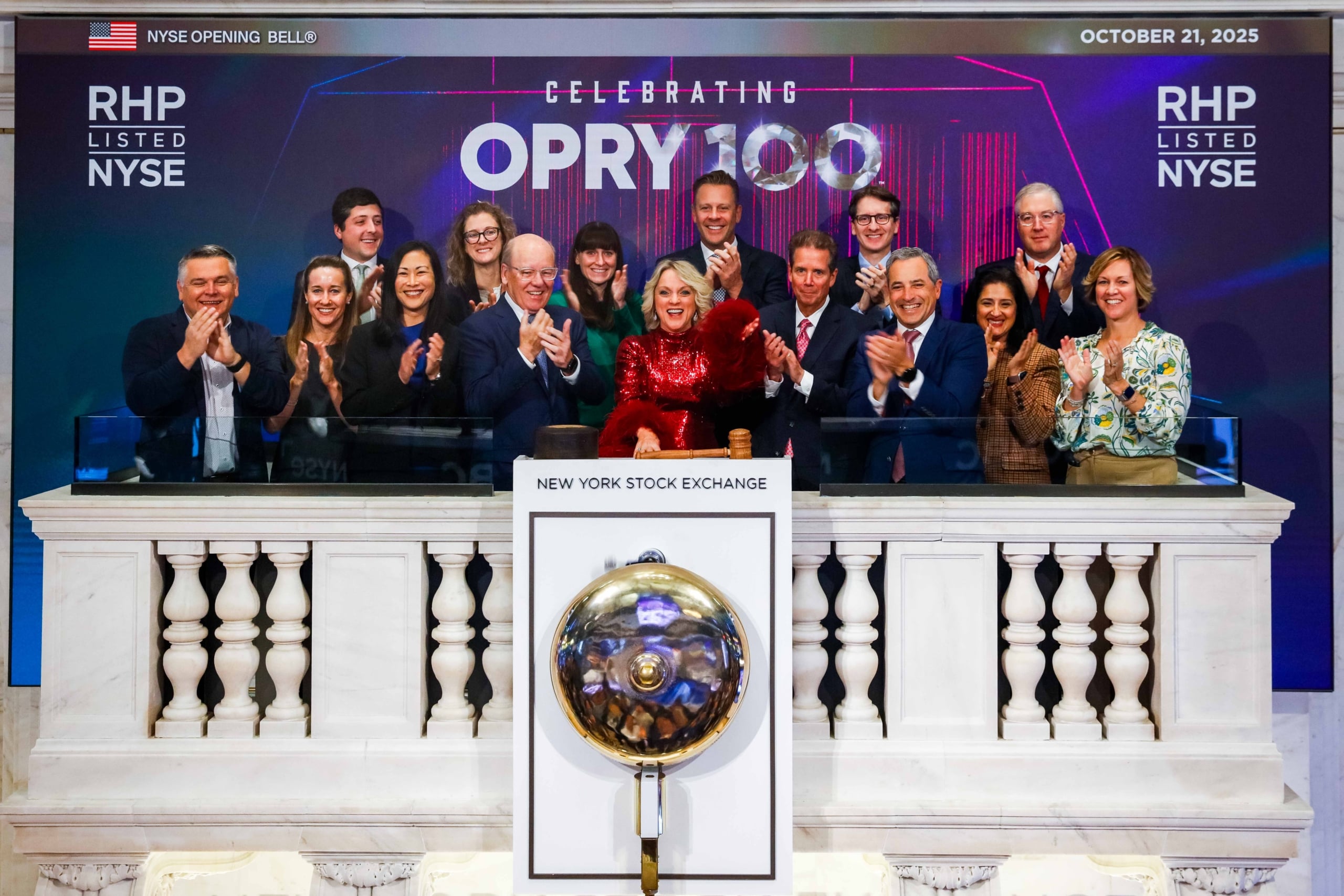
On October 21, 2025, Mark Fioravanti joined a party at the New York Stock Exchange. Rhonda Vincent was there, along with Ryman Hospitality Properties executive chairman Colin Reed and colleagues celebrating the Grand Ole Opry’s hundredth anniversary. In the photograph, the Opry100 sign fills the background. A country music institution had arrived at a place where the opening act is a bell.
For Fioravanti, Ryman’s president and chief executive, the pairing made professional sense. His company brings convention resorts and live entertainment into the same corporate conversation. Its responsibilities run from the places where people gather for business to the places where they gather for a song. The photograph compresses that unusual assignment into one frame: country music, corporate leadership, and a very punctual audience.
His route to that balcony began far from the CEO’s office. He joined the company in 2002 to work in marketing. Over the following two decades, his responsibilities crossed sales, a vacation rental business, treasury, and finance. When he became chief executive on January 1, 2023, he had already spent years learning how the business attracted customers and how it paid for the places they visited.
First, learn why the guest comes
Gaylord Entertainment’s November 2002 announcement of his promotion to senior vice president of sales and marketing contains an instructive detail. Before joining, Fioravanti had worked at Harrah’s New Orleans as vice president of finance and administration. Earlier assignments included corporate strategic planning and marketing, planning, and strategy. Finance was already part of his vocabulary when Gaylord handed him a marketing brief.
He described his assignment as continuing the development of hospitality and entertainment brands, improving analytical tools, and executing competitive initiatives. It is a revealing combination. The customer’s choice and the calculation behind it appeared together, in a job ostensibly concerned with selling the experience. “My charge is to ensure we continue to build that momentum,” he said.
The announcement also recorded his Ohio State bachelor’s degree and University of Tennessee MBA. His undergraduate subject was landscape architecture. That is an appealing detail in the biography of someone whose eventual business would revolve around places. It would be a stretch to make a degree explain every subsequent decision. Still, a career that begins with the design of physical space and ends with responsibility for gathering spaces has a pleasing shape.
A longer apprenticeship than the title suggests
In March 2004, Fioravanti became president of ResortQuest International, a Gaylord subsidiary. He held that position until June 2007, when he moved into the senior finance and treasury role. The sequence matters. Before he became the person explaining the company’s financial choices, he had been responsible for a business within it.
He became chief financial officer in 2009. The company credits his work during the 2008 financial crisis as part of that progression. President followed in 2015, alongside the CFO title. A board seat came in March 2022. Each step enlarged the assignment; none required him to invent a new employer every few years.
There is little romance in a list of corporate appointments, until you notice what the list demands. Marketing asks why someone will choose you. Operating responsibility asks whether you can deliver. Finance asks what the promise costs. A chief executive eventually gets all three questions at once. Fioravanti’s career had made him answer them separately first.
- 2002Marketing
- 2004ResortQuest
- 2009CFO
- 2015President
- 2023CEO
The buildings stayed. The business changed.
In 2012, Gaylord undertook a substantial reorganization. Marriott acquired the Gaylord brand and hotel management company for $210 million. Ryman continued to own the hotels; Marriott managed them under long-term agreements. The transaction initially covered four hotels and approximately 7,800 rooms. The ownership of a building and the running of a hotel could now be understood as separate jobs.
Fioravanti was CFO during that change. Ryman completed its restructuring during 2012 and elected real estate investment trust tax treatment beginning with 2013. Those dates are easily squeezed into a single milestone, but they describe different parts of the transition. The company also adopted the Ryman Hospitality Properties name.
For an executive, this sort of change is less photogenic than a new resort opening. It changes contracts, responsibilities, and the way money moves. Guests can continue arriving at a familiar hotel while the organization behind the reception desk becomes something different. Fioravanti’s contribution belongs to that less visible part of hospitality: arranging a business so the physical experience can keep working.
Austin gives the strategy an address
By 2022, another kind of real estate was coming into the portfolio. Ryman purchased Block 21 in Austin on May 31. Its stated $260 million purchase price was subsequently adjusted to $255 million under the agreement. The complex included the 251-room W Austin, the 2,750-seat ACL Live at the Moody Theater, the smaller 3TEN club, and commercial space.
Here was an acquisition in which a hotel and a performance venue shared an address. ACL Live also served as the filming location for the Austin City Limits television series. The purchase gave Ryman a physical presence in another music city, with several ways for people to spend time in the same development.
Fioravanti’s company biography credits him with leading the acquisition. It is an especially concrete expression of his career’s overlapping interests. Someone evaluating Block 21 has to think about rooms and audiences, property and programming. The attraction of the combination is clear enough. Making its different parts earn their keep is the ongoing work.
Finding partners for the next verse
Another 2022 transaction brought Atairos and NBCUniversal into Opry Entertainment Group. The deal closed in June with a $296 million investment for a 30 percent equity interest. It initially valued the entertainment business at $1.415 billion, including Block 21. Ryman described the arrangement as a way to support entertainment growth while reducing debt and preserving shareholders’ participation in future value.
The distinction between the investment amount and the valuation is useful. A minority stake does not mean selling the entire enterprise, and an enterprise valuation is a different measure from the cash paid for equity. Fioravanti had spent enough of his career in finance to know how much meaning can hide inside a short transaction headline.
The partnership also placed the entertainment business alongside organizations with investment and media experience. For an enterprise connected to the Opry and the Ryman Auditorium, expansion carries a particular question: how do you reach more people while preserving the reasons they cared in the first place? That tension is part of the job, rather than a problem that a closing announcement can settle.
An $800 million question in Texas
Fioravanti’s first year as CEO brought another proposed purchase. In June 2023, Ryman announced an agreement to buy the JW Marriott San Antonio Hill Country Resort & Spa for $800 million. He said the company had identified it as a target some time earlier. His explanation emphasized its market, the absence of emerging competitive supply, and its fit with the existing Gaylord portfolio.
That explanation gives a fairly clear view of his investment criteria without requiring an invented personality portrait. He was interested in whether an asset could serve both group and leisure customers, how it related to existing properties, and what competition might appear around it. The scenery could sell the holiday. The neighboring supply would help determine the economics.
At REITworld in late 2024, he described a portfolio with five of the country’s ten largest non-gaming convention resorts. Ryman was undertaking a $1 billion capital improvement plan over four years. The scale helps explain why his public discussions return to financing and reinvestment. Once a company owns such large places, improving what it already has becomes a substantial undertaking of its own.
“We own five of the 10 largest non-gaming convention resorts in the country.”Mark Fioravanti · November 2024 interview
The person between the appointments
Fioravanti has spoken about the value of formal and informal mentoring in his career. He regards it as a way to develop talent and pass along an organization’s priorities. His own lengthy progression through Ryman gives that view some context: professional development can involve a series of different assignments inside the same enterprise.
His stated interests include hiking, duck hunting, travel, and cooking. His reading recommendations in 2023 ranged from Paolo Cognetti’s novel The Eight Mountains to Unscripted, James B. Stewart and Rachel Abrams’s account of the Redstone family and a media empire. There is room on that reading list for both a mountain and a boardroom. Neither requires us to imagine what he is like at dinner.
His responsibilities extend into Nashville’s civic business organizations, including its chamber of commerce and convention and visitors corporation. He also serves on Nareit’s advisory board of governors. In April 2025 he joined Brookdale’s board, becoming its non-executive chairman in June 2026. These appointments broaden the public record of his work beyond his day job at Ryman.
The next gathering is already being booked
By the second quarter of 2026, Ryman reported $749 million in consolidated revenue, up 13.6 percent from the comparable quarter. Entertainment revenue was $144 million. The company also booked more than 768,000 same-store hospitality gross definite room nights for future periods, at an estimated average daily rate of about $310.
The future bookings are particularly relevant to Fioravanti’s assignment. They record business being arranged before the gathering takes place. Their estimated rate is a measure attached to those bookings, rather than the rate already earned across the current hotel portfolio. Ryman raised its full-year outlook following the quarter.
From a marketing role in 2002 to responsibility for that forward calendar, Fioravanti’s work has kept returning to the same practical subject: what makes people choose a place, and what must a business do before they arrive? The opening bell photograph offers a cheerful public answer. The rest of the answer sits in contracts, renovation plans, customer relationships, and bookings for dates that have yet to come.
Consolidated revenue · millions of dollars
13.6% year-over-year increase. Company figures for the quarters ended June 30; company performance, not personal earnings.