An internet customer reports a problem. Somewhere inside the company providing the connection, the equipment appears to be working. Both descriptions can be accurate. For the customer, this is little consolation: the service has failed at the very place where it is supposed to succeed. A reassuring technical report has never persuaded a frozen picture to move.
Marie-Véronique Lacaze became interested in that disagreement while working at Oléane, the French internet provider serving businesses. Customers were reporting errors that her team could not see at the source. The intriguing part was the distance between those two accounts of reality. Something was happening along the way, and the company needed a way to observe it.
In 2000, after Oléane’s sale to France Télécom, Lacaze and Jean-Michel Planche co-founded Witbe. Their new company would measure digital services from the user’s position, using real devices and networks. Over time, its work moved from web services toward streaming video. The screen at the end of the connection became a place to gather evidence.
It is an unusually durable premise for a technology business. The products, markets and vocabulary have changed around it. The question remains recognisable to anyone who has paid for something that refuses to work: what is actually arriving? Lacaze’s career has unfolded around getting that question taken seriously, first by customers, then by employees, partners and investors.
Before the robots, there were PCs
Lacaze started her career selling early personal computers to large corporate customers in France. She subsequently worked for a services company and established her own business, helping implement local and wide area networks. In the early 1990s, she joined Oléane with most of her colleagues and worked alongside Planche on its commercial development.
The sequence matters. Selling a machine, connecting machines and supplying an internet service each involve a different promise to a customer. A computer can be delivered and inspected. A service has to keep earning its keep after the salesperson has left. Her early work put her close to the practical business of persuading companies to adopt unfamiliar technology.
At Oléane she became managing director. France Télécom acquired the company in 1998; after two years devoted to integrating the teams, she left to found Witbe. There was a sale, a period inside a larger organisation, and another beginning. The next business carried forward a question raised by the previous one.
Her experience also helps explain the partnership at Witbe. Planche’s background lay in internet technology and networks; Lacaze had led sales and commercial operations. Their collaboration brought the construction of a technical system into contact with the task of making somebody want to buy it. A clever invention still needs a customer who understands what it is for.
- 1990sCommercial development at Oléane
- 2000Co-founds Witbe
- 2016Paris public listing
- 2024FEED Honours recognition
A bell in Paris, a business across the Atlantic
On 18 April 2016, Lacaze and Planche rang the opening bell in Paris to mark Witbe’s introduction on Alternext. By then, she was its president and chief executive, having taken that role in 2014. Sixteen years separated the company’s founding from the ceremony. It was a public milestone for a business built around inspecting services that most people notice only when they misbehave.
Lacaze was already based in New York. The company’s ambitions crossed the Atlantic while its shares would trade in France. That arrangement gave her a particular vantage point: building relationships in the American market while answering to investors on the other side of an ocean. Expansion and explanation had to proceed together.
Years later, she recalled a warning from investor Kenneth Sawyer about listing in France. The recollection was pointed, and her response was characteristically unfinished: she was still fighting for the venture. In that same 2024 post, she acknowledged that financial results had sometimes fallen short of expectations. She also reported that the United States accounted for 55% of Witbe’s 2023 revenue.
The share of Witbe’s 2023 revenue generated in the United States, as Lacaze reported in her 2024 reflection.
The bell makes a good photograph. The years afterwards make a more revealing story. A public listing creates a date everyone can celebrate, followed by a calendar of results everyone can inspect. Lacaze’s willingness to describe both commercial progress and disappointing financial periods gives that milestone some texture. Success at the ceremony did not relieve her of the work that followed.
The pleasure of being stubborn
Lacaze has her own explanation for staying with a difficult project. In a public reflection on entrepreneurship, she called the Witbe team “stubborn French people”. Her account of developing technology included experiments, mistakes, fresh starts and repeatedly returning to the work. The desired destination was a product people could use.
That is a revealing choice of emphasis. A founder can speak about invention as a moment of inspiration, which has the advantage of being short and easy to applaud. Lacaze describes repetition. The achievement lives partly in work that has to be done again because the previous attempt was insufficient. Anyone who has revised a spreadsheet will recognise the principle, if perhaps at a smaller scale.
Her public response to recognition follows a similar pattern. The FEED Honours List 2024 awarded her a People’s Choice distinction in the Pioneering Women category. When she wrote about it, she credited the people who had shared the journey and the teamwork behind Witbe’s development. An individual award became an occasion to talk about a group.
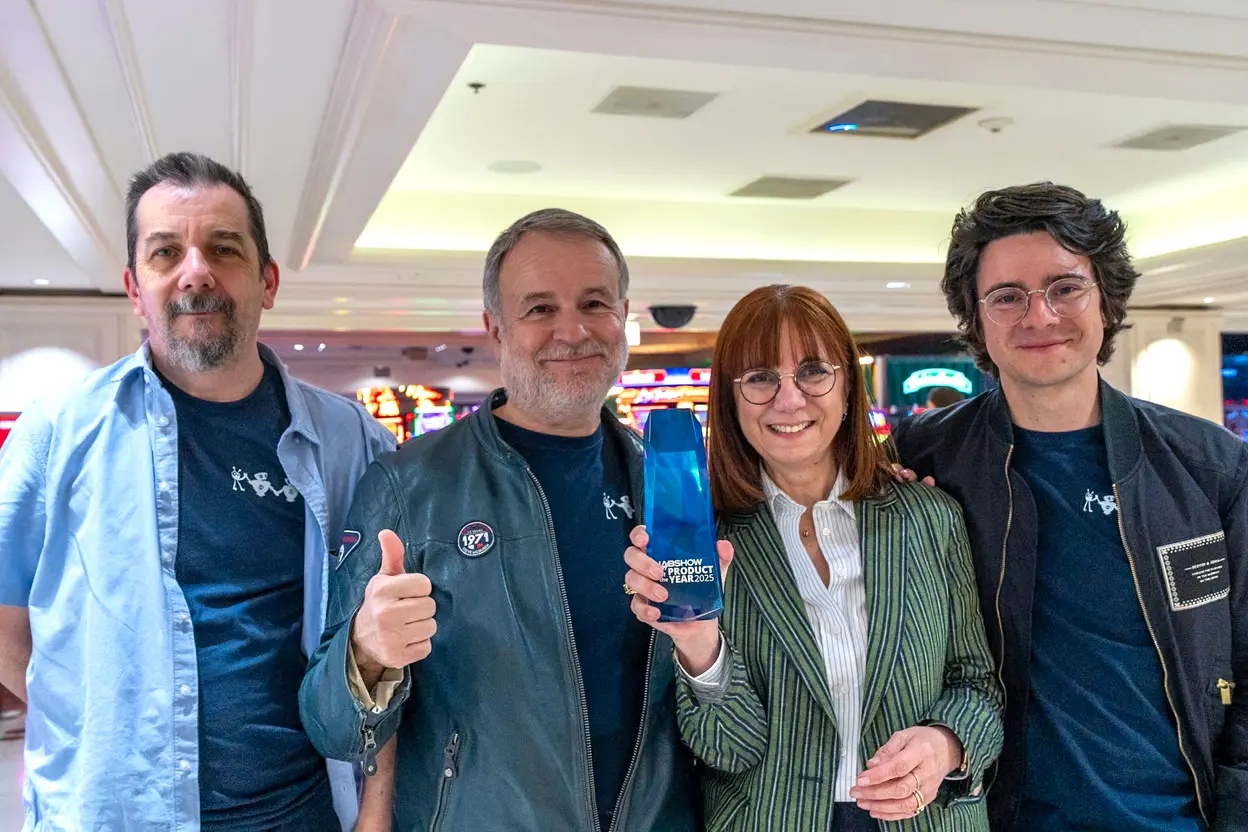
The company photograph from 2025 catches that collective aspect rather neatly: Lacaze beside colleagues, a blue NAB Show Product of the Year trophy held up between them. It is a cheerful image of an enterprise whose daily subject is malfunction. The people who spend their working lives looking for problems are allowed to enjoy a moment when something has gone right.
A viewer has very little interest in your infrastructure
Consider the ordinary ambition of starting a programme on a television and continuing it on a phone. For a viewer, the transaction ought to be simple. Behind it sit different devices, applications and connections. In a 2023 discussion of streaming, Lacaze used this kind of handover to explain the expectations providers face and the testing workload those expectations create.
She also paid attention to live events. Sport, news and other shared broadcasts retain an appeal that survives changes in distribution technology. Watching something together can mean sitting around one screen or watching at the same time from different places. That social habit gives a technical failure a particular sting: the event continues while your picture has other ideas.
This is where the business vocabulary becomes useful. Quality of service concerns technical performance, including latency, bandwidth and packet loss. Quality of experience asks what happens to the person trying to use the service. The measurements address different points along the same journey. Lacaze’s company has made its business out of observing the destination.
Witbe’s robots interact with real equipment. They can test the sequence a viewer follows rather than treating the device as an abstract specification. A service provider can examine whether its applications and video behave as expected on the hardware through which customers encounter them. The approach makes an everyday complaint available for systematic investigation.
By 2017, Lacaze was also explaining the importance of a controlled reference network for measuring variations in service quality. Witbe’s Galilei offering supplied cloud-based monitoring for internet-delivered video from multiple locations. The logic is practical: to investigate a changing service, the measuring arrangement itself needs to be understood. Otherwise the ruler introduces its own surprises.
The next revision still has to work
Artificial intelligence has added another chapter to that work. In 2023, Lacaze discussed Smart Navigate, a tool designed to reduce the effort of maintaining test scenarios when an application’s menus changed. A test written to find an item in one position needed attention when that item moved. The change sounds minor until it has to be repeated across a testing operation.
The underlying ambition is familiar from her commercial career: make the technology easier to put to use. Her recent public comments about testing return to accessibility, depth and the value customers can describe from their own operations. As software becomes more capable, somebody still has to configure it, maintain it and decide whether the result deserves their confidence.
“Notre particularité est de réaliser ces tests sur de véritables appareils.”
Marie-Véronique Lacaze · October 2026“Our distinguishing feature is running these tests on real devices.” Translation from French
In October 2026, Lacaze put profitability first among the indicators she wanted shareholders to watch. She described the goal as combining growth with profitability, and thanked the investors who had stayed through the years of development. It was a continuation of the conversation she had been having since the listing, now with greater emphasis on the economics of the installed business.
The scale of that business supplies context. A June 2025 company announcement described more than 300 customers in 50 countries. Those are company figures, rather than a personal scorecard, but they show how far the original problem travelled. An observation about customers reporting invisible errors became work performed across markets, devices and organisations.
Lacaze remains a co-founder whose public attention moves between the product, the customer and the people doing the work. Her account of persistence leaves room for error and revision. Her account of recognition leaves room for colleagues. The combination is useful in a business that must keep adapting its instruments to a changing world of screens.
At the far end of all that effort sits somebody with a remote control, expecting an evening’s entertainment. They are unlikely to applaud a monitoring system. They may never learn the name Witbe. For Lacaze, that ordinary expectation has supplied more than two decades of work: making sure the view from the customer’s chair is finally visible to the company providing it.