Margaret Sullivan has spent a career in rooms where the coffee cools faster than the argument. The setting changes - a Buffalo newsroom, an office at The New York Times, a Washington column, a graduate seminar, a Substack inbox - but her question has remained stubbornly unfashionable: is the journalism useful to the public? It is a modest sentence with expensive consequences. Answer it honestly and a newsroom may have to change its language, its habits, even its idea of whom it works for.
Her story begins without a grand entrance. In 1980, after Georgetown and a master’s degree from Northwestern’s Medill School, Sullivan arrived at her hometown daily as a summer intern. The Buffalo News was not a stepping stone she quickly abandoned. It became the place where she learned the craft from the floorboards up: reporting on business and government, writing a metro column, editing features, managing desks. Nineteen years after that internship, she became the first woman to edit the paper in its 131-year history.
There is something pleasingly old-fashioned about that climb. No personal brand, no viral thread, no dramatic pivot. Just the accumulated knowledge of who calls back, what a city meeting sounds like after hour three, and why an editor cannot bluff a reporter who knows the street better. In 2001, vice president was added to her title, another first for a woman at the paper. She ran a newsroom of roughly 200 people for almost 13 years.
The city desk as a civic education
Sullivan’s Buffalo tenure was not merely long. She established the paper’s first investigative team, pushed local enterprise reporting and helped develop BuffaloNews.com. Under her leadership, the newspaper repeatedly received New York’s Distinguished Community Service award. One cited project examined airline safety after the 2009 crash of Continental Connection Flight 3407, reporting that helped lead to federal reforms around pilot training and fatigue.
That work supplies the emotional architecture of her later argument about local news. A newspaper is easiest to romanticize after its advertising has vanished and its desks have emptied. Sullivan is too practical for the sepia treatment. What concerns her is the missing function: the reporter at the school board, the institutional memory at city hall, the person paid to notice that this year’s assurance contradicts last year’s minutes. When the observer disappears, public life does not become simpler. It becomes easier to game.
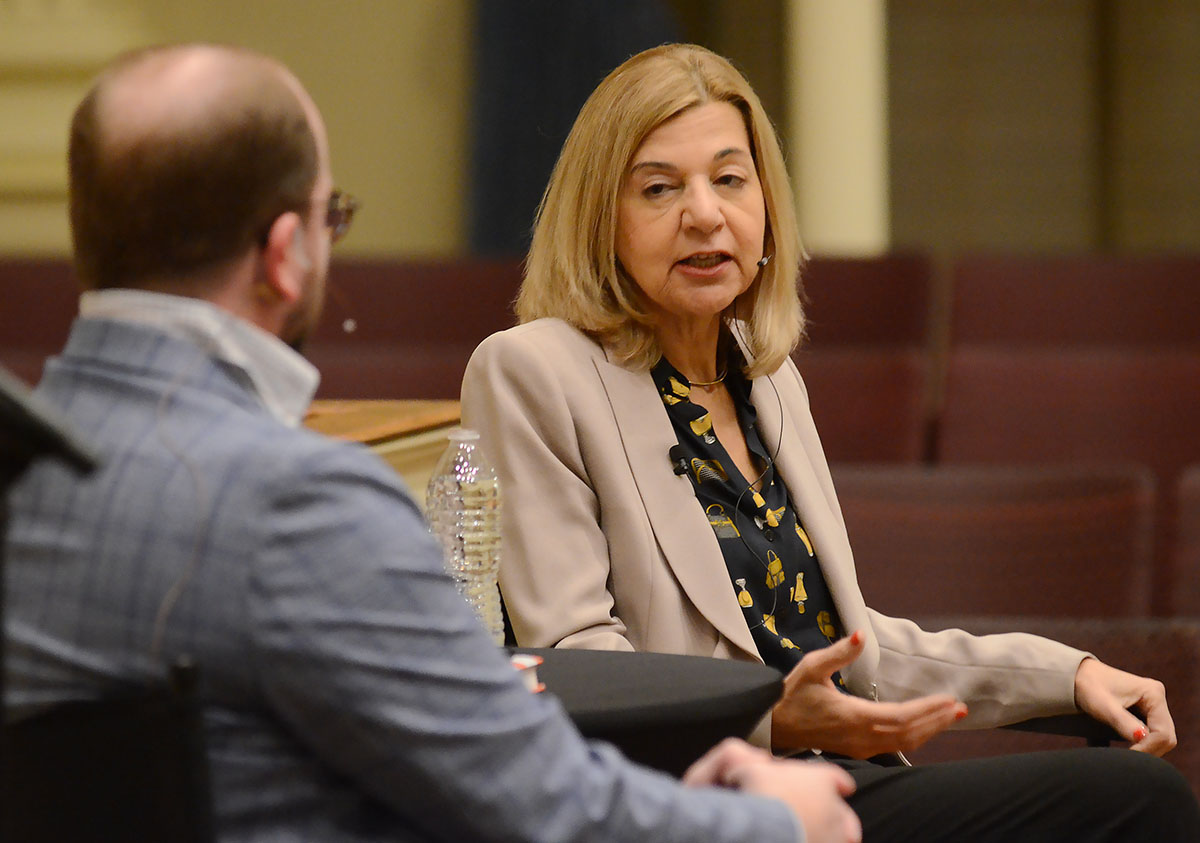
Her concern for the civic machinery did not make her a newspaper preservationist. She understands that technology broke the old bundle and opened publishing to almost everyone. “We all own the printing press now,” she said in 2022, and she meant it as encouragement as well as diagnosis. Her complaint is not that the gate came down. It is that verification, local knowledge and accountability have yet to find stable support on the other side.
“We all own the printing press now.”Margaret Sullivan, on the democratizing force of digital publishing
The critic moves inside the building
In 2012, Sullivan left the newsroom she knew intimately for a job constructed around estrangement. As public editor of The New York Times, she represented readers and assessed the work of her own employer. She was the first woman to hold the post. The title sounded municipal; the actual brief was institutional conscience with a deadline.
She questioned the paper’s reliance on unnamed sources, objected to officials approving quotations before publication and examined political coverage at moments when every word seemed to arrive carrying its own legal team. The position rewarded clarity and punished comfort. Sullivan later summed it up neatly: “I never had a completely comfortable day as Public Editor.” This was less a grievance than a performance review. A watchdog with a favorite chair has probably missed something.
The public editor job also revealed Sullivan’s characteristic kind of loyalty. She criticizes journalism because she thinks it matters, not because disdain is entertaining. Cynicism would be easier and considerably less work. Her method is to take the institution’s stated principles seriously, compare them with the day’s choices and write down the difference. This can make everyone cross while leaving the central idea intact: standards are promises, not décor.
In 2016 she moved to The Washington Post as media columnist, just as political reporting entered a long stress test. She pressed journalists to describe falsehoods plainly, to resist treating democratic norms as just another partisan dispute, and to recognize when familiar conventions obscured rather than clarified reality. She also kept returning to the hollowing out of local reporting. National spectacle attracts the cameras. Democratic erosion is often filed from a county without a reporter.
Two books and a refusal to mope
Ghosting the News, published in 2020, made the local crisis compact and concrete. Newsroom Confidential followed in 2022, carrying the subtitle “Lessons (and Worries) from an Ink-Stained Life.” The parenthesis is pure Sullivan: experience offered without pretending that experience settles the argument. The memoir begins in one newspaper era and ends in another, part recollection and part industry brief.
She can enjoy the artifacts of the old trade without worshipping them. At a Manhattan lunch for a 2022 interview, the Lebanese food recalled her grandmother’s cooking. Nearby, a museum exhibition displayed the vanished paper city, right down to a newsroom Rolodex. Sullivan called herself “a creature of my era,” then added that she was a creature of the current era, too. The qualification matters. Nostalgia gets an afternoon; the next edition still has to publish.
Her life away from the media argument peeks through in useful flashes. At Nardin Academy she was both newspaper editor and basketball captain. She has described herself publicly as a Knicks fan and a member of Bills Mafia. She likes theater, pop music and inviting newsletter readers to argue about the best Beatles cover. Her travel ambition is to reach all seven continents. A 2025 trip to Morocco brought her tally to five, with Australia and Antarctica remaining at that point.
Accuracy and fairness are not passive poses. They require editors to notice when convention disguises the truth.
Local accountability begins with presence: someone must attend, ask, check and return next week.
An inbox with a public purpose
After the Post, Sullivan taught at Duke and returned to Columbia Journalism School. From 2024 through 2025, she served as interim executive director of the Craig Newmark Center for Journalism Ethics and Security. The pairing of ethics and security initially struck her as odd. In practice, she found them inseparable: protecting reporters and sources, deciding how to use artificial intelligence, being transparent about methods and resisting manipulation all meet in the same newsroom.
She described part of her Columbia life as an informal “ethics hotline” for students. It is an appealing picture: decades after being the intern asking how the place works, she became the person students visited when no manual could give them a clean answer. The counsel was not mystical. Be honest. Be transparent. Get it right. Do work that serves the public. Simple rules become interesting only when applying them costs something.
Her current publishing home is more direct. American Crisis began in 2023 as a podcast asking whether journalism could help save democracy. It evolved into a reader-supported newsletter, alongside her column on media, politics and culture for The Guardian US. After the 2024 election, Sullivan removed the newsletter paywall; by early 2025 it was landing in more than 20,000 inboxes, and its audience has continued to grow. The former gatekeeper now arrives by email.
The format suits her. It allows a running conversation with readers, room for sharp verdicts and occasional exits into music, travel and basketball. It also restores something familiar from local journalism: a legible relationship between writer and community. Subscribers reply. Sullivan reads the comments. The beat is national, but the exchange can feel like meeting a columnist in the produce aisle.
“Honesty, transparency, getting it right and trying to do work that serves the public.”Sullivan’s durable standard for journalism
Standards without a velvet rope
Sullivan’s aspirations are large but not foggy. She wants journalism that is accurate, fair, mission-driven and public-spirited. She wants news organizations to coordinate when press freedom is attacked, to state their democratic purpose plainly and to stop giving lies the borrowed dignity of a “both sides” frame. She wants local reporting funded because communities cannot hold power to account with vibes and a neighborhood Facebook group.
Her honors acknowledge the consistency of that argument: election to the Pulitzer Prize Board in 2011, the Bart Richards Award for media criticism in 2020, a First Amendment Award in 2023 and election to the American Academy of Arts and Sciences that same year. Yet her career makes more sense as a chain of obligations than a shelf of prizes. The intern owed accuracy to an editor. The editor owed a city a strong paper. The public editor owed readers candor. The critic owes the profession an honest mirror.
In 2026, her weekly writing remains fixed on press freedom, political coverage, corporate media choices and the hazards of normalizing the abnormal. The urgency has increased; the prose has not put on a helmet. Sullivan remains direct, sometimes wry, suspicious of euphemism and capable of encouragement when journalism earns it. She is not pining for the clatter of typewriters. She is asking what must survive after the noise is gone.
There is even a better name waiting in her imagination. Sullivan has written that she would love to change American Crisis to American Comeback someday. It is a revealing ambition because it contains a condition: improvement first, rebrand second. Until then, she keeps filing. Faith, in her version of journalism, is not cheerfulness. It is the decision to hold the work to a standard again next week.