A freight invoice has a mischievous relationship with time. The work is finished. The trailer is empty. The driver has burned the diesel, paid the tolls, and produced the paperwork. Yet the money can remain somewhere over the horizon for roughly 30 days. Payroll, insurance, repairs, and fuel have the poor manners to arrive sooner.
Marcus Womack built Outgo in that gap. The Seattle company bundled the carrier's back office - broker setup, documents, invoicing, collections, banking, and factoring - into one financial platform. A small fleet could submit proof of delivery, turn an approved receivable into available funds, and move money without conducting an administrative tour of several vendors. It was less a digital bank than an accounts-receivable department compressed into software.
The product is specialized. Womack's route to it was anything but narrow. He worked on Xbox Live at Microsoft, product at the social-music service iLike, family-photo sharing at Familiar, cloud software at Axon, and travel and airport products at Uber. Gaming, songs, grandchildren's photographs, public-safety evidence, airport pickups, freight bills: an eccentric dinner party of industries. The common guest was a product operator looking for the human nuisance inside a complicated system.
The reunion was the strategy
Outgo has three co-founders: Womack, Mike Bohlander, and Ray Fortna. Their origin story begins long before freight. They met at iLike, the Seattle music-discovery service that MySpace acquired in 2009. Womack led product there, first as a director and later as vice president and general manager for events and ticketing. Bohlander and Fortna were already learning how he made decisions, and he was learning how they built.
The trio next helped create Familiar, a service that put family photos onto the idle screens already sitting in relatives' homes. It solved a tender problem with a practical bit of distribution: grandparents did not need to master a new social network to see new pictures. In 2013, the business behind EVIDENCE.com acquired Familiar. The subject matter changed abruptly from family albums to cloud-managed digital evidence, but Womack and his colleagues went with it.
At the company now known as Axon, Womack rose to general manager of EVIDENCE.com, then Executive Vice President of Software and Services and general manager of the Seattle office. His remit included product management, engineering, security, and design. It was an education in making software consequential: storage, reliability, permissions, and trust were no longer ornamental concerns. They were the product.
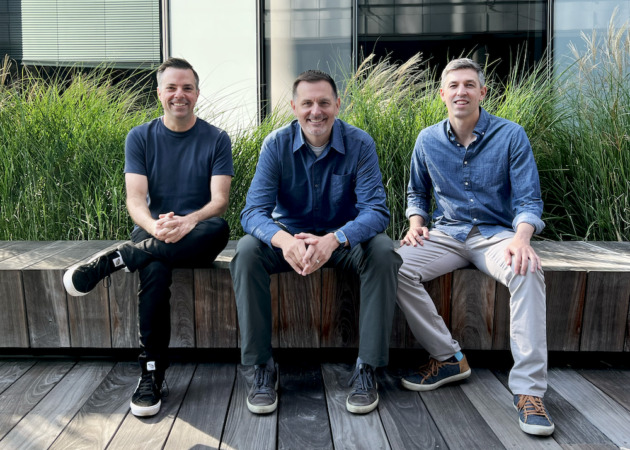
After Axon, their paths spread out. Womack held a technology leadership role at Uber, concentrating on global travel, airports, and premium products. Bohlander and Fortna worked at freight marketplace Convoy. When the three regrouped, they brought both halves of an interesting combination: a history of consumer-grade product work and a close view of trucking's operational machinery.
Fourteen years is a long courtship for a cap table. It meant Outgo did not have to discover the temperaments of its founding team while also discovering its market. The founders already knew how one another behaved when a launch slipped, an interface failed, or an acquisition turned one job into another. In startup mythology, novelty gets the champagne. In operating life, familiarity often gets the software shipped.
Listen for the expensive sigh
The team did not begin with factoring as a fashionable thesis. Before building, they spoke with hundreds of carriers about cash flow. They kept hearing a simple division of labor: carriers find work, perform work, then try to get paid. Technology had changed the first part. The second still involved rate confirmations, bills of lading, broker portals, invoice queues, payment clocks, and traditional factoring arrangements.
Factoring lets a business sell a receivable rather than wait for the customer to pay. For a carrier with fuel and wages due now, the speed is useful. The cost and contract can be less charming. Womack's team saw that much of the price came from manual processes and disconnected systems. If software could automate the invoice lifecycle and connect it directly to a bank account, the carrier could gain speed without treating every unpaid bill as an all-or-nothing event.
documents uploaded
Outgo launched publicly in March 2022 with $3.4 million in seed backing. Its early pitch joined invoice management to a connected debit card. The carrier could factor only what was needed for a purchase, at the moment of the purchase, instead of financing an entire invoice by default. The company later expanded the platform around non-recourse factoring, banking, payments, and automated collections.
There is a stealable founder lesson here, and it is not the weary instruction to hunt for boring industries. Boredom is a spectator's judgment. To the person waiting on a broker while a fuel card comes due, the problem has plenty of dramatic tension. The better instruction is to listen for the expensive sigh - the repeated moment when a customer pauses before explaining the workaround everyone has accepted.
A career shaped like a product map
Womack's resume can look restless until it is read as a sequence of systems. Microsoft and iLike taught distribution and consumer behavior. Familiar joined a simple interface to a deeply personal use case. Axon demanded enterprise trust and dependable cloud infrastructure. Uber placed software inside a physical network where drivers, passengers, airports, and rules collide. Outgo used all of it: approachable design, reliable financial plumbing, physical-world operations, and customers who cannot wait for a committee meeting.
The personality visible in that path is not the lone inventor guarding a revelation. It is the repeat collaborator. Hadi Partovi, who managed Womack at Microsoft and recruited him to iLike, has described his drive, energy, customer focus, and ability to motivate teams. Womack's own public writing habitually distributes credit: to co-founders, employees, customers, and investors. When DAT bought Outgo, his announcement lingered on what the team had overcome, created, and solved.
The buyer beside the product
Outgo disclosed another $15 million in venture funding in September 2024. Gradient Ventures, Construct Capital, Neo, PSL Ventures, The Fintech Fund, Operator Stack, and Upper90 were among its backers. By the following May, the company had about 30 employees in Seattle and a strategically obvious neighbor.
DAT Freight & Analytics operates a major North American truckload marketplace. Carriers use it around the decision to find and book work. Outgo lives around the next decision: how to turn that work into cash. DAT acquired Outgo on May 15, 2025, for undisclosed terms. The service remained based in Seattle as a distinct offering, the team was asked to stay, and Womack joined DAT's executive group.
The pairing makes a blue checkmark unusually productive. A qualifying load visible in DAT can be identified as eligible for Outgo factoring. A carrier sees not only possible work, but a clearer route from the load to payment. Marketplace trust and financial infrastructure begin to occupy the same screen.
Womack framed the acquisition as a way to develop payment innovation at greater scale. In a later freight-industry conversation, he described Outgo as software hired to run a carrier's accounts-receivable department. That language is revealing. It avoids the fog of “disruption” and gives the customer a job description. The software clocks in, handles the documents, chases the workflow, and helps make cash available. A useful product can survive being explained without a laser show.
The ambition now is larger than a factoring transaction. Outgo's original long-term vision covered financing, banking, payments, expenses, and accounting for freight businesses. Inside DAT, Womack describes the work in terms of flexibility, transparency, control, and a more connected marketplace. The road from proof of delivery to payment is still full of paper cuts. It simply has a larger crew assigned to it.
When the acquisition was announced, Womack closed with two words: “day one.” Founders are professionally fond of beginnings, but this one fit. The team had already begun together several times - at a music service, with a photo app, inside public-safety technology, and around freight finance. Their recurring advantage was not predicting the same future. It was trusting one another enough to enter a new one.