Manohar Chapalamadugu had a way for a website visitor to make a phone call. His customers wanted to type first. In the early development of ClickDesk, that small preference changed the product: text chat joined the calling service. Customers then wanted a better way to handle the messages that arrived when nobody was available. A helpdesk followed. The people buying the software kept suggesting what it should become.
There is something pleasantly awkward about this origin. A founder arrives with a plan; the customer arrives with a different afternoon. Chapalamadugu’s account of ClickDesk gives the afternoon a vote. Businesses could answer through Google Talk and Skype, tools they already knew, rather than install another application. Convenience was a design requirement.
By June 2012, ClickDesk had passed 20,000 customers in 11 months. Chapalamadugu had expected no more than a thousand companies. The surprise came with practical consequences: the platform had to bear the traffic, and support had to survive the growth. His advice ended simply: “Keep customers happy and more will come.”
“Keep customers happy
Manohar Chapalamadugu · 2012
and more will come.”
Two founders, then a busier dashboard
ClickDesk’s beginning also belongs to Sreedhar Ambati. The two founders were BITS Pilani alumni, and by May 2012 their business was already serving customers across the United States, Europe and Southeast Asia. Their small-business audience was international early. That matters to Chapalamadugu’s later career: serving customers abroad was an operating reality before it became an expansion slogan.
The initial offer combined live communication with a pricing model based on the number of agents. As a customer’s own business grew, it could add people answering questions. This placed the software beside the customer’s daily work, with a reason to stay as the team changed. A live-chat window may be small; the business arrangement behind it can last for years.
In May 2013, ClickDesk introduced a revised dashboard and a web panel for agents. It reported more than 70,000 users, mainly startups and small and medium businesses. The release put chat history, visitor information and details from outside services closer to the person answering a question. Reports covered chats, agent performance and engagement. These were improvements to the working day, measured in fewer interruptions.
Chapalamadugu described the effort as making dashboard navigation seamless. The updates also included chat themes and attention-catching animations. There was room for a little theatre, provided the operator could still find the controls. The agent panel allowed chats and tickets to be handled online from different devices, extending the original preference for meeting people where they already worked.
The map, the bill and the next question
Two subsequent additions show how broad a conversation window could become. In July 2013, ClickDesk added real-time visitor tracking to its web panel. Agents could see visitors on a map and initiate a chat. Chapalamadugu said the team was adding features almost every week after launching the panel in beta. The product was acquiring context around the conversation.
Then, in February 2014, an integration with Chargify brought subscription and billing details into the live-chat window. An agent could identify a paying customer without manually searching another system. Chapalamadugu said ClickDesk was then powering more than 100,000 customers across over 120 countries. Those were the company’s figures at the time, marking the reach of a service that had started with browser calls.
The billing integration is an especially revealing detail. When someone asks about a subscription, a polite answer is only half the job. The operator also needs the account information. Moving that information into the conversation changes what the operator can do. In Chapalamadugu’s product history, a new feature often occupies this gap between talking to a customer and having enough information to help.
Calls, chat, helpdesk
Sales, marketing, service
A portfolio of applications
A second business inside the first
Agile CRM grew out of ClickDesk’s own difficulties keeping leads and customers engaged. The team initially built internal tools using its existing CRM’s application programming interface. As more sales and marketing functions accumulated, a visual campaign designer became the next step. Software intended to help run one company had acquired a purpose outside it.
By September 2015, Chapalamadugu was describing an open beta that had begun in March 2014 and a community that had submitted more than 1,000 feature requests. Telephony and sales gamification were among the additions shaped by that feedback. His account emphasized recurring revenue and steady improvements: a subscription business needs customers to return after the excitement of launch has worn off.
The first year demanded restraint. Agile’s early team wanted to move aggressively into sales and marketing, but chose to spend time on the product and customer confidence. Launched in 2013, the business combined sales, marketing and service automation for smaller companies. By September 2016, Chapalamadugu reported that it had crossed $1 million in revenue by the end of its first year and $3 million by the end of its second.
Agile had about 9,000 customers at that point. The team had initially kept operations in India despite advice to establish a US office early. Dallas followed after roughly two and a half years, with market expansion and customer service in view. The order is telling: establish the product, then add the office. A new address would have been easier to announce than a useful piece of software.
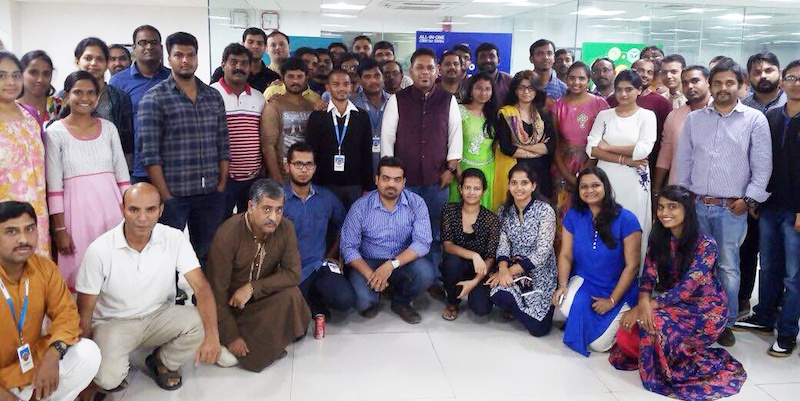
A historical snapshot of a business built from India before adding a Dallas office.
A forecast with a long afterlife
Chapalamadugu’s formal education crossed the same broad geography as his businesses. He earned a bachelor’s at Birla Institute of Technology and Science, Pilani, and a master’s at the State University of New York. His startup work took him through ClickDesk and then Agile CRM. His writing makes the product questions visible beyond the release notes.
In January 2018, he set out six CRM trends for the coming year. AI-powered workflows came first. He also discussed connected devices, consistent customer experiences across channels, mobile access, self-service and social CRM. The central concern was connection: customer software becomes more useful when it can share information with the other systems a business depends on.
The AI argument was specific. Learning from interactions could help software automate actions and reduce manual work for sales and marketing teams. Read alongside the earlier billing integration, this sounds like a larger version of a familiar problem. An employee has information in one place and a task in another. Better software should shorten the journey between them. The forecast preceded his later AI-focused products by several years.
One subscription gets a larger job
The ambition widened again with 500apps. A desktop package published in September 2021 described a suite of more than 30 applications spanning sales, support, development and operations. Its catalog included CRM.io, electronic signatures, a low-code app builder, a helpdesk and ClickDesk. The suite turned several business tasks into a shared purchasing decision.
For Chapalamadugu, the change enlarged the unit of work under consideration. ClickDesk handled a conversation; Agile connected customer-facing functions; 500apps offered tools across more of the company. A bundle has its own demanding logic. Each application needs to be useful, while the subscription has to make sense for a team whose priorities change from week to week.
The suite also returned to phones. In October 2019, 500apps announced PBXPlus, a cloud phone-system product. It offered centralized number management, call forwarding, reporting and automated menus. Chapalamadugu pointed to the expense and dropped calls associated with traditional systems as the motivation. The project brought a recurring concern back into view: a customer trying to reach a business should have a workable route to a person.
The customer may be buying a home
The same career now includes real estate software. GharPe identifies Chapalamadugu as its founder and CEO and describes a platform using 3D property exploration and virtual tours. Homebuyers can inspect a property remotely, while builders receive tools for presenting and managing their projects. The transaction is different from buying a software subscription. Clear information and a dependable response still have work to do.
BuilderPe addresses the other side of that market. Its tools and services cover marketing, sales, communication and property presentation for builders and developers. Its leadership includes engineering cofounder P B Jagadish Naidu Chikkala, strategy director Arief Shaik and regional sales head Vivek Kumar Vangapandu. Chapalamadugu’s move into this field brings his customer-management experience into a more specific commercial setting.
A home tour and a sales pipeline look quite different on a screen. Both become less useful when the person interested in them cannot get the next answer. The connection between these ventures is a practical one: present the information, manage the inquiry and help the work proceed. His newer companies give that sequence a different audience, including businesses in the Indian property market.
Back to the classroom, forward to the agent
Chapalamadugu describes himself as a SaaS founder and a builder at heart. He also describes returning to the classroom after 25 years through a Harvard Business School leadership track, to test his experience as a founder. That is a useful counterpoint to a career spent expanding products. Experience can accumulate; it can also benefit from being examined.
A brief public comment gives his small-business commitment a less formal expression: “We built Agile with love for small businesses.” It is a modest sentence beside the catalogs and customer counts. The emphasis stays on the intended user. His public location remains the Greater Hyderabad Area, connecting a portfolio of international products to the city where much of the building has taken place.
CRM.io’s present chapter puts AI agents into the customer-management workflow. Its company history dates the CRM.io and 500agents chapter to 2025. The advertised agent can create contacts, update deals, schedule tasks and draft outreach. These are concrete chores, familiar to anyone who has ended a productive conversation and then faced the less glamorous task of recording it.
Chapalamadugu is identified there as founder and CEO. The stated goal is to give growing teams access to sales, marketing and automation capabilities while reducing the routine work around them. That promise has moved from an agent answering a chat to software carrying out actions. Whether in a contact record, a telephone menu or a property inquiry, the task begins with someone waiting for a response.
The arc of his career leaves a founder with an unusually consistent question across changing products: what else does the customer need to finish the job? Years ago, the answer was a text box before a phone call. Today it may be an automated follow-up after one. Customers, inconvenient as ever, continue to supply the next item on the brief.