An invitation has a small but unforgiving job. Someone must open it, understand what is happening, and decide whether to come. For a small business, producing that invitation can require an absurd detour through fonts, image sizes and software menus. MAKA built its business around shortening that detour. Its starting point is a familiar occasion: a shop opening, a recruitment drive, a school enrollment campaign. The user brings the particulars. The platform supplies a structure.
- Make H5 pages, posters and marketing graphics from editable templates.
- Use free options, then pay for additional content and capabilities.
- The useful lesson: package the decisions that customers keep repeating.
The invitation comes before the software
In MAKA’s world, “H5” means the mobile web pages used for invitations, promotions and interactive stories. The underlying technology is HTML5; the customer’s ambition is usually more specific. Put the event on a phone. Add the right pictures. Give people something they can share. A business owner does not need a position on web standards to know whether an invitation is late.
The editor, launched in September 2014, offered a way to replace text and pictures, choose animation and publish without programming. By April 2015, TechNode reported 1.7 million users, roughly 80 percent of them enterprise users. Those are historical figures, rather than a current customer count. They nevertheless help explain why an apparently modest creation tool attracted investment: organizations had recurring communication work they could do themselves.
Today, the creation menu resembles a busy merchant’s desk. There are coupons, flyers, product-detail pages, social covers and recruitment materials. Wedding invitations sit within the same broader catalog as enrollment campaigns. These occasions differ emotionally, but share a production problem. The layout is familiar; the names, prices, dates and pictures change. MAKA makes that repetition useful.
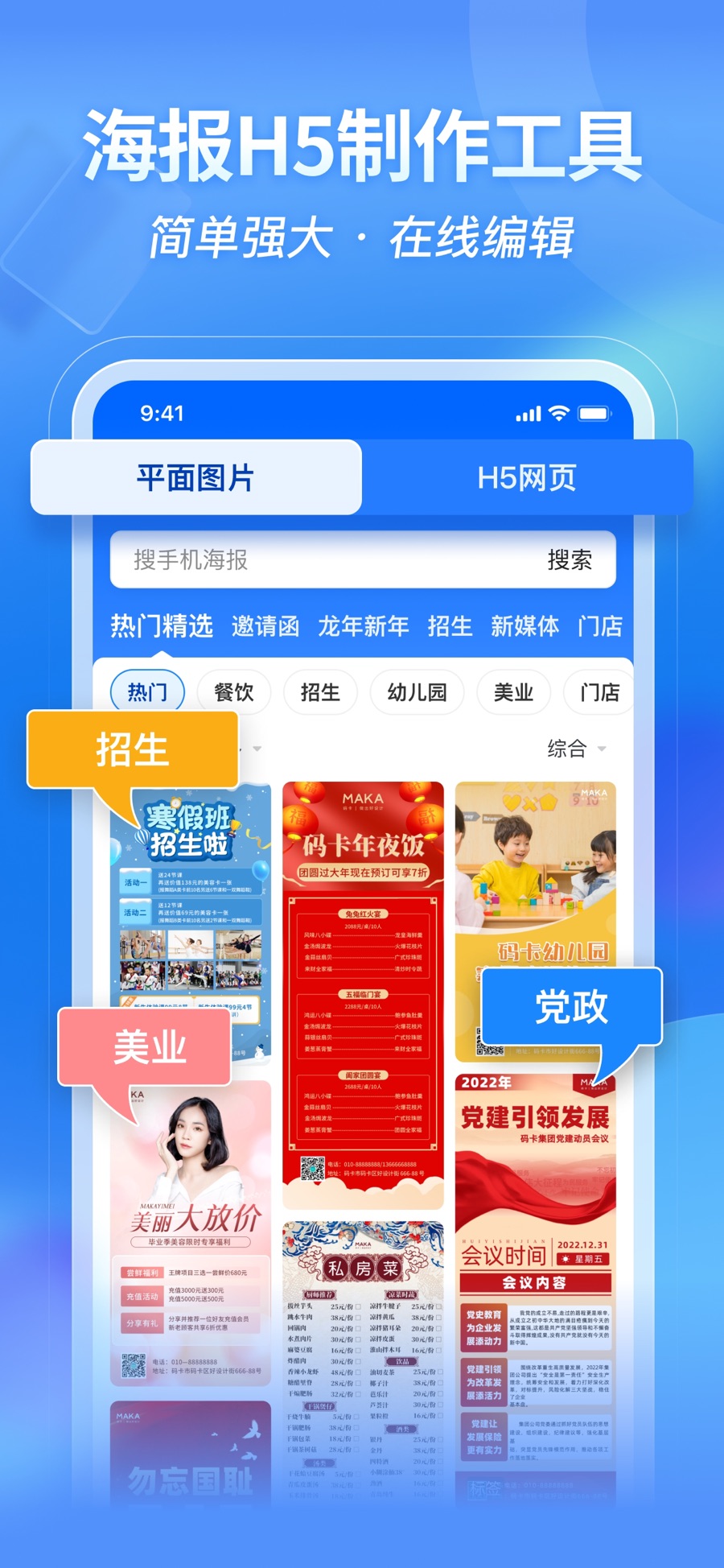
The work behind the shortcut
Founder Ma Yanfei had a choice about what kind of company to build. A 2017 profile describes inquiries for custom campaigns carrying attractive fees. He preferred a standardized product. “We will take the standardized route,” he said, in translation. The distinction matters economically. Custom work earns money each time a team solves another client’s problem. A template can carry one design solution into many subsequent projects.
Standardization still needs taste. MAKA’s marketplace brought professional designers into the process, including a reported recruitment collaboration with the design community Huaban. A novice gets a shortcut because someone else has already considered hierarchy, spacing and visual rhythm. The expertise has moved upstream. It is present before the customer opens the editor.
“We will take the standardized route.”
Ma Yanfei, translated from a 2017 founder profile
The company added its mobile app in 2015 and a long-page creation tool in 2016. Its download page now describes a wider collection spanning H5, graphic design, video and print. That expansion follows the customer’s workload. An event may need a page, a poster and a social cover. Keeping those jobs nearby makes the tool useful beyond one fashionable format.
- 01ChooseStart with the occasion
- 02ReplaceAdd your own details
- 03PublishShare the finished work
- 04ReviewLook at the response
The price of getting it out the door
MAKA combines free creation options with paid memberships. The Chinese App Store listing’s description advertises advanced membership at RMB 68 for a month or RMB 388 for a year. Those are advertised iOS options, not a universal price sheet. The website’s help center tells buyers to check the current plan and export entitlements. For a merchant, the practical calculation includes both the subscription and the time saved producing the next piece.
A sensible first project is a small, real one. Choose a format close to the intended output, replace the sample copy, and preview the result on the phone that will receive it. Check the date and the action you want someone to take. The time-saving test is whether a colleague can repeat that process next week without asking the original creator to explain every choice.
Its marketing ambitions extend past appearance. The app description lists registration, forms, voting, group buying and payment collection among its capabilities. The older company introduction emphasizes propagation data and customer information. These features connect the design to a business question: did anyone respond? A handsome page cannot answer that merely by looking handsome.
MAKA’s recruiting page claims more than 30 million enterprise and individual users. Read that as a company claim about reach, with no stated active-user definition. Its positioning is clearer than the metric: give merchants and organizations tools to create content and maintain customer interaction. The repeat customer has another promotion next week.
There is competition on both sides. Canva China offers templates for visual work; Eqxiu offers H5 creation and marketing interactions. MAKA’s combination of everyday graphics and mobile marketing pages is useful, but the category is crowded. Buyers should compare a real task across tools. Make the invitation, check the mobile result, inspect the export and determine which response data the chosen plan supplies.
The template approach works best when the format repeats and the details change. A distinctive brand identity or unusual interactive experience may still need a designer or developer. Distribution remains work, too. Publishing a page does not supply an audience, and a faster production process does not establish that an offer is persuasive.
For teams considering the same product strategy, the useful question is which choices genuinely recur. Standardize those first. Leave room for the details that make each customer’s message their own. If every request changes the structure, the economics begin to resemble a service business again. The shortcut depends on a substantial part of the job being reusable.
The résumé problem
The shortcut had an organizational complication. In a 2017 talk, cofounder Zhang Yuting described recruiting people with impressive backgrounds, then discovering that credentials did not ensure practical fit. One management integration brought declining efficiency over roughly six weeks; repairing the cultural consequences took another three months, she said. The cost was time spent recovering the team’s ability to work together.
MAKA responded with more deliberate alignment around goals during onboarding. Zhang described checkpoints on days one, three, seven and fourteen, and a preference for people who had independently built things. The lesson readers can copy is specific: agree on the work, the decision process and the expected result before handing someone a large mandate.
That concern runs through MAKA’s product as well. A template is valuable because it makes a sequence of decisions easier to execute. A team needs enough shared understanding to do the same. For the customer, the test remains pleasantly ordinary: can the person who knows the event finish the invitation?

WeChat: maka_2014 · Design tips: H5college