In October 2005, Maeve Hagen’s field hockey team needed a fresh start. Monmouth’s Hawks were 3-12, still chasing a place in the Northeast Conference tournament. A junior defender, she offered a prescription with very little room for theatrics: “We need to start fresh and just take it one game at a time.”
It is an ordinary sporting sentence, which is part of its charm. Nobody was promising to revolutionize field hockey. There was a difficult run behind them, a consequential run ahead, and a group of people who needed to keep playing. Hagen was thinking about the next game. Twenty years later, she would be responsible for an agency whose clients compete for attention during some of sport’s busiest occasions.
The college remark makes an unexpectedly useful introduction to her. Public relations is a profession that sells the big moment. Hagen’s career asks a quieter question: what happens when someone keeps showing up long enough to become responsible for the whole enterprise?
A captain before a corner office
Hagen grew up playing sports in Pennsylvania. At Hershey High School, she earned letters in both field hockey and softball. At Monmouth University, where she studied communications, she played defense and became a team captain. Her biography records 53 starts in 54 appearances across the 2003-2005 seasons. In 2004, she accounted for six of her team’s 14 defensive saves.
These are the numbers of someone regularly asked to hold a position. Defense has its own economy of attention: the work matters most when an opponent threatens to make everybody notice. Yet Hagen also scored, including the overtime winner in a 1-0 victory at Robert Morris in September 2005. Reliability and a decisive intervention can comfortably share a uniform.
The sporting background gives her later work a concrete starting point. Before sports became a client platform, it was a place where she had teammates, a position and a result to answer for. There is a difference between knowing an audience category and having once been on the field yourself.
The promotion took years. The handover took five.
Hagen joined Taylor as an intern in 2006. The agency became the setting for her professional rise, from its New York office to leadership in Charlotte. In 2017, she became president of Taylor Charlotte. Managing partner followed. Then came the announcement on October 29, 2024: she would succeed Tony Signore as CEO on January 1, 2025.
The handover had a long runway. Signore said the succession plan began in 2019. He had been CEO since 2004 and would remain chairman. The change therefore combined a new person in charge with an experienced predecessor still involved. Five years of preparation is a rather substantial answer to the question of who should get the keys.
Hagen’s stated ambition was to keep Taylor adaptable while strengthening strategy, creativity and earned media. That puts a useful tension at the center of the appointment. A long-serving insider knows the institution. The job also asks her to keep changing it. Familiarity supplies context; judgment decides which habits deserve another year.
- 2006Joins Taylor as an intern
- 2017President, Taylor Charlotte
- 2019CEO succession planning begins
- 2025Becomes CEO on January 1
- 2026Joins WISE National Board
Charlotte was a proving ground
The Charlotte presidency is worth pausing over. An office is a practical unit of responsibility. People need decisions, accounts need attention, and growth has to be managed close enough to the work that problems cannot disappear into a slogan. Hagen’s ascent included that intermediate scale before she took responsibility for the agency as a whole.
Her 2017 promotion placed her in charge of the Charlotte office while Mike Costabile became a managing partner in New York. The geography matters to the story: this was a career developing through a regional office inside a wider organization. The route to an agency’s top job did not require her story to remain entirely in its headquarters city.
When the award arrives, thank the squad
Recognition gathered around her before the CEO appointment. In 2024, she was named to PRWeek’s 40 Under 40 and received a PRNEWS Top Women award in the Business Entrepreneurs category. The labels point to professional achievement, but her response to the PRNEWS honor supplied something more revealing than the trophy itself.
She used the occasion to talk about the Taylor team. Individual awards, she wrote, were only part of the picture; colleagues’ contributions deserved recognition. Her language was affectionate and considerably less polished than the average awards announcement. She called them her squad. It sounded like somebody who remembered that a name on a list rarely contains all the names involved.
The economics were present too. Her business development leadership included work overseeing major accounts, including Diageo and Procter & Gamble. Taylor’s 2023 financial results supplied a measure of the agency’s growth. The agency rose 14 percent to $26.4 million that year. Those figures belong to Taylor, and to that year. They give the leadership story a business dimension without turning an agency result into a personal score.
The questions she asks other people
One way to see Hagen at work is to listen to the questions she puts to other executives. On The Taylor Ten, she spoke with Susan Oguche about building a career with purpose and agility. Oguche’s route crossed major brands, a food company and professional basketball. Hagen’s prompts kept returning to the choices behind the résumé.
She asked what connected Oguche’s different roles, what it meant to choose work with purpose, and which leadership skills travelled from one organization to another. These are revealing interests for an executive whose own career has unfolded largely in one place. She was inviting a person with a different route to explain how that route worked.
Their exchange also had a small, pleasing interruption. As Oguche described the underrated value of being easy to work with, Hagen supplied the word “Nice.” A single syllable, briefly rescuing the conversation from the possibility of becoming a competency framework. Professional relationships are still relationships, however many boxes a performance review provides.
A brand has to earn its place in the conversation
Her conversation with Tracy Doyle, Diageo’s senior vice president of Brands in Culture, moved the same curiosity into the marketplace. They discussed how brands participate in cultural moments, understand communities and maintain trust. Hagen pressed on the relationship between trust and purchasing decisions when consumers’ money would not stretch as far.
It is a grounded concern for someone working around sports and entertainment. A cultural moment can attract an enormous crowd; the crowd still consists of people deciding where to spend their attention and money. Her questions make room for both sides of that equation. Excitement is useful. Credibility has to survive after the excitement subsides.
She also brought up the visibility of Wicked’s marketing. The example put a recognizable entertainment phenomenon alongside the more abstract discussion of authenticity. A conversation about culture becomes easier to follow when someone names a piece of culture. For an agency leader, that movement between the broad principle and the actual thing is part of the work.
Opening doors beyond the agency
Hagen co-founded the Charlotte chapter of WISE, Women in Sports and Events, in 2018. Her involvement extended the career beyond client accounts and office leadership into the professional networks through which women find opportunity in the sports business. In 2026, she joined the WISE National Board as a director.
The move from a local chapter to a national board provides another scale change. Here, the institution she helped build was a network of professionals rather than an agency office. Both jobs involve people finding their way through an industry, but the WISE role widens the circle beyond her own employer.
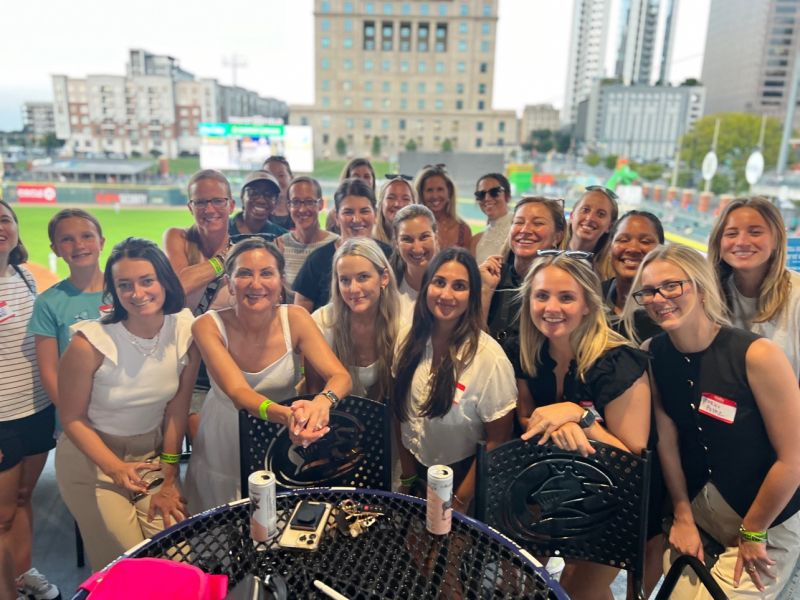
There was a lighter sporting appearance along the way: she threw the first pitch at a Charlotte Knights Women in Sports game. WISE members gathered at the ballpark for the occasion. A professional network can have serious aims and still meet over baseball. The photographs are a welcome reminder that advocacy sometimes comes with stadium seats.
On July 27, 2026, Sports Business Journal included Hagen in its Game Changers class. By then, the arc contained collegiate sport, agency leadership and national board service. The recognition offers a current marker in a career that has continued to add responsibilities after the CEO title arrived.
The next game is somebody else’s opportunity
When she announced her coming CEO transition, Hagen described Taylor as the professional home she had known for nearly 20 years. She thanked Signore, colleagues, clients and partners, and outlined a continuing emphasis on people and new ideas. It was the language of someone taking responsibility for a place with which she already had a long relationship.
That history makes the familiar intern-to-CEO shorthand both useful and incomplete. It captures the distance between two titles. It leaves out the office, the accounts, the colleagues and the succession planning between them. A career can look wonderfully tidy once somebody removes all the years in which it was being lived.
The more interesting part is what such continuity permits next. An agency promotes an intern to chief executive only once in that person’s life. Developing other people is a recurring task. The significance of her appointment will keep unfolding through the opportunities available to colleagues who are earlier in their own careers.
And then there are the chickens
Outside the agency, Hagen lives on a hobby farm with her husband and two boys, with cows, pigs and chickens among the residents. She has described the experience as a lesson in patience, problem-solving and adaptability. An animal is a refreshingly literal stakeholder. It is unlikely to be persuaded by a beautifully arranged presentation.
Her account of leadership has the same practical bent. She emphasizes curiosity, resilience and connection, seeks perspectives outside Taylor, and describes inclusion as something that belongs in hiring, retention and leadership development. The aim she gives her life is helping people recognize possibility. She connects that ambition to mentorship and the opportunities she can help other people see.
That sentence brings the career back to other people. Teammates in a difficult season. Colleagues sharing an award. Women building connections in sports. An executive guest explaining a different path. For Hagen, the public story of advancement keeps accumulating a cast. The CEO title is hers; the next game will require a team.
“It’s to help people see what’s possible.”
Maeve Hagen, on her life mission