An offer of $16 a share arrived. CV Therapeutics turned it down. A few months later, Gilead Sciences agreed to pay $20. For Lou Lange, the company’s chairman and chief executive, the difference was four dollars per share and a rather consequential ending to years of company building. The board unanimously approved the Gilead transaction. On April 17, 2009, the acquisition was complete.
The announced price was approximately $1.4 billion. Such a number tends to swallow the rest of a biography. It offers a convenient climax, a neat valuation, and an invitation to imagine the founder departing into a retirement with excellent weather. Lange’s subsequent career has been considerably more crowded. He advised Gilead, helped establish other companies, invested through Asset Management Ventures, and continued serving academic institutions.
There is another name attached to his work that offers a quieter point of entry: the Louis and Dorothy Lange Professorship in Chemistry at the University of Rochester. Lange established it in memory of his parents. The entrepreneur whose professional history includes public companies and acquisition agreements also made room for two names from his family, in the subject he had studied as an undergraduate.
Those two records belong together. One shows a founder negotiating the fate of a company. The other shows an alumnus supporting the institution where his education began. Between them is a career that has continued well beyond the transaction usually chosen to explain it. The interesting question is what happened after the buyer paid.
Four dollars a share. A different outcome.
A chemistry degree before the corner office
Lange graduated from the University of Rochester in 1970 with a bachelor’s degree in chemistry. He went on to Harvard, where his qualifications included a doctorate in biological chemistry. His early professional life unfolded in academia, including appointments at Harvard and Washington University. He joined the Washington University faculty in 1980 and became a full professor in 1990.
The university years give his later business career a substantial prologue. Before he appeared in the familiar company titles of chairman, chief executive, and founder, he had spent years working inside academic institutions. The sequence matters: the company builder came out of the university. The research background and the executive responsibilities accumulated in the same career, rather than arriving as unrelated entries on a résumé.
By August 1992, Lange was chairman and chief executive of CV Therapeutics. The move placed him in charge of an enterprise headquartered in Palo Alto. In 1996, he led it through an initial public offering. A university appointment and a listed company operate on different calendars, with different constituencies; his career now included both. The public listing became an early business milestone, thirteen years before the sale.
An IPO makes a useful marker because it resists the temptation to compress everything into the exit. There was already a public company to lead in the 1990s. The acquisition came much later. Lange’s story therefore contains a long stretch of operating responsibility between the ceremony of going public and the paperwork of being bought. That stretch deserves its place on the page.
chairman & CEO
offering
Gilead Sciences
An exit with a price attached
Astellas made its $16-per-share proposal privately in November 2008. CV Therapeutics rejected it, and subsequently rejected it again. The dispute supplied a concrete test of what the board considered an acceptable offer. Lange said the company remained “receptive to opportunities to further enhance shareholder value.” It was a sentence with room for another bidder.
In March 2009, that bidder appeared. Gilead offered $20 a share in cash, a quarter more than the Astellas proposal. The comparison is plain arithmetic: four dollars divided by sixteen. For shareholders, the distinction was measurable. For anyone reading the history years later, it helps explain why the sale is more than a large number floating free of the decisions that preceded it.
The agreement used a tender offer followed by a merger. Gilead intended to fund it with cash on hand; the transaction was not conditional on financing. These are prosaic details, but an acquisition ultimately has to become a sequence of actions. Shareholders tender stock. Remaining shares become rights to receive cash. A company that once had its own ticker becomes a subsidiary.
When the agreement was announced, Lange described it as offering “compelling value for our shareholders.” The merger was completed the following month. The transaction furnished a clean ending for CV Therapeutics as an independent company. Lange’s involvement continued: he spent the next decade as a senior adviser to Gilead. The farewell, in practical terms, came with a continuing appointment.
CV Therapeutics’ acquisition by Gilead closed on April 17.
The next company was already waiting
After the sale, Lange’s name appeared among the cofounders of Rapidscan Pharma Solutions. Established in 2010, it brought him together with Brent Blackburn and Dan Spiegelman. Blackburn had previously worked at CV Therapeutics. There is an ordinary human continuity in that detail: the next venture included someone from the previous one. A company can change ownership while professional relationships continue into another enterprise.
The subsequent ventures took different forms. Lange founded Cardiogen Sciences in 2014, working to translate discoveries by Silvia Priori and her team in Pavia, Italy, into a company. Audentes Therapeutics announced its acquisition of Cardiogen in September 2015. In conjunction with the deal, Lange joined the Audentes board, while Priori became a scientific adviser. The company’s change of ownership again came with continuing roles for the people involved.
That sequence also widens the map. Rochester, Harvard, Washington University, and Palo Alto are familiar coordinates in his biography. Pavia introduces a collaboration across the Atlantic. The venture was built around another researcher’s work, with Lange as the founder helping give it an organizational home. The later combination with Audentes added a further company and a different set of resources to the arrangement.
Amygdala Neurosciences, founded in 2015, lists Lange as executive chairman and founder. Its leadership also includes Blackburn. Bitterroot Bio lists him among its cofounders alongside Nick Leeper, Irving Weissman, and John C. Martin. Martin had been Gilead’s chairman and chief executive when the CV Therapeutics agreement was announced. Across these companies, names reappear; the connections are visible without requiring a theory about anybody’s private motives.
Lange is also a general partner at Asset Management Ventures. The title adds investing to the founding and operating work. His board appointments extend the same professional record: NewAmsterdam Pharma, for example, lists his service on its predecessor board from 2021 and on the current company’s board from November 2022. The post-sale years have produced a set of overlapping responsibilities rather than a single replacement job.
Two names that stayed in Rochester
Alongside the businesses runs Lange’s relationship with the University of Rochester. He served as a trustee, and in 2010 received its Distinguished Alumnus Award for the School of Arts and Sciences. Forty years separated that recognition from his undergraduate graduation. The university remained part of his professional life across that interval, even as his work took him into other institutions and companies.
The chemistry professorship carries the names Louis and Dorothy. They were Lange’s parents, and he established the position in their memory. An endowed academic position is a particular form of giving: support attached to a discipline and a place. Here, the discipline was the one on his bachelor’s degree. The family memorial and the academic connection occupy the same line.
Company names tend to travel through mergers, rebrandings, subsidiaries, and acquisition announcements. A professorship belongs to a different register. Its name sits beside teaching and research, and the people it honors need never have been company founders themselves. In Lange’s case, the choice brings his parents into the public record of his university, alongside his own work as an alumnus and trustee.
The contrast gives the biography some welcome texture. The investor’s name can be found in financial documents; the son’s gift can be found in a chemistry department’s history. Neither requires a sentimental reconstruction of a childhood or a claim about what he felt when he signed a check. The documented act is personal enough: he chose his parents’ names, his university, and chemistry.
Louis and Dorothy.
Remembered in chemistry.
Another seat at the table
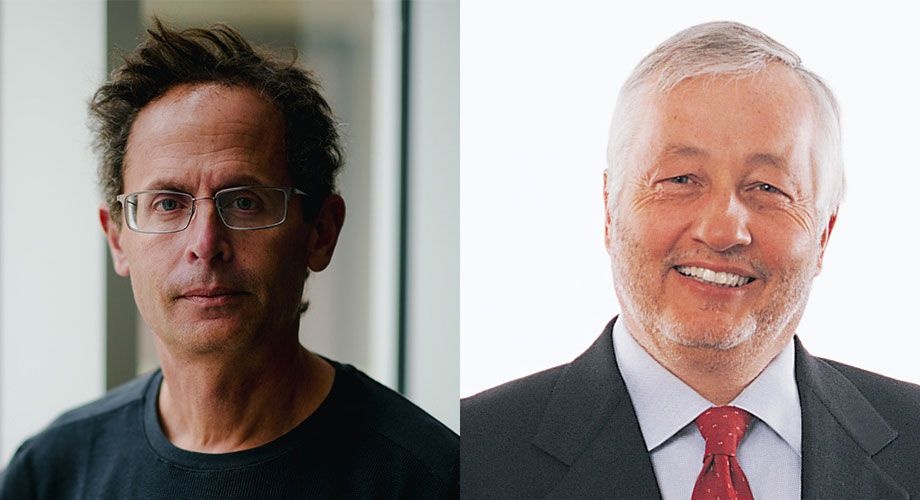
In November 2024, Scripps Research announced that Lange and chemistry professor Benjamin Cravatt had joined its board of directors. The accompanying image places them side by side. They arrived with different careers: Cravatt as a faculty member and company cofounder, Lange with experience in founding, executive leadership, and investment. The announcement brought the academic and business strands of Lange’s biography into the same institutional setting.
His other affiliations have included the Institute of Systems Biology, the Gladstone Foundation at UCSF, and the Biotechnology Innovation Organization. Longwood Fund lists him on its strategic advisory board. These roles place him among researchers, executives, and investors, with advice and governance joining the work of starting companies. A board seat adds a responsibility that continues after a founding announcement has faded.
Bitterroot’s list of cofounders supplies a particularly telling connection to the earlier business chapter. John C. Martin, the executive on the buyer’s side of the 2009 agreement, later appears alongside Lange on the same founding roster. The public record offers a simple sequence: an acquisition, years of advisory work, and another shared company connection. It is a useful reminder that a deal can be followed by further collaboration.
The sale of CV Therapeutics remains the conspicuous event, with its competing offers and cash price. Yet the later entries make the profile more interesting to read. There are new enterprises, continuing colleagues, a return to institutional governance, and a family name preserved through a university gift. Lange’s career kept acquiring appointments after the company had acquired a buyer. The exit was real. So was the work that followed.