A freight shipment is a promise with wheels under it. The customer sees a pickup and a delivery. The operator sees the unruly middle: the quote, the carrier, the dock, the handoff, the weather, the missing document and the phone call nobody planned to make. Lori Stinson spent more than two decades living in that middle. Now she is building a second act around another technology full of promises - artificial intelligence - and her pitch carries the unmistakable accent of someone who knows what happens after a demo ends.
Stinson is the founder of YourAiTeam.ai, an Orange County consultancy for growing service businesses. She is also a GlobalTranz authorized agent owner, a role she began in October 2023 after roughly 21 years as a multiple branch owner in the DSV network. Her resume contains the usual vocabulary of logistics - sales, branch management, transportation solutions, client relationships - but its most useful line may be the duration. Twenty-one years is enough time for fashionable management theories to arrive, acquire acronyms and wander back out. Freight still has to arrive on Tuesday.
That makes Stinson an intriguing participant in the current AI rush. She has entered a young market with an old operator’s suspicion of unnecessary motion. YourAiTeam does not present AI as a digital thunderbolt. Its language is domestic: missed follow-ups, repetitive tasks, disconnected tools, leads that wait too long. These are small failures, the sort that hide in a business until growth gives them compound interest.
The education of an exception handler
Stinson studied business management at California State Polytechnic University-Pomona from 1990 to 1995. Public career accounts place her first in sales and branch management, then as an owner inside the DSV network from November 2001 until June 2023. In freight, ownership is not an abstract title. It means winning the customer and then preserving the customer’s trust while equipment, capacity and timing refuse to behave like tidy cells in a forecast.
Logistics quietly trains a particular kind of mind. Every shipment is a chain of dependencies. Every chain has a weak handoff. Every weak handoff produces an exception. The operator learns to distinguish noise from consequence, to notice when an apparently small delay will become tomorrow’s expensive emergency. The craft is less about worshipping a perfect plan than building a system that can survive imperfect reality.
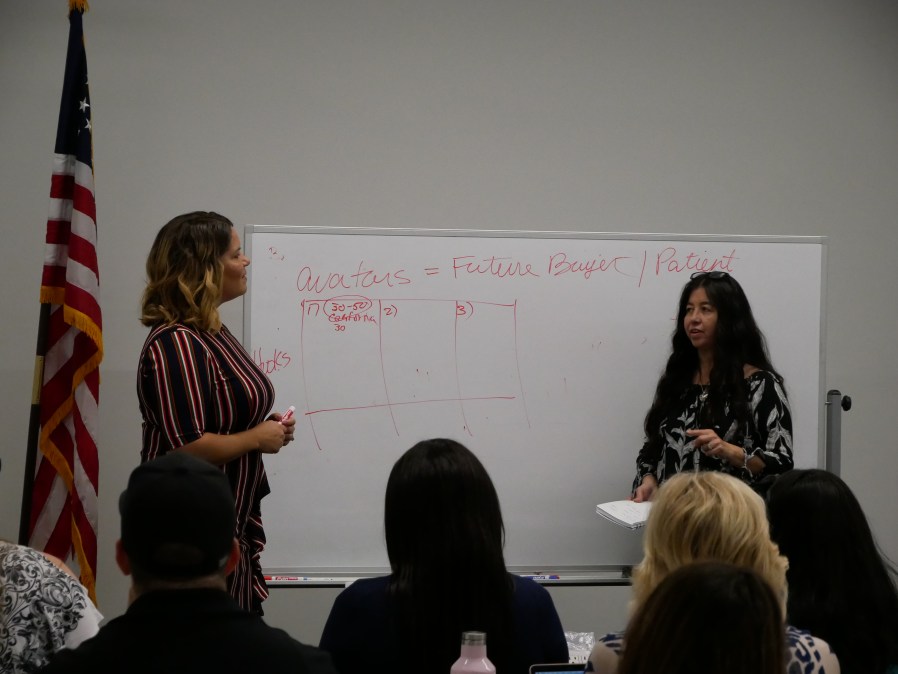
A photograph from a 2019 social media workshop in Austin catches Stinson in front of a whiteboard. She had volunteered for a live analysis of her DSV logistics business. The exercise built avatars for her ideal customers - established companies in California - and considered LinkedIn as a practical place to find them. It is a modest scene, two women and a marker, but it reveals an appetite for translation. Who exactly is the customer? Where do they pay attention? How does a vague ambition become the next useful action?
Those questions survived the career change. In 2023, Stinson moved into ownership within the GlobalTranz authorized agent program. The network handles parcel, less-than-truckload, truckload, managed transportation and cross-border work. It also brings technology and carrier relationships to independent operators. The arrangement sits at a revealing intersection: software supplies reach and visibility; a person still supplies judgment, trust and the call made before a problem grows teeth.
A career built along the handoff
A new company with an old discipline
YourAiTeam packages Stinson’s new work into six areas: strategy consulting, compliance infrastructure, AI employee systems, business automation, GoHighLevel services and custom AI solutions. The menu is broad. Her explanation of it is narrow in the best sense. The company begins by understanding the business and the owner’s goals. Then it recommends, implements and supports. Diagnosis comes before software. Responsibility continues after installation.
The practical automation loop
The sequence looks obvious on paper. Its value lies in how often technology projects reverse it. A tool is purchased, a use case is hunted, and the staff is asked to reorganize life around a license. Stinson’s version starts with the friction already present. A hot inquiry cools while a team is busy. Information is copied between systems. An owner becomes the switchboard because only one person knows where everything lives. These are not glamorous problems. Glamour has ruined many perfectly serviceable budgets.
“After more than two decades helping businesses run better, I’ve learned one thing. AI should make running your business simpler, not more complicated. That’s why every recommendation I make starts with your goals, not the latest technology.”Lori Stinson, founder of YourAiTeam
Her target customer is also specific. YourAiTeam speaks to growing service businesses, including transportation and logistics, staffing, recruiting, real estate, accounting and consulting. These firms sell expertise or execution. Their work passes through inboxes, calendars, customer relationship software, documents and the private memory of experienced employees. The cost of disconnection rarely appears as a dramatic outage. It arrives as a lead answered tomorrow, a task performed twice or a client who must explain the same thing to three people.
Stinson’s logistics background offers a useful metaphor for correcting that. A transportation management system can show where freight is, but visibility alone does not move the trailer. Someone must design the route, choose the carrier, manage the exception and keep the customer informed. AI has the same division of labor. A model can generate, sort or summarize; the business still needs an operating design around it. Who checks? Who approves? Where does the record live? What happens when the confident answer is wrong?
The unfashionable advantage
In March 2026, Stinson added an AI Consultant Certification from AI InnoVision to the longer education provided by operations. YourAiTeam also identifies her as an AI Compliance Architect. The pairing matters. Small businesses are being invited to automate customer communication and internal decisions at the same moment they are being told to think carefully about data, permissions and accountability. The consultant’s job is partly construction and partly restraint.
This is where experience becomes more than biography. Stinson has sat on the sales side, the management side and the ownership side. She has had to make promises legible to customers and executable by teams. That accumulated judgment is difficult to package, which may be why the market so often undervalues it. A new model can be learned. The instinct to ask what breaks at 4:45 on Friday takes longer.
Her public life suggests that she values gathering people as much as arranging systems. Stinson served for a year as the city leader of the Huntington Beach chapter of Gals That Brunch, an international community built around local connection and women’s encouragement. She also lists Spanish at native or bilingual proficiency. Neither fact belongs in a software specification. Both are reminders that implementation is a social act. A workflow changes who speaks, who waits, who knows and who is interrupted.
A useful way to read her career is through one question: does the system reduce the distance between a promise and its fulfillment? Freight provides the blunt version. The load arrives or it does not. Service businesses have softer edges, but customers keep their own clocks. Faster follow-up, connected information and fewer dropped tasks are not technological achievements in isolation. They are kept promises.
There is another lesson in the sequence of her roles. Stinson did not approach AI from outside the work and search for an industry to modernize. She arrived with a catalog of recurring frictions already in hand. Sales had shown her where trust begins. Branch management had shown her how quickly a small process gap becomes a team habit. Ownership had attached cost and consequence to both. That order matters because useful automation depends on knowing which inconvenience is merely annoying and which one quietly governs revenue, service or risk. The person who has answered the customer’s impatient call can often see that distinction faster than the person admiring a dashboard. Stinson’s bet is that this operational memory can guide businesses through a technical transition without asking them to become technology companies themselves.
YourAiTeam is still a young venture, and its public story is being written in real time. The ambition stated on the company’s site is not to give every business more AI. It is to help each business choose the right AI, implement it responsibly and fit it to the way work actually moves. That is a mature sentence in an excitable category.
Stinson’s second act therefore feels less like reinvention than a change of vehicle. The cargo remains coordination. The route runs through customer expectations, messy handoffs and operational calm. Logistics taught her that technology earns its place when people can depend on what happens next. AI will be judged by the same severe, wonderfully ordinary standard.
Follow the work
Explore Stinson’s current company, professional profile and the logistics networks that shaped her operating career.