Good intentions create work. Someone must check the accounts, follow the money, explain the result and make sure that the next person can understand what happened. Before Lorhan Caproni became the co-founder and CEO of BotCity, he helped build an organization around that unfashionable observation. Phomenta worked with nonprofits, volunteers and social investors. Its business involved making worthy ambitions easier to evaluate, support and sustain.
Years later, his customers have a different sort of paperwork. Their employees can ask an AI assistant to write a script, automate a task and produce something useful before the central technology team has even heard about it. Caproni now works on the organizational consequences of that convenience. The distance between a charitable organization in Brazil and a Python program in a corporate office is considerable. The question of who can trust what runs through both.
His career makes more sense when followed through these ordinary complications. There is biology, an education startup, a social enterprise, a developer platform and a move toward enterprise governance. The subjects change. The work keeps bringing him back to the machinery that lets other people do theirs.
An apartment, a pair of biologists, a practical problem
Caproni studied biology at Unicamp, where he and Izadora Mattiello met in 2007. He later pursued postgraduate study in business administration at FGV. Biology and business are an unusual pairing only if one assumes that a university subject comes with instructions for the rest of a life. His next steps took him toward organizations, their incentives and the difficulty of turning an idea into something that works outside a classroom.
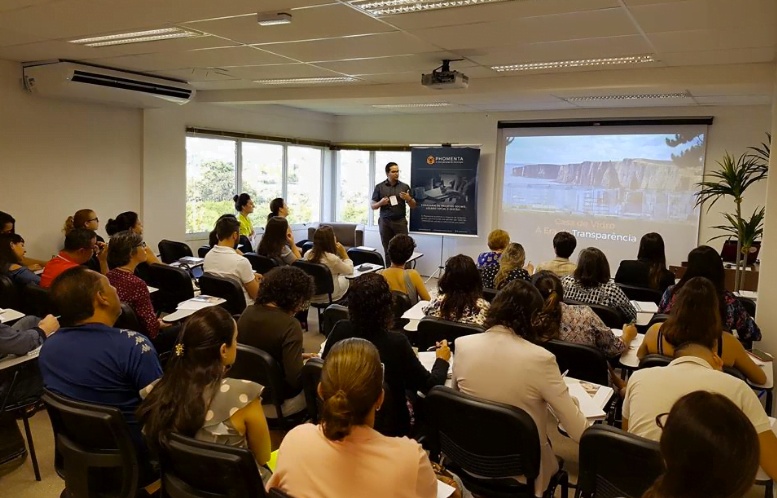
At Geekie, an education startup, he worked around an initiative to bring its platform into public schools with corporate resources. That brought him into contact with social investors. Mattiello, meanwhile, saw nonprofit management problems through volunteering. By 2015, they were developing Phomenta from their apartment in Campinas. The organization grew out of the gap between people willing to help and institutions equipped to make that help effective.
Phomenta’s own account of its beginnings puts those two perspectives together: Mattiello understood difficulties inside nonprofits, while Caproni saw the possibility of greater involvement from companies. Their proposal required both sides to become more legible to each other. An organization needed a workable model. A supporter needed confidence. A volunteer needed somewhere useful to put a particular skill.
Consider the practical challenge in that arrangement. A willing donor and a capable organization can still fail to connect. Each has information the other needs. Someone has to translate between enthusiasm, finances, capacity and expectations. Caproni’s early venture put that translation at the center of a business. The unglamorous details were part of the service.
A founder who wanted the code left open
BotCity’s account dates its beginnings with Caproni and Gabriel Archanjo to 2018. The pair came from different backgrounds. Archanjo brought software development experience and a master’s degree in artificial intelligence; Caproni brought business development and his experience building a previous venture. Their collaboration turned toward the repetitive processes that occupy employees long after everyone agrees they ought to be automated.
The early work involved automation services. Doing that work exposed restrictions in the available tools: licensing costs, limited flexibility and dependence on particular platforms. The founders developed their own approach using open-source programming languages, then made the consequential decision to concentrate on a product rather than continue providing services. In 2021, Hugo Slepicka joined the founding team as BotCity began its US operations from the Bay Area.
The product choice carried a point of view. Developers should be able to use code and retain room to adapt it. A company should be able to oversee the result. Those two requirements create a more interesting design problem than simply asking how quickly a robot can click through a screen. Freedom becomes valuable to an organization when useful work can be repeated, understood and maintained.
A small 2023 example captures the texture of this world. A desktop-automation tutorial published under Caproni’s name walks readers through building a Python bot for Sicalc, a Brazilian tax application. It deals with installation, locating interface elements and filling in a form. There are pop-ups to dismiss. The future, in this instance, has a Continue button.
The tutorial also urges readers to test as they go and understand the process before coding it. That is a revealing emphasis in a field often sold through demonstrations of speed. An automation has to deal with the application that actually exists, including its menus and interruptions. A successful first run is the beginning of the maintenance problem.
San Francisco was part of the job
BotCity joined Y Combinator’s Winter 2022 batch. For Caproni, international expansion also meant confronting a question that a software download cannot answer: where does a founder need to be? The product could travel electronically. The relationships surrounding the company required a different kind of presence.
In discussing international growth with Astella, he described the limits of competing against heavily funded international companies while relying on the Brazilian market alone. Moving to San Francisco helped address US investors’ doubts about the company’s focus on their market. He also described a distributed team working across India, Europe and the Americas, with English as a shared language and time zones shaping hiring.
This makes geography a practical part of his story. Selling across borders involves product distribution, but also conversation, availability and the confidence that a company will remain close to its customers. The founder becomes one of the things that must be moved. A calendar is an unexpectedly important piece of international infrastructure.
He has also made room for a less formal sort of infrastructure. In 2023, Caproni celebrated BotCity’s first San Francisco meetup for RPA and intelligent automation. Rod Johnson, creator of the Spring Framework and a BotCity investor, and Slepicka joined the discussion. Attendees came on a basketball playoff night. The venue was a brewery.
Caproni clearly enjoyed that detail: a technical conversation had found a sociable setting. The post offers a useful counterweight to the language of platforms and enterprise sales. Developer communities consist of people who choose to show up. Sometimes the competition for their attention is an elimination game, and Python has to make its case over a drink.
The future, in this instance, has a Continue button.A desktop detail from the automation business
The spreadsheet acquired a programming language
The phrase near the top of Caproni’s LinkedIn profile is compact: “AI made Python the new Excel macro.” It describes a change in who gets to automate work. A task that once required finding a programmer can now begin with a request typed into an assistant. The resulting code may arrive before its author knows much about running it.
That is the setting for BotCity’s work on shadow automation: scripts and agents created outside the usual oversight of central technology teams. In a September 2025 announcement, the company said it had raised a $12 million Series A led by Four Rivers. Investors included Y Combinator and New Relic founder Lew Cirne. BotCity described the funding as support for expansion and the development of its governance platform.
The appeal is easy to understand at the level of a single employee. A tedious task takes less time. The organizational questions appear when useful shortcuts accumulate. Who owns each one? Which information does it use? What happens after its creator moves to another job? A helpful script can become a dependency without anyone holding a meeting to appoint it.
Caproni’s response is to make those activities visible and manageable while letting people continue building. The ambition connects a programmer’s immediate need to finish a task with an organization’s continuing need to know what happened. Both are reasonable demands. Making them coexist is where the product has to earn its keep.
In October 2025, he discussed this shift with Daniel Chalfon on Astella Playbook, alongside the work of taking a technical company into international markets. Their conversation covered product-led adoption and enterprise selling. The pairing is apt: the person trying a tool and the person approving its wider use may be asking very different questions.
Responsibility, with room to move
Caproni’s interests extend beyond the sales conversation. His Y Combinator biography lists astronomy, science fiction, learning and the scientific method among his enthusiasms. It also identifies BotCity as his second startup after Phomenta. Those details give the career a broader frame than the usual procession of job titles. Curiosity about systems did not begin with enterprise software.
A separate glimpse comes from his own account of listening to Astella Playbook while stuck in traffic on the Bandeirantes highway. He said that, when he first spoke with Chalfon, the hours spent listening made the host feel familiar already. Eventually appearing on the program gave the commute an agreeable sequel. The founder on the microphone had previously been the listener in the car.
His language about responsibility is equally direct. BotCity’s culture page describes a company that trusts people to take responsibility for their roles. Set beside its product philosophy, a pattern emerges: autonomy needs arrangements that make responsibility possible. Trust has to survive the moment when the founder, donor or developer leaves the room.
The connection between Phomenta and BotCity is therefore more than the novelty of a biologist starting a software company. Each venture deals with people who can achieve something useful, and with the organizational work required to support them. At Phomenta, the participants included nonprofits and social investors. At BotCity, they include employees, developers and the teams responsible for their company’s systems.
For Caproni, the next part of the business rests on a question that is almost impolitely simple. Once a useful piece of work exists, can an organization account for it? AI makes creating the work easier. The responsibility travels with it. Somewhere beyond the demonstration, somebody still has to know what the thing is doing.