Lorenss Martinsons has spent an improbable amount of his young life asking systems to reveal their rules. At a linguistics Olympiad, the system might be a language he had never seen. At a physics Olympiad, it could be a floating cylinder or a magnetic field. In a Yale lab, it became human language arriving through noise. At HUD, the San Francisco company he co-founded, it is an AI agent clicking, browsing, reasoning and occasionally making a complete hash of the assignment while sounding serenely competent.
The work looks different at each stop, but the pleasure is consistent: find the hidden structure, build a model of it, then create a test severe enough to expose where the model breaks. Plenty of people in artificial intelligence build things that answer. Martinsons builds part of the machinery that asks, with bureaucratic persistence and scientific intent, whether the answer deserves to count.
His own thumbnail biography resists bureaucracy. He has described himself as interested in “natural intelligence, flowers, and the human condition.” His personal site adds that he is periodically an artist, filmmaker and composer. The combination sounds like a very literary dating profile until one notices that all four interests concern perception: what a mind notices, what it values and what it does next.
Riga, where the puzzles were serious
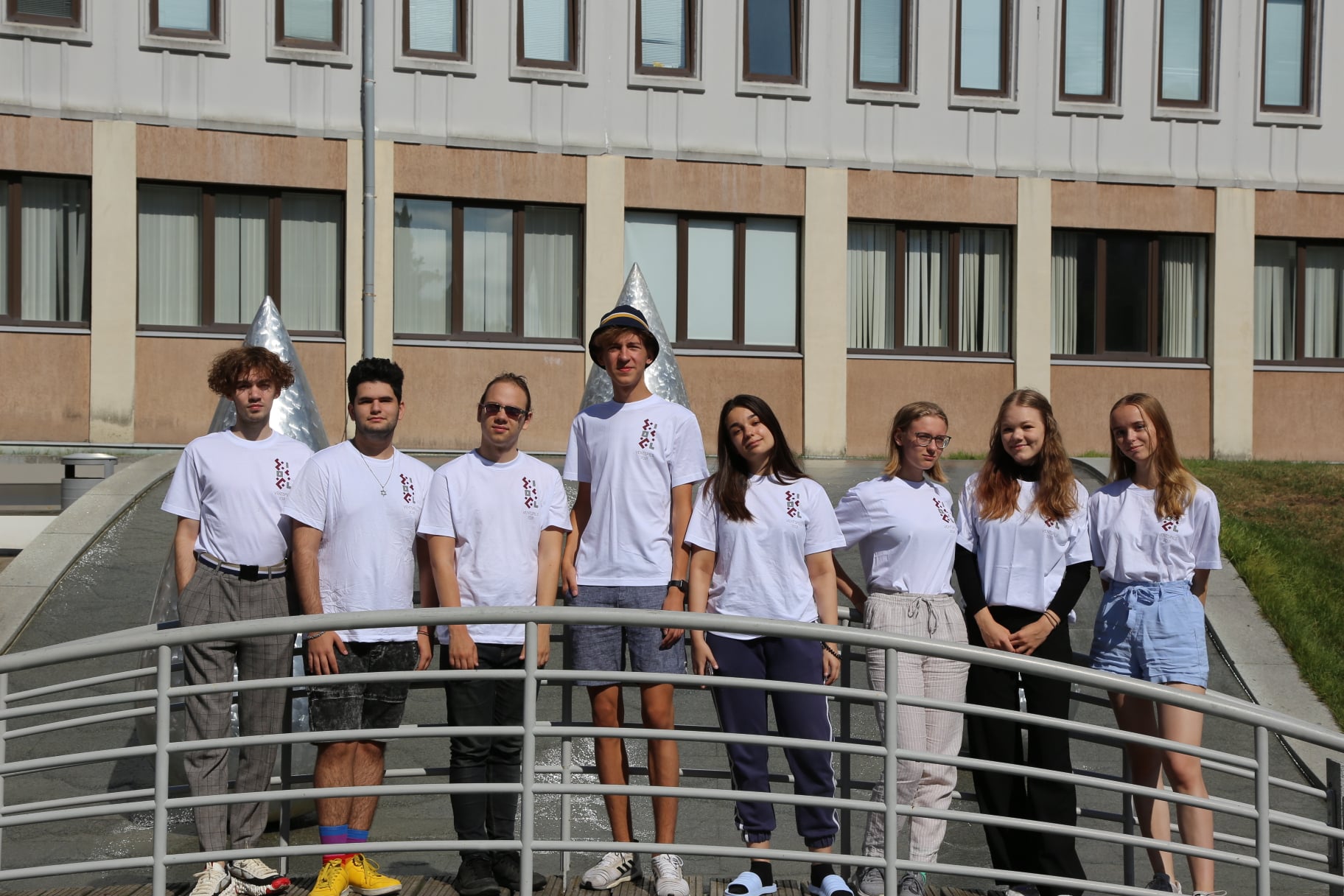
Martinsons came through Riga State Gymnasium No. 1, a Latvian school whose name appears repeatedly in national competition results. His range was conspicuous. In 2022 he won a silver medal for Latvia at the International Linguistics Olympiad and a bronze medal at the International Physics Olympiad. He had already earned an honorable mention at the 2021 linguistics competition and results across Latvian contests in physics, chemistry, mathematics and economics.
At the 2022 European Physics Olympiad in Ljubljana, he and teammate Lukass Roberts Kellijs offered the sort of verdict only a competitor can give after several hours under fluorescent lights: “The theory problems were actually elegant!” Then came the disarming addendum. They had made a few mistakes and realized them later. It is a small quotation, but a useful portrait: aesthetic delight first, honest error accounting immediately afterward.
Competitive linguistics is less about speaking many languages than reverse-engineering an unfamiliar one from sparse evidence. Physics asks for a related discipline of mind: translate the world into a tractable model without simplifying away the thing that matters. Martinsons carried both habits to Yale, where he studied cognitive science and moved between computational linguistics, neuroscience and computer science.
“The theory problems were actually elegant!”Lorenss Martinsons and Lukass Roberts Kellijs, after the 2022 European Physics Olympiad theory exam
A theory of understanding, built in a grid
In Yale’s Cognitive & Neural Computation Lab, Martinsons and collaborators John Muchovej and Ilker Yildirim studied a charmingly human problem: how do we understand someone when their language is noisy? Their test world was deliberately small, a 10-by-10 grid in which an agent moved toward one of four possible goals. An observer received an imperfect verbal account of the movement and had to infer the destination as each fragment arrived.
The resulting model, called the Generative Semantic Transformation Process, combined a causal model of goals and actions with a language model that could produce messy utterances. Instead of treating language as a floating pattern of words, it grounded those words in an agent doing something in a world. The model updated its guess as the sentence unfolded. Comprehension became a live wager on intention.
That grid world feels like an early sketch of his later company. In both cases there is an agent, an environment, a goal and a need to infer whether behavior matches intention. The scale changes dramatically. A research participant follows directions across tiles. A production AI agent opens websites, edits documents, uses tools and stumbles into the real world’s bottomless supply of awkward interfaces. The demand for evidence remains.
His Yale years were busy beyond the lab. At the Yale Computer Society, he became Director of Development and described leading nine software teams with more than 100 developers building student applications. He led MajorAudit, a degree-planning product. He served on the Yale International Students’ Organization tech team. Meanwhile, his portfolio kept accumulating side quests: a node-based logic-gate simulator, a live map for intercity buses, a hand-written machine-learning library and ClaimCap, a live fact-checking pipeline that won the 2024 Baltic AI Hackathon.
The artist in the test harness
There is another branch of the biography that refuses to fit inside the standard machine-learning founder template. Before Yale, Martinsons produced and engineered music for films at K Films. He co-directed, shot, edited and produced music for screen work with Theater Studio KĀPNES. His portfolio credits feature-length soundtracks and more than 100 hours of video editing and color correction.
This is not decorative trivia. Film editing trains attention on sequence, causality and the dangerous confidence of a smooth cut. Music composition makes structure felt before it can be explained. Product design, which he later led during a 2023 internship at Realm AI, asks a similarly difficult question: what should a person understand without being told?
At Hume AI in 2024, Martinsons worked first as an AI alignment research engineering intern, then as an interpretability research engineer. He described work on multimodal models for speech and language, sparse features for audio generation, data-quality pipelines and distributed training. The human voice, full of pitch, texture, implication and error, brought his artistic and scientific interests unusually close together.
A company for productive failure
HUD began in 2025 with Martinsons, Jay Ram and Parth Patel and entered Y Combinator’s Winter 2025 batch. Its early public work focused on evaluations for computer-use and browser-use agents. Martinsons’s January 2025 essay introducing Autonomy described more than 100 tasks spanning documents, browsing, multimedia, processes, products, applications, collaboration, knowledge and games. Expert humans completed more than 98 percent. The best AI agents completed less than 25 percent.
The interesting part was not the cruelty of the exam. Martinsons separated capability into skill, flexibility and intelligence. Skill handles familiar variations. Flexibility orchestrates work in less familiar domains. Intelligence acquires new abilities as helpful prior knowledge approaches zero. Each category points to a different engineering problem. A single score can rank; a diagnostic evaluation can teach.
An evaluation is valuable when failure becomes specific enough to fix.
HUD has since broadened from a benchmark into a platform for building reinforcement-learning environments and post-training datasets. By June 2026, the company said more than 50 businesses were using it to build environments, sell them to AI labs or train models. It announced $16 million in total funding led by Standard Capital, with Y Combinator and other investors participating. The company’s stated mission is to enable “data entrepreneurs,” people who create digital or physical environments that push AI systems toward particular goals.
It is an ambitious economic idea tucked inside an engineering workflow. Define the world. Give the model a job. Specify a verifier. Run the attempt. Preserve the useful failure. Improve the model. The environment becomes both classroom and market stall.
Keeping the human condition in frame
The phrase “align AIs to their specific goals” returns Martinsons to his earliest public research question. A goal is never just a point on a grid. Someone chooses it. Someone decides which behavior counts as progress. Someone writes the verifier and accepts its blind spots. Evaluation is technical work, but it also contains a compact theory of value.
That may be why his interests in natural intelligence and the human condition belong beside the code. Machines do not enter an abstract world. They encounter forms, browsers, spreadsheets, production systems and people who are very particular about what “done” means. Flowers, meanwhile, are permitted to remain flowers. Even an evaluation founder needs one category that does not require a leaderboard.
Martinsons’s story is still near its beginning. The medals, papers, products and funding round are mile markers, not a verdict. The more useful observation is methodological. He keeps crossing disciplines without losing the question that first made the puzzles elegant: what structure produces this behavior, and what evidence would prove the explanation wrong?
AI has no shortage of performances. What it needs are better critics, stages with trapdoors, and judges willing to inspect the landing. Martinsons has been rehearsing for that role from Riga to New Haven to San Francisco, one carefully designed failure at a time.