A library has a peculiar talent for making ignorance look expensive. You can own the right book, shelve it carefully, and still fail to find the paragraph you need. Add another hundred books and the problem acquires better furniture. For a pastor preparing a sermon or a student following a Greek word, possession is only the beginning. The next task is knowing where to look.
Logos has spent decades selling help with that second task. Its Bible study platform puts translations, commentaries, dictionaries, and theological works into a connected research environment. The proposition is practical: give the computer some of the fetching, cross-referencing, and organizing, leaving the reader more time for the passage itself. The company’s history also contains a caution for businesses with enthusiastic customers. Knowing their needs does not mean you should build everything they need.
- The work: Bible study, original-language research, and sermon preparation in a linked library.
- The customers: individual readers, pastors, small-group leaders, scholars, and institutions.
- The bill: subscriptions for current tools; separate purchases for lasting book access.
- The lesson: expertise in a customer’s research does not automatically extend to running the customer’s organization.
01 / THE ORIGINAL COMBINATIONTwo programmers and a publisher problem
In 1992, Bob Pritchett and Kiernon Reiniger, both Microsoft employees, founded Logos Research Systems with Bob’s father, Dale. Bob and Kiernon supplied programming; Dale brought sales, marketing, and publisher relationships. Their first commercial product was Bible software for Windows. It is an unusually revealing division of labor. Software could make the texts useful, but someone had to persuade publishers to put their texts inside it.
The early technical milestones followed the library’s expanding requirements. Logos 2.0 arrived in 1995 with Unicode support. In 2001, the company introduced its Libronix Digital Library System architecture. Logos 3, released in 2006, added reverse interlinear Bibles and syntactic tagging. Those names sound forbidding until you consider the job: connecting what an English reader sees with the original-language words and structures behind it.

02 / UNDER THE BOOK JACKETThe invisible work between the books
Imagine asking about a biblical person whose name appears only occasionally, while the surrounding sentences call him “he.” An exact word search sees the name. A tagged text can connect the pronoun to the person. Logos describes this distinction in its explanation of Research Editions: books receive information about topics, Scripture references, theological concepts, citations, and more, then connect to the platform’s tools.
That work is part of the product. It also explains why every digital book in the store is not equivalent. Research Editions receive extensive treatment; Reader Editions have lighter tagging for reading from beginning to end. Ebooks arrive with still less research enrichment. A buyer comparing prices should ask what kind of book is being purchased, as well as which title is on the cover.
- 01Start with a passageRead a translation. Mark the question that interrupts you.
- 02Follow the linksConsult commentary, cross-references, and language resources.
- 03Make somethingOrganize notes into a paper, sermon, or group discussion.
The useful comparison is with other research environments. Accordance offers original-language analysis and Bible study tools. Olive Tree links study material to the passage being read. Logos’s case rests on how its books, guides, language data, and preparation tools work together. A reader should judge that arrangement against an actual assignment. A long feature list makes a poor substitute for finishing one.
03 / A REPEAT CUSTOMER CALLED SUNDAYThe sermon is due again
For a pastor, the need recurs. Read the passage. Consult the commentary. Investigate a word. Keep the notes. Turn the research into something people can follow. Logos offers Sermon Builder and Sermon Manager alongside its study tools; Bible Study Builder serves discussion preparation. Proclaim handles church presentations, while Verbum provides a Catholic study platform. Courses and digital resources widen the available material without changing the basic work of learning and teaching.
Institutional customers have a different version of the shelf problem. Dallas Theological Seminary needed consistent resources for students across its main campus, extension locations, online study, and language programs. Its committee evaluated software against twelve categories, including platforms, language tools, Chinese and Spanish resources, and training. A campus-wide Logos implementation began in 2014, with a custom library establishing a common starting point for students and faculty.
“We hold firmly to the mission, but the methods can change.”
Mark M. Yarbrough / President, Dallas Theological Seminary
The distinction matters: a personal library serves one person’s curiosity; a shared institutional library also serves a curriculum. In August 2025, Liberty University announced free Logos subscriptions for students and faculty. Its announcement described reading plans already created by its spiritual development office. Here the platform becomes a place where a community can study with common materials.
04 / THE COST OF WANDERINGThe eight-year detour
Under the Faithlife name, the company expanded into church management and related services. In October 2022, then-CEO Vik Rajagopal explained the retreat: after eight years, Faithlife Equip still lacked necessary features, while churches had accelerated their adoption of competing management and giving products during COVID. Development attention was divided. Parts of Equip, including Sites, Live Stream, and core church management, would close on June 30, 2023.
Before the announced retreatDevelopment time cited in the company’s 2022 explanation of the Equip decision.
What failed was the promise of a sufficiently complete ministry platform. The cost included years of work and a difficult customer transition. It suggests a useful discipline: test an adjacent product against your distinctive expertise, not merely your existing customer list.
A later transaction fits the same focus. Baker Publishing Group acquired Lexham Press in September 2025. Logos retained rights to Lexham content within its platform. The company could keep an ingredient of its libraries while another business took responsibility for the publishing operation. This is a more precise arrangement than trying to do every job under one roof.
05 / READ THE SMALL PRINTBuy the books, rent the machinery
On October 21, 2024, Logos launched its new subscription generation: Premium, Pro, and Max. The company framed the change around continuing improvements rather than waiting for another major numbered release. It also acknowledged requests for further simplification, introducing a Get Started wizard and help inside the app. A research tool loses much of its value when the researcher cannot work out how to begin.
A subscription includes access to books, but separately purchased resources follow a different rule: those remain in the customer’s library after cancellation. Subscription-only book access ends. That distinction belongs in any purchase decision. So does Dynamic Pricing, which reduces eligible collections to account for resources already owned, including qualifying books acquired free.
The practical approach is to begin with one real study task and the free app or trial. Choose the reference works that task requires, learn the workflow, and then decide whether more tools earn their place. Someone who only wants to read a daily passage may have little reason to pay for advanced research. Someone comparing translations, preparing regular lessons, or working in Greek and Hebrew has a different calculation.
06 / THE QUESTION RETURNSAn answer still needs a reader
Study Assistant adds conversational discovery to the library. Logos describes answers drawn from its books with citations, plus filters for an author, collection, or individual work. In June 2026, the company brought it into selected study layouts and expanded mobile reading-plan creation. The newer tools bring questions and books closer together.
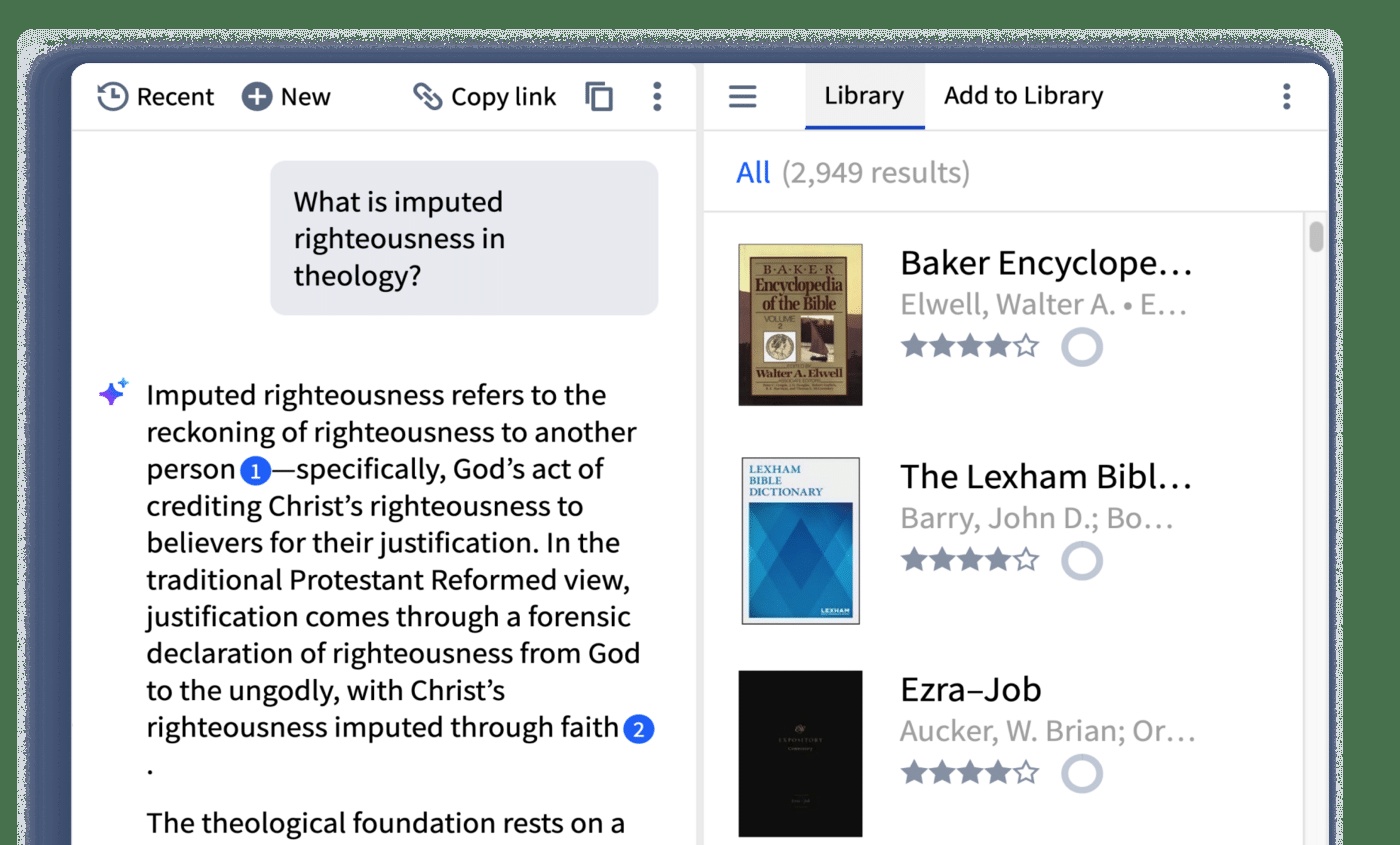
The design offers a concrete habit worth copying: constrain the material, show the references, and make it easy to inspect them. A citation lets the reader test an answer; it does not settle the interpretation. A narrowly selected library will also bring a narrowly selected conversation. The person asking has to notice who is present and who is missing.
Logos reported 76 million study sessions for 2025. A session counts activity, not understanding, but it does illustrate how often the task returns. There is always another passage, another class, another Sunday. The company’s business depends on helping the reader find something worth thinking about when that question arrives.