At McFarlane Law, the trouble could be counted in cheat sheets. Fifteen of them. The Florida insurance-defense firm had rules about what could be billed, who could bill it, and at which rate. Its practice-management system was Aderant; its billing system was Timeslips. Information had to travel between them. The controller, Cindy Halpern-Cohen, sometimes waited until the second or third day of a month to begin billing.
- Litify connects legal work from the first inquiry through billing and reporting.
- Its Salesforce foundation supports workflows configured around a team’s processes.
- The buying decision includes migration, training, and the rules behind the software.
The firm chose Litify, built billing guidance into templates, and automated task assignment. In Litify’s published customer account, billing that previously consumed a month took two weeks. The revealing part is what persuaded the buyer: rules could be applied inside the work itself. A reminder pinned beside the system had become part of the system.
“At first, it was a hard sell.”
Cindy Halpern-Cohen / McFarlane Law controller
That small migration, from cheat sheet to workflow, explains much of Litify’s appeal. Legal teams need documents, deadlines, clients, and money to stay connected. When those connections depend on somebody remembering the next step, good intentions become expensive.
Salesforce, taught to speak legal
Founded in 2016, Litify grew from John Morgan and Reuven Moskowitz’s effort to modernize the business of law. Early co-founder and technology chief Ryan Hallman brought more than a decade of Salesforce experience. The architectural choice was consequential: build legal applications on an established business platform, then adapt that foundation to legal work.
The resulting product follows a matter through its working life. Intake captures an inquiry. Matter plans organize tasks. Documents sit alongside case information. Timekeeping and billing connect activity to revenue. Dashboards make the accumulated data available for operational decisions. Corporate legal teams can also manage legal spending and review outside-counsel invoices.
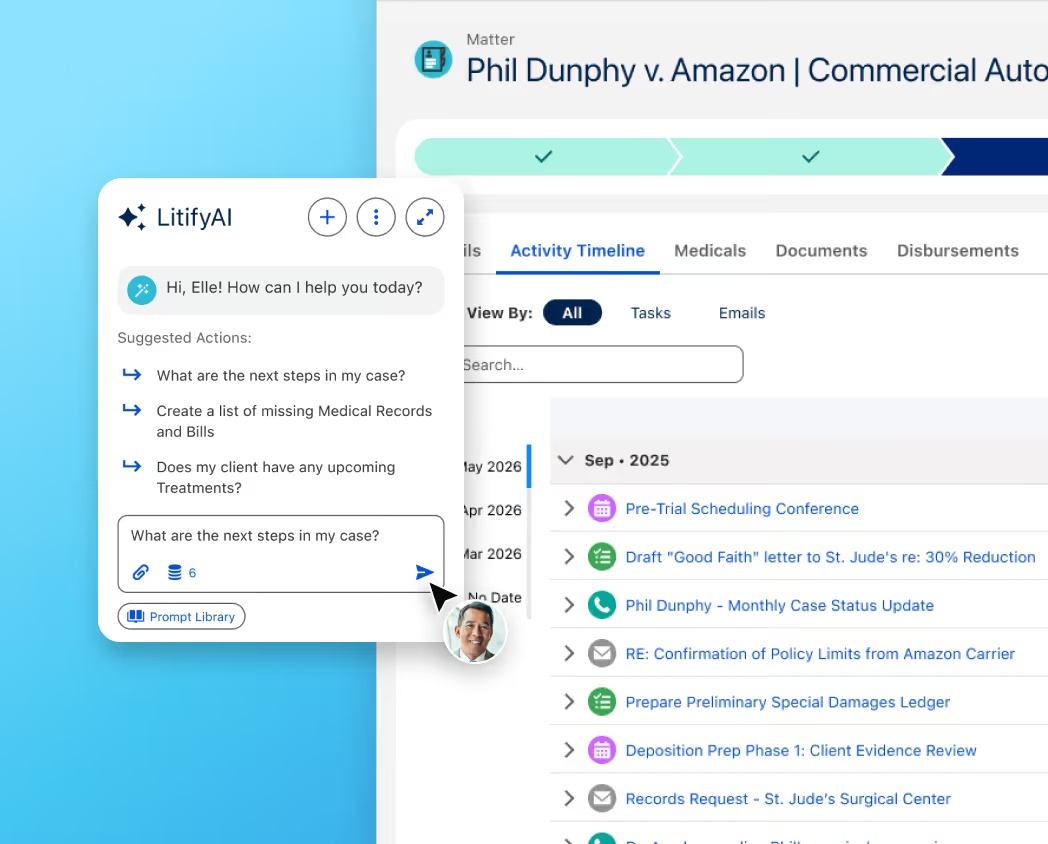
This puts Litify in the legal-operations market alongside case-management and practice-management alternatives such as Filevine, Clio, and Aderant. Its Salesforce architecture gives buyers a particular reason to consider it: workflows and reporting can be configured around an organization. That matters when different teams handle different case types, billing arrangements, and approval chains.
There is a distinction between storing a legal file and running the operation around it. A case-management database can tell you what exists. Litify’s configured matter plans can specify what comes next, who receives the task, and which information belongs in the report. Its expertise lies in translating those recurring legal procedures into software. Buyers should still inspect the exact version of each workflow they intend to use; a feature list cannot describe how their own team will work.
The customer base stretches from plaintiff firms to insurance-defense practices, immigration firms, and corporate departments. Morgan & Morgan and Salesforce are named customers. In August 2026, Litify reported more than 55,000 legal professionals and 450 enterprise clients. Those are different units: people using the software and organizations buying it.

The price is also a project
Litify’s Salesforce AppExchange listing gives a starting price of $200 per user per month, with nonprofit discounts available. At that rate, 25 users would represent $60,000 annually. That arithmetic is an illustration, rather than a complete purchasing quote; the listing also specifies Platform Cloud as a requirement.
25 users × 12 months = $60,000 at the listed starting rate.
Illustrative subscription arithmetic; implementation and final scope require a quote.
Buyers should ask what their proposal includes: platform rights, selected capabilities, migration, training, support, and AI features. Litify’s own services describe implementation, workshops, adoption work, and continuing customization. This is a purchase that asks an organization to participate. Someone must own the decisions about fields, permissions, task sequences, and what gets measured.
For a team with straightforward needs, limited implementation capacity, or little appetite for configuration, that participation may be a poor bargain. A department with repeated reporting demands and distinct approval paths may value the flexibility more. The sensible comparison is the full cost of changing how the team operates against the cost of its current delays. Ask for a demonstration using a representative matter, including the awkward exception that usually sends somebody back to a spreadsheet.
Investors have financed that model. Fortress provided $5 million in 2017; Tiger Global led a $50 million Series A in 2019. Bessemer acquired a majority stake in February 2023, when Litify announced profitability. Curtis Brewer became CEO that August, bringing experience running software businesses in field service and hospitality.
A spreadsheet reaches its limit
At construction company EllisDon, a growing spreadsheet had become awkward to analyze as the business expanded. Its legal team wanted a system that could follow existing processes. In Litify’s customer account, configuring that fit helped users adopt the platform without learning an entirely new workflow.
The striking result concerned loss runs, reports used in insurance underwriting. A process that had taken four days fell to less than an hour, the team said. Centralized information made recurring reports easier to produce and check. This is a customer-reported result for a particular process, rather than a promise about every report.
- 01CaptureThe inquiry
- 02OrganizeThe matter
- 03ApplyThe rules
- 04MeasureThe result
There is a useful buying test here: identify the repeated handoff that consumes time, establish its baseline, and decide who owns it. Then examine whether the proposed configuration removes that delay. Without clear ownership and usable data, an elaborate workflow can simply preserve an elaborate mess.
Now the software takes the next step
Litify’s 2026 product direction builds on that connected record. Its Agentic Case Expert, ACE, launched in March. A September expansion added firm-wide reasoning alongside individual-matter work, plus connections to repositories including iManage, Google Drive, and SharePoint. The company describes agents that surface stalled matters, assign follow-ups, and update records.
On October 20, Litify launched Call Intelligence. It transcribes intake conversations and proposes questionnaire answers linked to transcript passages and timestamped audio. Staff review suggestions before committing accepted answers to the record. That review step makes the proposition concrete: an intake specialist can check what the caller actually said.
Automation still needs judgment about the process it inherits. Taylor King Law’s experience supplies a useful wrinkle. Using Litify, the firm discovered that persistent follow-up could annoy prospective clients. It changed outreach timing with conditional rules. A system becomes useful when it helps a team notice that doing more can accomplish less.
The practical lesson travels beyond law. Pick one handoff. Measure the delay. Put the rule where the decision happens. Check the outcome. Litify’s wager is that enough of those small connections can change how an entire legal business works.