Lisa Matherly keeps an old-fashioned craft close at hand: she makes scrapbooks. The raw material is ordinary life - photographs, fragments, memories from family trips - but the work is editorial. Some details deserve a page. Others need a neighbor. The finished book must make sense to a person who was not there. Matherly has said she wants to pass these books down through generations. Permanence begins with selection.
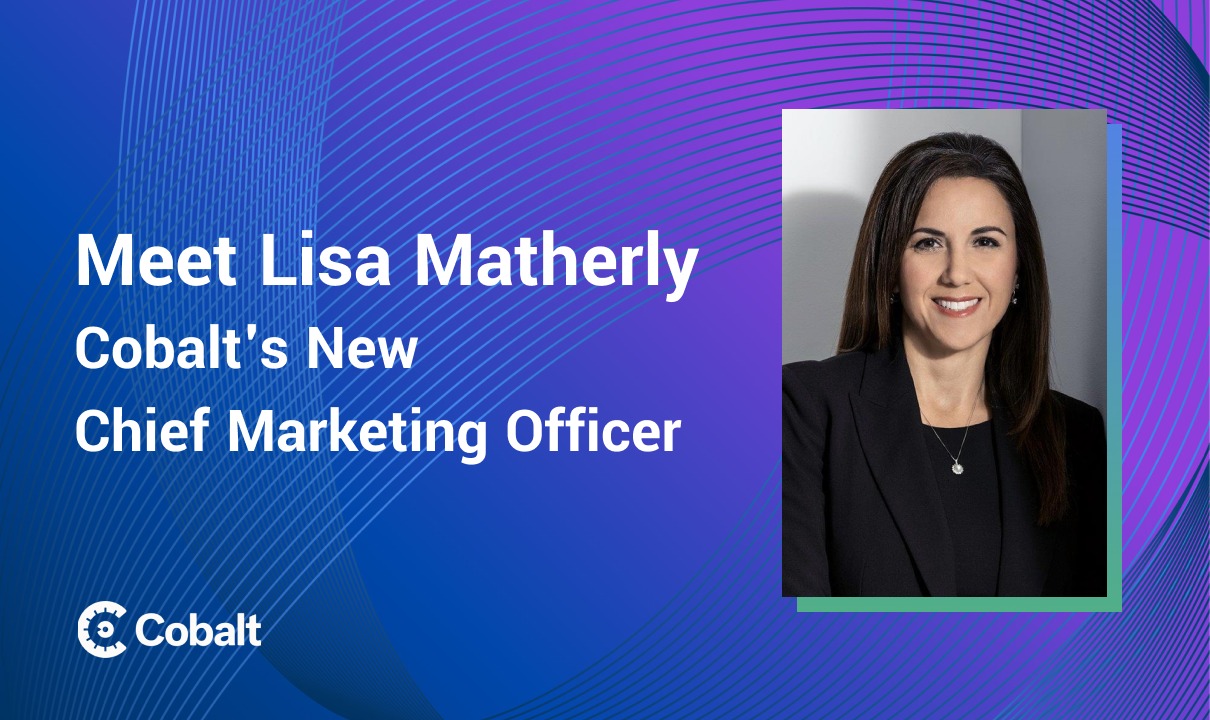
Her professional life requires much the same eye. Cybersecurity arrives as a thicket of products, threats, acronyms and anxieties. A marketing executive has to decide what matters, arrange it honestly and give the reader a reason to stay. Matherly has done that work from several angles: partner programs, marketing operations, content, brand, demand generation and go-to-market strategy. Since 2023, she has done it as chief marketing officer of Cobalt, the offensive-security company known for pentesting as a service.
The customer is her organizing principle. Matherly describes one of marketing's essential jobs as being the customer's voice inside the company. The phrase widens the function beyond campaigns. That voice belongs in corporate strategy and the product roadmap. It should be heard in sales enablement, partner conversations, customer success and support. Promotion is only the visible edge of a much larger job.
“I enjoy being the voice of the customer inside the company.”Lisa Matherly
A Silicon Valley apprenticeship in complexity
Matherly was born and raised in San Jose. She studied business administration and marketing at San Jose State University, where she was part of Alpha Phi's Beta Psi chapter. The geography of her early career reads like a compact history of enterprise technology. She worked at 3Com, then joined McAfee in 2002. Intel acquired McAfee years later, and her titles moved across the combined organization as her remit expanded.
By 2012, she was McAfee's vice president of marketing operations and partner marketing. The following year, she was responsible for worldwide partner programs and marketing. One project distilled the work: eight different partner sites became one integrated portal with a single sign-on. It is not the sort of achievement that begs for a billboard. It is the sort that users notice when the irritation disappears.
Channel work also gave Matherly an early education in shared authorship. A vendor can design a program, but partners meet the customer in markets and moments the vendor cannot fully control. Her public comments from that period favored practical enablement: help partners identify where they could compete, equip sales teams with more prescriptive tools, and ground campaigns in research about the security buyer's real concerns. The brand might be centrally owned. Its usefulness had to survive a long journey through other people's hands.
CRN placed her in its Women of the Channel Power 100 in 2013, then again in 2014, 2015 and 2016. She also served on the Women of the Channel advisory board. In 2014, Alpha Phi gave her its Ursa Major Award, which recognizes professional or volunteer achievement beyond the fraternity. The awards describe influence, but her stated ambition was more personal: she wanted people to look back and say she had made a positive, valuable and lasting impact.
Partner marketing
Operations, channels, content
SaaS brand and go-to-market
Global marketing
Teaching before selling
In 2016, Matherly moved from worldwide partner programs, marketing and operations to lead content marketing at Intel Security. A colleague later credited her with creating McAfee's first content marketing group. The change was not fashion chasing. Enterprise buyers were changing their habits. They researched long before talking to a vendor, and McAfee was too often missing from that private phase of the decision.
Matherly's response was educational. The company studied what security buyers cared about, then created work that helped them understand threats and possible responses. Some readers wanted a short social post. Others wanted an article, a technical brief or a white paper. The format followed the appetite. The aim was useful understanding, not content for content's sake.
This was also a subtle repositioning of authority. A security brand does not earn trust merely by knowing more than the buyer. It earns trust by making the buyer more capable. Matherly argued for research that addressed the broader security market, not only McAfee's existing customers. Good education travels farther than a product sheet because it remains valuable even before a purchase is imaginable.
The productive tensions in Matherly's work
She calls marketing both art and science. That formulation can sound ceremonial until one looks at her path. Operations gave her the plumbing: process, systems and measurement. Partner work taught her that distribution is a relationship, not a pipe. Content demanded judgment about language and attention. Brand work asked all of those disciplines to agree on a promise.
The company with an unusual invitation
Before Cobalt, Matherly led marketing at [24]7.ai, where she worked on the brand and go-to-market transformation of a SaaS business in conversational AI and contact-center automation. When Cobalt recruited her in 2023, the product opportunity mattered, but the company's language about people caught her first.
One value said, in effect, that everyone's opinion mattered. It aligned with what she calls recognition: seeing the value of each person and making sure the members of a team have a voice. Cobalt's then-CEO, Chris Manton-Jones, introduced her by emphasizing authenticity, open communication and collaborative leadership. Then he supplied the detail no corporate biography should be without: she used to drive race cars.
The racing detail is tempting because the metaphors turn up without being invited. Cobalt values quality at speed. Security teams need faster testing without careless results. Marketing must move while keeping the story on the track. Yet Matherly's public remarks suggest that pace alone does not impress her. Direction, trust and the people making the calls matter more.
Her initial Cobalt agenda was concrete: give the team confidence in where the company was going, build a multi-segment portfolio strategy, strengthen enterprise go-to-market work, listen to customers and reconnect with the channel community. She also saw three pressures converging. Cloud adoption demanded security woven through development. Smaller businesses were becoming richer targets. The talent shortage made on-demand expertise increasingly practical.
The role made her responsible for an unusually broad collection of rooms: analyst relations, communications, product marketing, demand generation, brand and partners across a global team. The list matters because coherence is hardest when many specialists are each doing sensible work. A portfolio strategy has to give those specialists a common destination without sanding away their expertise. Her first promise to the team was confidence about where the organization was going. Confidence, in this usage, did not mean certainty about every turn. It meant enough shared direction to take the next one together.
“I recognize everyone's value as a human being.”Lisa Matherly
Humans, machines and the next lap
By 2024, Matherly was representing Cobalt in briefings at the RSA Conference and helping extend its channel reach through a Middle East distribution partnership. In 2025, she wrote regularly about customer recognition, offensive-security strategy and the peculiar community ritual of RSAC, a conference she has attended across much of her cybersecurity career.
Then AI accelerated the argument. Software could be produced faster. Attackers could automate more of their work. A quarterly test could age quickly against a continuously changing application. In July 2026, Cobalt launched Autonomous Pentest and repositioned its brand around continuous offensive security. Matherly's explanation avoided the easiest binary. The future, she wrote, was human expertise amplified by AI.
The distinction is central. Automation can increase frequency and coverage; expert direction supplies context, skepticism and creative adversarial reasoning. Cobalt placed experienced pentesters in charge of engagements while its system handled prediction, prioritization and sequencing. The machine could move quickly. A person remained responsible for where it went.
It is also a tidy expression of Matherly's career-long preferences. She resists lonely nouns. Art travels with science. Speed answers to quality. Direct routes coexist with channels. Technology is most persuasive when joined to people who understand the problem. Even the customer voice is plural, assembled from research, conversations, partners and support rather than invented in a conference room.
The record she is making
Outside work, Matherly has described a life with her husband and three children in the city where she grew up. She likes hosting friends and family, finding local places to eat and heading to the beach. She calls the camping version “glamping,” a parenthesis with better pillows. When she joined Cobalt, wakesurfing was the newest thing she was trying to learn.
And there are the scrapbooks, an antidote to the infinite scroll. They make her aspirations physical. A positive and lasting impact is difficult to measure in the moment; a book made for the next generation accepts the delay. Page by page, it says that attention was paid.
Cybersecurity marketing rarely presents itself as a memory practice. Its calendar is dominated by the new: the next threat, the next release, the next AI capability. Matherly's work offers a useful counterweight. Listen long enough to know what should endure. Explain it well enough that another person can act. Move quickly, certainly, but keep a human hand near the wheel and a place at the table for the person you hope to serve.