The last unit of a coffee grinder is sitting in a warehouse. It is also, apparently, sitting on Amazon, eBay, Walmart and the retailer's own site. Four shoppers can see it. Only one can own it. The moment one shopper presses Buy, a small administrative storm begins: reserve the stock, suppress the other listings, decide which location should ship, choose a carrier, print the right paperwork and send tracking back to the storefront. The customer sees a confirmation screen. The retailer sees a relay race between databases.
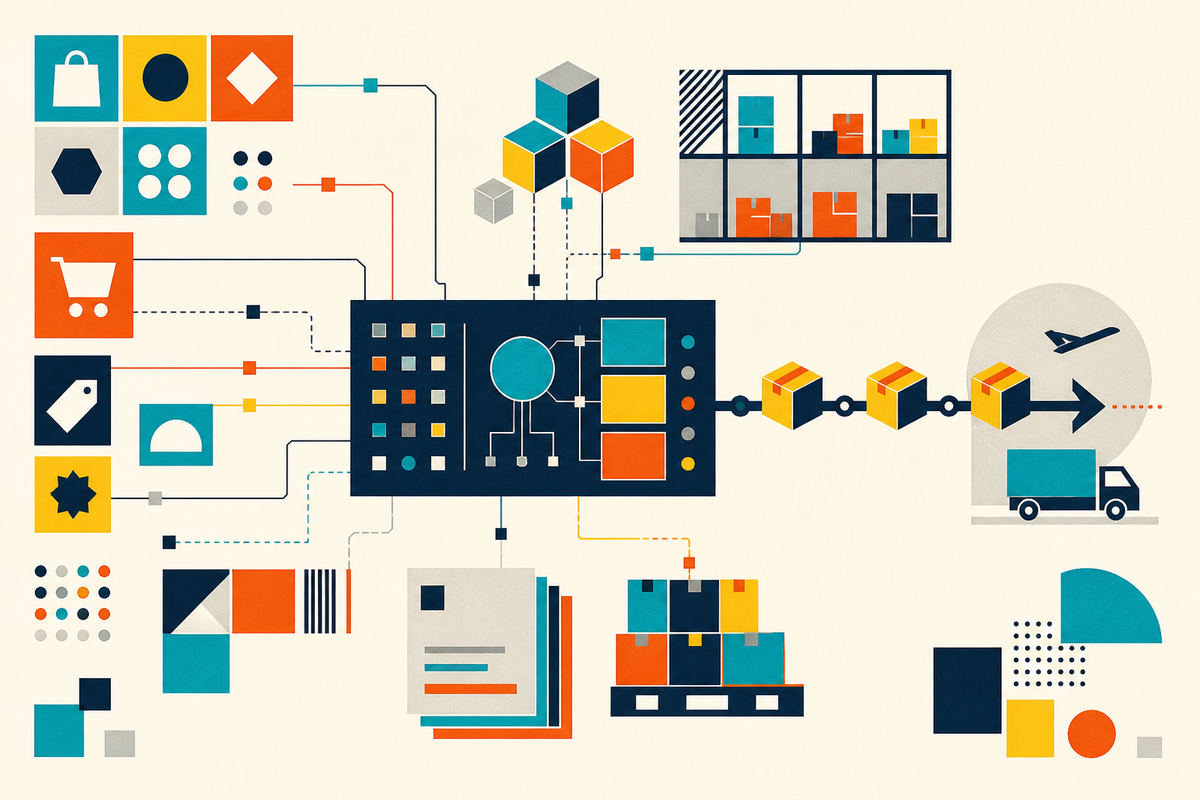
Linnworks exists to keep the baton from falling. The privately held British software company describes its product as a connected commerce-operations platform. In plainer English, it is the control room between the places where goods are sold and the places where goods are stored. Inventory, orders, product listings, warehouse work and shipping sit in one system, with rules handling the routine decisions.
That location in the stack matters. Shopify and marketplaces make a shop visible. Carriers move the parcel. An ERP may keep the financial books. Linnworks handles the frantic middle - the operational promise that what was advertised can actually be found, packed and dispatched. It is enterprise plumbing disguised as a dashboard.
Born beside the label printer
The company's origin is refreshingly specific. Fedor Dzjuba and Jegor Possashkov were online sellers before they were software founders. An early account of Linn Systems says they started working together in 2003 after encountering the limitations of multichannel retail themselves. Linnworks uses 2005 as its official founding date. Dzjuba has since recalled a side business on eBay and the practical urge to automate its labels and repetitive chores.
That history explains the product's temperament. Linnworks did not begin as a grand theory about the future of retail. It began with the sort of job that consumes three minutes, fifty times a day. Over time, the desktop tool became a cloud platform. Offices opened in Chichester and Tallinn in 2013; the company hired its first American employee in 2018. Marlin Equity Partners made a majority growth investment in 2021, with the amount undisclosed.
A year later, Linnworks combined with Louisville-based SkuVault. The match joined Linnworks' multichannel order and stock-control strengths with SkuVault's deeper inventory, warehouse and third-party logistics tools. SkuVault remains a North America-only product, while the broader Linnworks operation has offices in the UK, Estonia and the United States.
The company now lists 201 to 500 employees on LinkedIn and is led by Jon Bahl, who became chief executive in September 2025. Its named customers range from ambitious specialists such as Rave Coffee and Source BMX to Ford, Turtle Wax and European distributor Spreetail. That variety gives away the target market: businesses large enough to suffer from multichannel complexity, but still looking for a focused commerce layer rather than rebuilding every operation around a heavyweight ERP.
One sale, five decisions
The core product, Linnworks Advanced, collects orders from connected channels and keeps a shared inventory record. Its rules engine can filter an order, assign a warehouse, select a shipping service, split a shipment or flag special handling without requiring code. Listing tools push product data and price changes to marketplaces in bulk. Warehouse modules govern locations, scanning, picking and packing. Forecasting looks backward at sales to inform purchasing and replenishment.
The value is not any one box. Plenty of products print labels or count stock. Linnworks' argument is that the boxes should share context. If the same platform knows the available quantity, channel promise, fulfillment location and carrier rule, a sale can trigger a coherent sequence instead of a chain of exports and human checks. Its open API and app ecosystem acknowledge that no retailer will keep absolutely everything inside one vendor.
“Once Linnworks came in, we started expanding to thousands of orders per day.”Phil Wright, HomeScapes
Customer examples make the problem tangible. Linnworks says Rave Coffee handled a 100 percent rise in orders, Turtle Wax grew direct-to-consumer sales sevenfold in under two years, and HomeScapes moved beyond 2,000 daily orders. These are vendor case studies, not controlled experiments, but the pattern is consistent: the platform is purchased when growth has made manual coordination expensive.
The new assistant watches the clicks
Spotlight AI, launched in January 2026, is the company's most notable recent addition. It does not try to converse like a general chatbot. It studies activity inside Linnworks, spots frequently repeated manual actions, and recommends rules to automate them. Early recommendations covered shipping-service assignments, order identifiers and folders; the scope later expanded toward locations and fulfillment choices.
This is AI deployed as an operations observer. Linnworks says retailers average 15,000 manual actions a month and that customers implementing Spotlight recommendations save 52 hours a month on average. Dynergy, one highlighted user, reported eliminating 98 percent of selected manual tasks and reclaiming 28 hours monthly. Those figures are company-reported, but the design is worth noticing: the software points to a repeated behavior, estimates its cost and shows the user how to convert it into a rule.
Point tool
Solves one sharp job
Usually cheaper and quicker to adopt, but another database must keep pace as channels and locations multiply.
Linnworks approach
Shares one operational truth
Orders, stock, listings, warehouses and shipping inherit the same data and automation logic.
The price of fewer fires
Linnworks is a business-to-business subscription company with a sales-led buying process. Packages are priced by monthly order volume, with overages if a retailer exceeds its allowance. Listing and warehouse modules are additional monthly charges tied to order volume; forecasting is sold for a flat fee. The company also recommends a separately priced onboarding project. Core public list prices are not displayed.
That model positions Linnworks above the casual seller. Veeqo can appeal to Amazon-centered merchants with free shipping and inventory tools. Brightpearl and Cin7 combine broader retail or inventory functions. Rithum, formerly ChannelAdvisor, competes for enterprise marketplace operations. Sellercloud, ShipStation, Pipe17 and Extensiv overlap at different points. A retailer choosing among them is really deciding where it wants the center of gravity: shipping, accounting, marketplace reach, warehouse depth or a connected operational suite.
Linnworks' distinction is breadth within the commerce workflow. It offers native listing management and direct 3PL connections alongside order, inventory, warehouse, shipping, analytics and forecasting. That can reduce integration seams, but breadth also brings configuration. Rules need business logic; stock data needs discipline; onboarding needs time. The company's own marketing says customers are typically live in about 40 days. This is not an app-store impulse purchase.
For the right customer, the arithmetic is less about software seats than avoided exceptions. An oversold item can mean a cancellation, a marketplace penalty and an unhappy buyer. A badly chosen carrier can erase margin. A stale listing can trap cash in stock that appears unavailable. None of these failures looks dramatic in isolation. At thousands of orders, they become an operating model. Linnworks sells consistency at that scale.
It also sells optionality. A brand can add a marketplace without inventing a second way to count stock. A distributor can route work among warehouses instead of treating each site as a separate business. A 3PL can connect a client's orders to the physical routines of picking and packing. Managers get channel-level reporting; developers get low-level APIs; warehouse teams get the next task. The shared record is the product's real center.
There are limits to the all-in-one pitch. Implementation cannot repair poor product data by itself. Forecasts cannot predict every viral spike. Automation rules can faithfully repeat a bad decision if nobody reviews the logic. And a platform connected to dozens of outside services inherits their outages and policy changes. Linnworks can reduce operational fragmentation; it cannot repeal retail.
Software as permanent maintenance
A glance at the August 2026 release notes shows why this market resists a finished product. Amazon changed title limits. eBay standardized apparel sizes. Walmart Canada moved to a new API. Carriers rebranded services. US consumer-product imports acquired electronic filing requirements. Every external platform can change the shape of the pipe, and retailers still expect orders to flow through it.
This is where Linnworks fits best in the market: not as a destination shoppers visit, but as a continuously maintained translation layer. It connects marketplace demand to the practical constraints of shelves, labor, cut-off times and customs forms. Partnerships with Shippo add shipping reach; Conjura adds profitability analytics; agency and developer partners adapt the system to individual businesses. ISO 27001 certification addresses the less visible requirement that the operational data moving through the platform be managed securely.
The culture described by Linnworks mirrors the product's methodical job: collaborative, curious, flexible and focused on customer outcomes. Careers material talks about authenticity, employee input, development and volunteering days. Its stated mission is to make commerce easier for all. The phrase is broad. The product earns it in narrow increments - one accurate count, one avoided duplicate sale, one order that selects its own route.
The useful promise is not that commerce becomes simple. It is that the complexity stops demanding a human witness every time.YesPress
That may be the most defensible way to understand Linnworks after two decades. It is a company built around operational attention. Retailers buy it because people should not spend the day reconciling tabs, copying tracking codes or remembering which carrier handles which parcel. The customer at the front sees a clean Buy button. Linnworks makes a living from everything the button leaves unsaid.