The ordinary obituary has a structural problem: it asks one person, on the worst week of their life, to summarize somebody who contained multitudes. LifeWeb 360 made a different bet. No one person knows the whole person, so the page should be built by the crowd - the cousin with the camping story, the colleague with the office nickname, the neighbor who remembers the runaway dog.
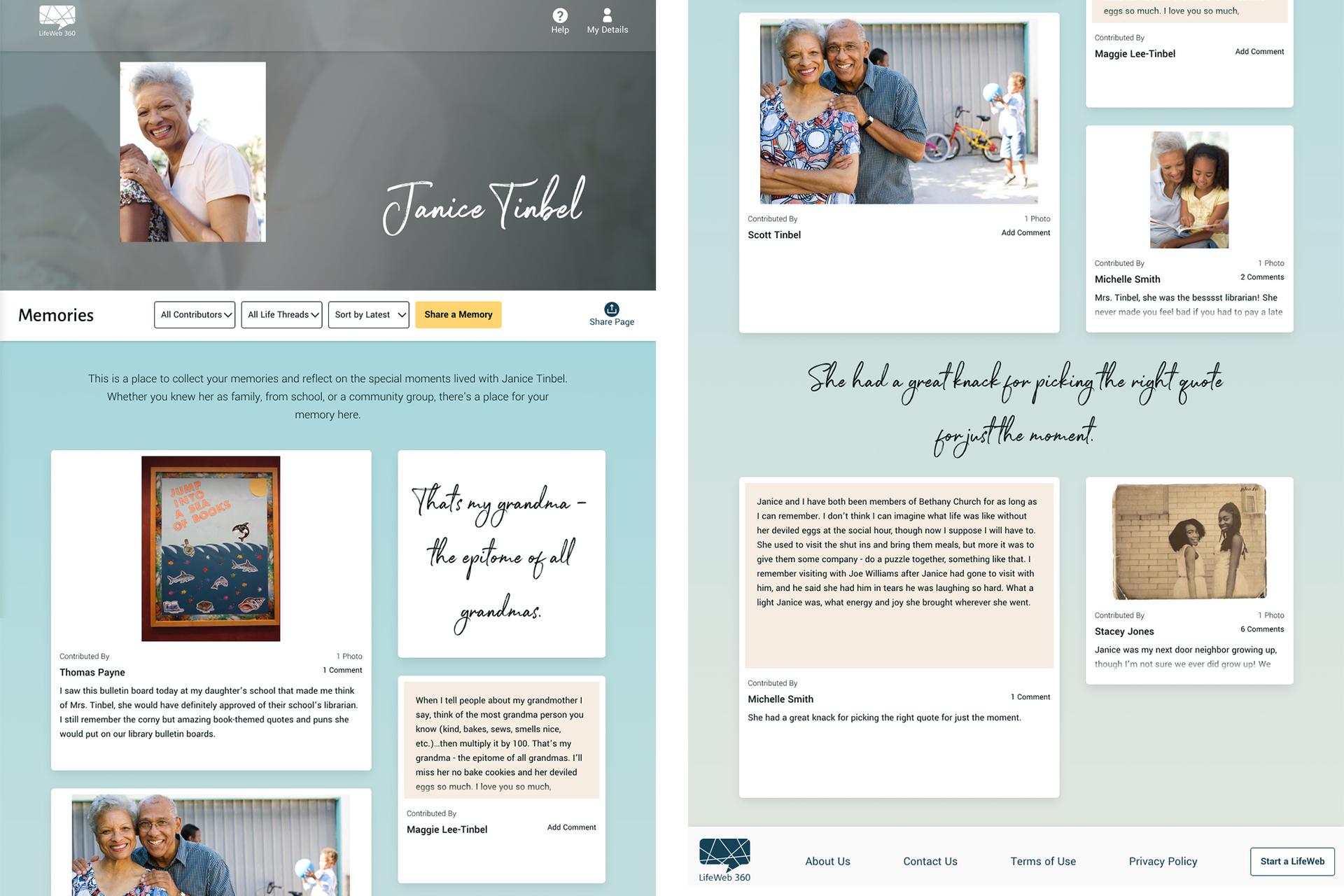
The Chicago company turned those fragments into a collaborative memorial scrapbook. Friends and relatives could contribute text, photos, and video links; an organizer could keep the page public or invite-only, pin favorite entries, and sort them into “Life Threads” such as family, friendship, work, or a private obsession. A short “memory highlight” pulled a good line out of a longer contribution. Instead of a notice that said somebody died, the interface tried to show how they occupied a room.
It was consumer social software stripped of the usual vanity machinery. There were no influencers to chase, and no infinite feed in search of an argument. Founder Ali Briggs once described it as “more like art than social media.” That is close. The product’s job was to assemble a portrait, then get out of the way.
01 / The originA class project with an unusually personal brief
Briggs, a former management consultant and Google operator, met architect Rachele Louis at Northwestern University’s Kellogg School of Management. Their original class project grew from a friend’s fear that memories of his late older brother would disappear. The founders had complementary instincts: Briggs brought operations and strategy; Louis, who had trained in architecture, brought a maker’s eye and a concern for how a space feels. They graduated in 2019 and kept building.
Then the pandemic wrecked the rituals around death. Funerals were postponed, travel was impossible, and a room that should have been crowded had a laptop in it. LifeWeb 360 published virtual-wake guidance and offered direct support. A family could create a page quickly, invite the scattered community, and collect material before it vanished into text threads, group email, Facebook posts, Google Photos, and shoeboxes. The team even invited families to forward condolence emails for staff to add on their behalf - an unscalable gesture, perhaps, but an excellent lesson in where users get stuck.
Friends and family can share things that remind you how your person lived.LifeWeb 360’s recurring product promise, condensed
02 / The businessFree memory, paid continuation
The early model was legible. In 2020, a LifeWeb was free to create, and collected memories could remain online. After an initial three-month collection period, adding more started at $35 a year. A designed physical scrapbook began at $100. Slideshows and more hands-on support created additional paid layers. It was sensible freemium: remove friction in the urgent moment, then charge for continued collection or a tangible artifact.
But grief is a difficult subscription category. Need is intense and unpredictable. The person who benefits may not be the person willing to organize or pay. Families are exhausted, contribution spikes early, and “use it every day” is the wrong success metric. Public evidence does not show that the consumer experience failed. The later strategy does show that consumer retention was not the only hill worth climbing.
The change was to keep the contributor experience but alter the buyer. Schools, faith groups, nonprofits, professional associations, and fraternities already had communities, records, communications teams, and an obligation to acknowledge deaths well. They also had a chronic engagement problem: members often heard from headquarters mainly when headquarters wanted money.
Family tribute
One organizer, an urgent event, scattered memories, optional paid keepsake.
Community system
An institution, recurring life events, member records, branded communication, long-term stewardship.
03 / The proofThe memorial email that beat the fundraising email
Alpha Phi Omega supplied the clearest evidence. The national service fraternity has more than 500,000 initiated members and strong chapter-level bonds, but, like many associations, struggled to keep older alumni close. LifeWeb 360 digitized the in-memoriam section of its magazine into a branded site, built tribute pages, and sent personalized notices to brothers whose college years overlapped with the member who had died.
The message did not begin with a capital campaign. It brought news people cared about, offered a place to read an obituary, and invited them to contribute. The reported numbers make most membership marketers stare at their dashboards: a 53.5 percent open rate against APO’s typical 42 percent; a 25.5 percent overall click rate against 11 percent; and only a 0.31 percent unsubscribe rate across more than 3,000 delivered emails.
The side effects were as valuable as the clicks. In ten months, community reporting surfaced 161 deceased brothers APO headquarters had not known about. That meant cleaner records, fewer mailers sent to dead members, and less risk of a painful solicitation reaching a family. More than 300 unique brothers visited in an average month, and more than 40 memories arrived in the first quarter.
Donation behavior moved too. Half of the alumni in the case study who both received a LifeWeb email and later gave to an appeal had not donated for at least three years. A tribute button also encouraged gifts in someone’s honor. The useful principle is not “use death to fundraise,” which would be ghoulish. It is the opposite: serve the relationship before monetizing the relationship.

04 / The exitThe product narrowed. The mission did not.
LifeWeb 360 joined Techstars Chicago in 2023 after earlier support associated with Google for Startups, TechRise Chicago, Prota Ventures, and Kid Venture Capital. In 2024 it entered Blackbaud’s Social Good Startup Accelerator. Public databases disagree on total capital - a familiar irritation with small private companies - but the disclosed checks were modest. This was not a blitzscaling story. It was a tiny team refining an emotionally specific tool until a strategic owner saw where it fit.
HistoryIT acquired LifeWeb 360 in late 2025 and announced the deal on February 24, 2026. The buyer had spent 15 years digitizing and organizing institutional history. The combined product, MemoryPort, applies that archival discipline to history happening now: branded commemoration sites, searchable community contributions, and opt-in updates for people-centered organizations.
The shift came with a real tradeoff. MemoryPort is organization-focused, and LifeWeb 360 no longer offers a free product for new individual users. The gentler consumer service found a home inside a more durable institutional package, but families arriving alone lost the original front door. An acquisition can preserve a product idea without preserving every product promise.
05 / The stealWhat another builder can copy
Borrow the mechanics, not the mourning.
- Ask for one small story. “Write the whole biography” is work; “tell us the time she…” is an invitation.
- Turn fragments into an artifact. Tags, highlights, curation, and books made contributions feel cumulative rather than disposable.
- Give before asking. APO’s memorial message earned attention because the first value flowed toward the member.
- Watch the administrator. The person cleaning records and coordinating outreach may reveal the actual buyer.
- Measure second-order value. Clicks mattered, but newly reported deaths, corrected data, renewed affinity, and safer communication mattered too.
LifeWeb 360 also shows where the pattern breaks. It will not work when an organization lacks trust, accurate identity data, staff willing to review sensitive material, or a genuine duty of care toward the people being commemorated. Personalization based on bad records becomes creepy. A donation prompt placed too close to grief becomes extraction. Public-by-default pages can violate family expectations. And no interface compensates for a community that has no real relationships to activate.
Permission, moderation, thoughtful timing, durable data stewardship, and an existing community bond. Remove any two and the same engagement loop can feel invasive rather than humane.
The company’s enduring insight is almost embarrassingly simple: a community is not its mailing list. It is the stories people carry about one another. LifeWeb 360 found a way to collect those stories at the moment they were most likely to be told, then discovered that the collection could help an institution behave more like a community. MemoryPort is the business-shaped continuation of that idea.
There is a final product lesson in the name change. “LifeWeb” described the emotional object a family could make; “MemoryPort” describes infrastructure an organization can operate. One sounds like a keepsake, the other like a system. The journey between them is the whole company story: begin with the human ritual, locate the repeatable workflow underneath it, and make sure the workflow never flattens the humans who gave it meaning.