The trouble with a successful fair is that everyone remembers the crowd. The entrepreneur remembers something else: what sold, what stayed on the table, and whether there is enough money to make another batch. Feira Preta’s history turns on that difference. A festival can make a business visible for a weekend. Keeping it alive requires attention to the less photogenic parts of commerce.
- A cultural fair grew into an ecosystem for Black entrepreneurship.
- Training, shared production spaces and sales channels tackle different parts of the same problem.
- Sponsorship losses showed that a busy marketplace can still have a fragile organizer.
First, give the creators a place to sell
Adriana Barbosa founded Feira Preta in São Paulo in 2002. Its starting proposition joined Black cultural expression with a place for Black entrepreneurs to sell. Fashion, food, music and design could share an audience. The person enjoying the culture could also become the person buying the work.
Over time, the initiative developed into PretaHub, a platform supporting entrepreneurship. Current pages increasingly use Feira Preta as the wider brand. The names overlap because the work expanded: the festival remains a public meeting point, while acceleration programs, physical spaces and research operate beyond its gates.
That expansion matters. A maker can have an attractive product and still lack equipment, business advice or a route to customers. Feira Preta’s particular expertise lies in bringing these needs into the same discussion, with Black cultural identity treated as part of the product’s value.
The empty space that changed the plan
Barbosa described a painful turning point to the British Council. An edition expected to attract 15,000 to 20,000 people brought fewer than 4,000. The organization suffered a financial collapse. Project-by-project fundraising offered too little continuity across the year. Gathering the initiatives under PretaHub became part of the restructuring.
“Fracassamos, quebramos financeiramente.”Adriana Barbosa, recalling the attendance shortfall. “We failed; we broke financially.”
There was a problem at the stalls, too. Entrepreneurs selling similar goods competed for the same buyers. The response included widening aesthetic references, improving products, and working on pricing and customer service. The market needed more than extra foot traffic.
Here is the useful lesson for someone building an entrepreneur program: start with the bottleneck you can observe. If sellers need better differentiation, another invitation to exhibit may simply reproduce the old result. Training should change what happens at the table.
Between the idea and the invoice
Feira Preta Cria, formerly Afrolab, launched in 2018. Its methodology was developed with the British Council and Coventry University. The program combines self-knowledge and business management with individual mentoring, workshops and educational resources. Marketing, sales, finance and management sit alongside the question of what a founder wants to create.
Different editions have served different groups. A women-focused version ran between 2019 and 2021; 2022 included a track for LGBTQIAP+ participants. These are concrete choices about who gets support, rather than an assumption that every founder needs the same classroom.
- 01CreateDevelop the offer
- 02ProduceAccess tools and space
- 03DistributeFind routes to market
- 04ConsumeMeet the customer
A BrazilFoundation-backed project in 2023 made the approach tangible: support for 50 Black-owned creative-economy businesses, covering product development, financial sustainability, technology and networks of mentors and customers. Financial investment was planned for five selected businesses. Participation and investment were separate steps.
The production problem has a physical answer. Embaixada Preta, formerly associated with the Casa PretaHub name, lists spaces in São Paulo and Cachoeira, Bahia. Its facilities include audio, photo and video studios, coworking, kitchens and a shop. Workshops and cultural activities share the premises. For a creative business, a kitchen or recording room can be the missing piece between an idea and a sellable product.

A crowded festival, counted carefully
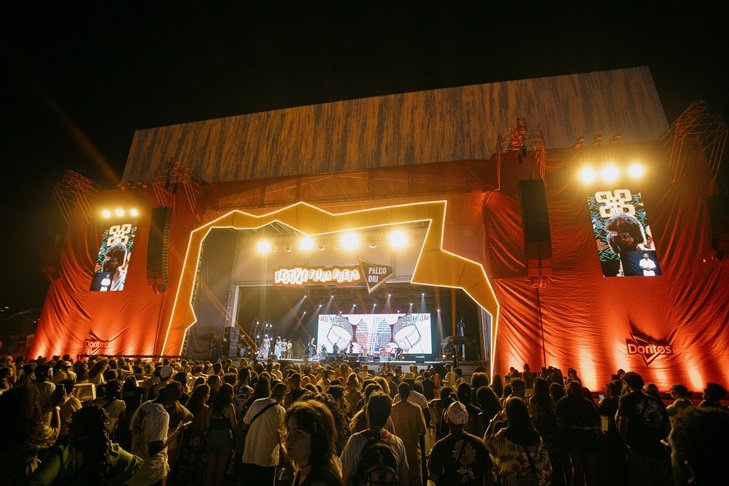
At Ibirapuera in May 2024, the festival brought together more than 150 entrepreneurs and more than 60,000 visitors, according to partner Mercado Livre. Its report puts vendor business at R$1.4 million, within more than R$7.7 million of total economic movement. These numbers describe different things. Neither should be casually presented as Feira Preta’s revenue.
The partnership extended the selling window. Selected fashion entrepreneurs received training and seed capital, presented collections at the festival and sold through an online Feira Preta store on Mercado Livre. The sequence is worth copying: develop the offer, put it before customers, then preserve a way to buy after the event.
Other services address the institutional side of the market. Feira Preta Inteligência publishes research on Black consumers and entrepreneurship; its 2025 regional study involved CAF and Plano CDE. Bioma Comunicação Ancestral connects communications professionals from historically marginalized groups with organizations, combining talent mapping and training. Companies and institutions therefore enter the ecosystem as partners, research audiences and potential buyers of expertise.
This puts Feira Preta in an unusual position within the support market. A general business course can teach financial management; a marketplace can supply a checkout; a festival producer can assemble an audience. Feira Preta connects those functions through a community and a cultural point of view. The attraction is the relationship between the parts.
That is also a useful way to judge the offer. A founder seeking equipment should look at the spaces. Someone struggling to price or develop an offer should examine the training. A brand trying to understand consumers has a different reason to approach the research work. Calling all of this an ecosystem is only helpful if people can identify the door they need. The practical test is whether the next connection helps them make, sell or sustain their work in the weeks that follow.
When the money changed direction
That breadth did not make the festival immune to sponsorship decisions. In 2025, the São Paulo edition was postponed. Barbosa told IstoÉ Dinheiro that corporate attention had shifted toward climate initiatives. Salvador offered institutional backing and relief on venue costs; she also described rising infrastructure costs in São Paulo.
The funding model draws on partnerships, sponsorship and institutional support, with public cultural-financing mechanisms and ticketed activities also in the picture. A model like this needs reliable commitments and workable production costs. Strong demand from visitors cannot substitute for those conditions.
By May 2026, the festival had reached Rio’s Pequena África. EL PAÍS reported more than 30,000 visitors. The format had moved again, while the central task remained recognizable: connect Black creative work with economic opportunity.
For entrepreneurs, the practical next step is to explore the relevant program or space and check its current intake. For organizers, the harder lesson is to budget for the months between celebrations. The crowd leaves. The business still needs somewhere to go on Monday.