A degree can travel thousands of miles without acquiring a single useful introduction. This is the small inconvenience hidden inside the grand phrase “international talent.” A graduate knows what they studied. An employer knows whom it needs. Between them sit unfamiliar companies, inconvenient time zones and a question no transcript answers: would these two actually work well together?
- Chinese employers meet overseas professionals, students and returning graduates.
- Recruiting combines online discovery with local search, campus outreach and interviews.
- The useful lesson: settle the role and the location before widening the search.
A degree travels. A network needs introductions.
Liepin Overseas occupies that space between qualifications and introductions. Established in Boston in 2016, it extends the Chinese Liepin recruiting platform’s connections into international labour markets. Its work includes executive search, overseas campus recruitment, employer promotion and recruitment process outsourcing. The candidates include experienced professionals as well as students preparing to enter work or return to China. That combination gives it a particular assignment: explain employers to candidates, and candidates to employers, across borders.
The distinction matters. A job board can publish a vacancy almost anywhere. Getting the right person to consider it requires another kind of work. Liepin Overseas advertises local recruiting knowledge, coordination across time zones and support through the hiring process. Its niche is especially relevant to Chinese enterprises seeking international staff and employers seeking overseas-trained returnees. A vacancy may be written in two languages and still need an interpreter of expectations.
Three days, three campuses
In October 2016, the company’s North American recruiting tour offered a wonderfully literal solution to distance. Go to the candidates. The itinerary was Harvard on October 21, the University of Pennsylvania on October 22 and New York University on October 23. Chinese employers could present opportunities in person rather than wait for overseas graduates to discover an unfamiliar name in a search result.
The surrounding program also included concerts and music masterclasses. Recruiting had acquired a cultural itinerary. The amusing detail points to a serious difficulty: an employer well known in China may need an introduction in America. A campus event supplies a place, a date and people who can answer questions. It turns a distant organisation into a conversation. That is an editorial reading of the method, rather than a claim that a concert caused a hire.
The invitation is only the beginning
A 2018 chamber report gives the work some texture. For the Chengdu Tianfu overseas talent tour, roughly 2,500 candidates were invited to events in Boston and New York. About 1,000 resumes arrived; 350 people attended. The Chinese-language account recorded more than 100 offers for senior or hard-to-fill roles. Offers, of course, are a stage in recruitment, rather than proof that everyone started work.
The same report describes a Detroit event organised for GAC’s research centre and automotive business, attended by more than 300 candidates. These examples reveal a service business built around particular employers and talent needs. The company arranges a meeting with a purpose. Employers buy assistance reaching people; candidates gain access to employers whose opportunities might otherwise be difficult to assess from abroad.


The vacancy that needed a better explanation
The revealing difficulty appears in a later Liepin group report published in February 2025. An unnamed pharmaceutical contract-development and manufacturing employer sought overseas graduates. The initial job descriptions were vague, priority vacancies were unclear, and few candidates were interested in Wuxi. The team clarified responsibilities and hiring needs with HR, explained the location’s appeal and focused on candidates from Jiangsu and Anhui. It reported recommending 128 resumes.
Here is the copyable lesson: fix the brief before buying more attention. A recruiter needs to know which position matters, what the person will do and why someone would move. An international search makes those questions more urgent. It also sets a condition on the method’s usefulness: broader exposure cannot compensate for a role or location that candidates do not want. In that case, the employer has work to do before the recruiter does.
A global search still begins with a specific job in a specific place.
THE EDITORIAL TAKE
What the employer is buying
Liepin Overseas’s own recruiter job description reads like a list of the tasks that disappear behind “talent acquisition”: analyse requirements, search, screen, interview, prepare candidate recommendations, coordinate meetings, assist salary discussions and background checks, then follow the candidate’s progress. The expertise lies in these transitions. Finding a name is useful; helping both parties reach an informed decision is the larger assignment.
Its model combines employer-facing recruitment assignments and campaigns with career-support products for candidates. Public materials advertise resume help, interview coaching and consultation; some event participation and online guidance have been offered free. Employers should ask for an itemised proposal covering delivery, assessment and follow-up. Paid search can make sense for a scarce specialist or cross-border team. For an ordinary local vacancy, direct outreach or a local job board may be sufficient.
Bring the decision-maker closer
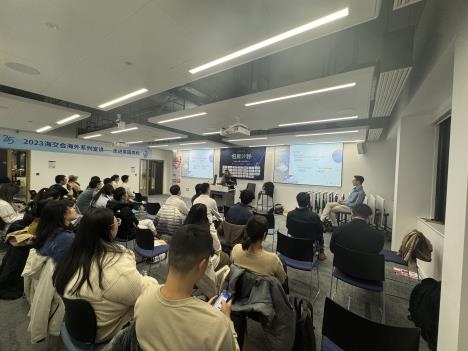
The 2019 autumn Guiyan Plan announced campus visits across Australia, Singapore, the United States, Japan and Britain. Its promise was familiar: bring employers and overseas candidates together. A later example makes the mechanism tangible. In November 2023, ACROBiosystems presented at University College London; the group report records student-community promotion, targeted campus emails and career-centre outreach, with more than 50 attendees. The photograph shows the result: an employer and potential applicants sharing a classroom.
LinkedIn, international search firms and university career centres all offer ways to discover talent. Liepin Overseas brings a China-facing employer network and managed recruiting to the task. For a candidate, that means another route to relevant opportunities. For an employer, it means help making an unfamiliar opportunity legible. The practical test is whether the introductions lead to suitable candidates, clear decisions and accepted offers. A crowded room is a pleasant beginning. The person who turns up for work is the point.