Lewis Gersh was cutting hay on a tractor at his upstate farm when the idea began to take shape. He had spent years investing in technology that followed people around the internet. Now he was thinking about what happened after they left it. He called a friend who would help found PebblePost and suggested a beer. A company connecting online activity to physical mail emerged from that conversation. The agricultural equipment was an unusual setting for an advertising idea. The invitation was very much in character.
Gersh’s career repeatedly brought distant things into the same room: financial information and online audiences, founders and investors, website visits and mailboxes. PebblePost, founded in 2014 with Robert Victor and Tom Gibbons, became the business expression of that habit. But the people who worked with him remembered another kind of connection, less easily drawn in a product diagram. They remembered the desk he offered, the introduction he made, and the joke he kept alive for years.
The office with room for one more
Before the mailbox came the office. Erik Matlick remembered Gersh housing several startups on a floor at One Park Avenue in 2001. Matlick was trying to raise money for his first advertising technology business during the dot-com bust. Gersh introduced him to angel investors and a community of New York entrepreneurs. The arrangement made it possible for people building separate companies to share more than a street address. They could encounter one another while the work was still uncertain.
John Elton had his own version of the spare-desk story. He first knew Gersh through Worldly Investor. Later, while working to get Inovia started, he accepted Gersh’s offer of space. Their funds had ambition and little capital. They eventually invested together in three startups. Years afterward, Elton joined Greycroft and invested in PebblePost. The relationship had crossed several business models without requiring a fresh introduction each time.
Gersh had arrived at investing from the operating side. He built an online financial-information business before founding the investment firm that became Metamorphic Ventures. In his career retrospective, he described the leftover office space as the setting for an angel investment accelerator. There is something pleasingly practical about that origin. The next venture began with room available for someone else.
Metamorphic’s interests included digital media and transaction processing. Its partners included David Hirsch and Marc Michel. Gersh’s portfolio relationships ranged across businesses such as FetchBack, Chango, Tapad, Sailthru, and Movable Ink. The names described different approaches to reaching customers, but the work kept returning to the same question: what makes a particular message useful to a particular person?
Seven syllables and a postal address
Gersh returned to operating with PebblePost. He had a compact way to explain its proposition: Programmatic Direct Mail. Seven syllables. Unfortunately for the pitch, the words placed a technical advertising term beside a channel people believed they already understood. Anyone hearing them had to make the trip from a web browser to a letterbox before the meeting could go much further.
He made that awkwardness material for his blog, Start Up! The Musical. In a 2015 post, he staged a venture pitch as dialogue, giving both the investor and himself comic directions. The investor was late, distracted, then increasingly attentive. Gersh’s character supplied the explanation while privately enduring familiar questions. It was a dramatization of the pitch experience, with the founder’s impatience left visible in the wings.
The product had four connected components in his account: segmentation, workflow management, analytics, and optimization. Online behavior informed a piece of mail. The system could measure subsequent response and use it to shape another day’s campaign. Printing and postage were part of the offering. Calling the company a software business did not make the paper disappear; calling it a mail business left out much of the machinery.
- 01Online interestA visitor browses a brand’s website.
- 02Mail takes shapeCampaign rules guide a physical piece.
- 03Into the homeThe recipient chooses when to respond.
- 04Learn and repeatResponse data informs the next campaign.
The attraction of the idea is easy to picture. A person can leave a website without ending their interest in what they saw. A physical reminder can wait while they do something else. Gersh was asking marketers to consider that interval and that setting. The domestic world, with its tables and refrigerators and piles of things to deal with later, had a place in his advertising argument.
Let the customer finish the sentence
Gersh’s explanation often began with the consumer’s control over timing. In his account, someone receiving a relevant piece of mail could decide when to engage and whether to return online or visit a store. He described a household member sorting the post and putting another person’s mail in front of them. It was a modest scene to place inside a technology pitch: someone doing the last few feet of delivery across the house.
“Bots don’t have mailboxes.”
Lewis Gersh
That short line made the contrast concrete. It worked because a mailbox is easy to visualize. Gersh could discuss targeting and campaign systems, but he frequently brought the explanation back to objects and ordinary behavior. His argument about the home gave readers something to consider beyond the screen. Whether a recipient responded remained a question for the campaign to measure.
He also wrote about the way a conversation changes when the person pitching stops assuming the room belongs to him. In late 2015, he described visiting marketing teams with Jacquelyn, PebblePost’s sales director. After years in venture meetings dominated by men, he sometimes found himself the only man present. The greetings and early conversation gravitated toward his colleague. He felt unfamiliar discomfort and tried to learn from it.
The revealing part was his account of adjusting his own behavior: resisting interruptions, avoiding answers that might sound patronizing, and allowing an interactive discussion rather than controlling the audience through a deck. He treated the experience as a limited glimpse into what women might encounter in their careers. A sales visit had become an occasion to examine the salesman. His joke at the end did not erase the point.
The cast turns up with checks
In May 2016, PebblePost announced a $5 million Series A led by Greycroft and Tribeca Venture Partners. Gersh’s own writing about the round spent considerable attention on the relationships behind the money. Ten CEOs from his portfolio had invested. Five seed-stage funds with which he had co-invested were participating. Six founders he had worked with or backed were advisers. He was counting the people who had decided to come along.
People he had worked with returned as backers of PebblePost.
Those four declined deals are an especially useful detail. A refusal can become the last event in a relationship. Gersh described helping the founders afterward, and their later investments suggest the relationship had continued. His account of the round treated character and chemistry as part of what made a team work. The theater metaphor gave everybody a role beyond the size of the check.
That spring brought another kind of recognition. At the National Postal Forum in Nashville, Gersh watched a keynote discuss digitally reactive direct mail and put PebblePost’s logo on the main screen. He later met USPS executive Jim Cochrane at an awards luncheon. Gersh also presented on programmatic advertising and the parallels with direct mail. The room was populated by people who knew the physical channel from the inside.
The company’s financing continued. Its 2018 Series C ultimately totaled $31 million. By then, the seven-syllable idea had traveled well beyond an explanatory conversation over a beer. The money supplied another chapter, although Gersh’s preferred account of company building kept finding its way back to the cast.
A very large catalog, a very small joke
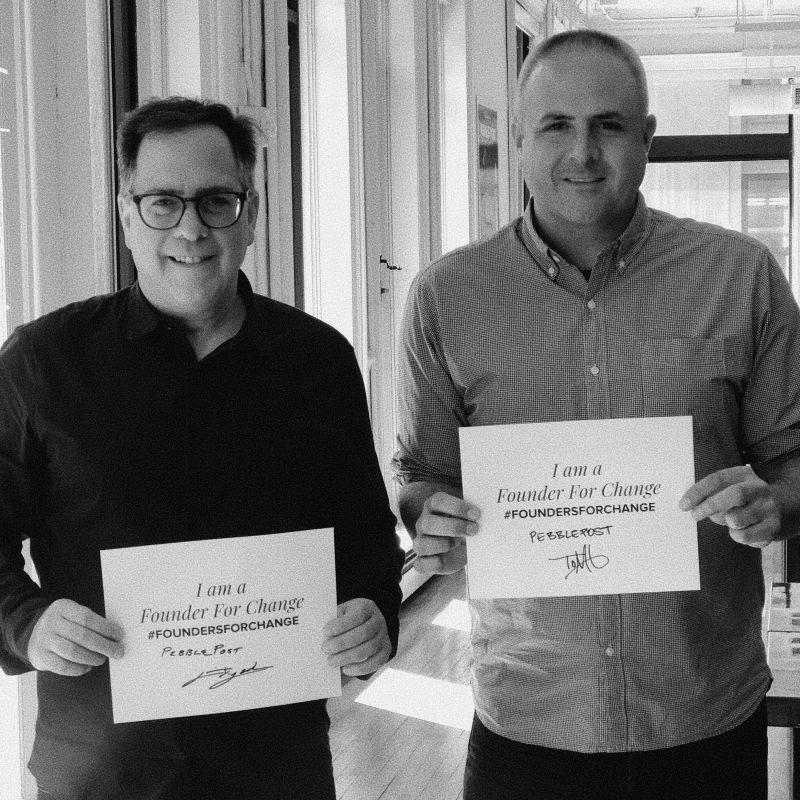
Gersh and Gibbons had been trading pranks long before PebblePost. Gibbons once sent fake messages inviting Gersh to speak to a bar association’s young-lawyer program. Gersh retaliated by having him move his desk to make room for supposedly arriving investors. The friendship accommodated both the flattering invitation and the inconvenient furniture.
At PebblePost, an April Fool’s meeting featured a giant, unmailable version of a catalog product. Gibbons presented it with a theatrical product-launch flourish. A junior salesperson promptly suggested a brand to try it. The joke had encountered that admirable commercial instinct: if there is something new on the table, perhaps somebody wants to buy it.
The humor survived changes in responsibility. Jacob Ross, who joined PebblePost and later became CEO, remembered meeting Gersh over breakfast at Lafayette. Their founder-and-hired-CEO relationship developed into a friendship. After they worked through a thorny problem, Ross joked about how easy it had been. Gersh kept returning to the line whenever another obstacle was cleared. He also remained available for board meetings and phone calls after stepping back from daily work.
The Lewisphere keeps its shape
After Gersh’s death in February 2025, colleagues remembered the introductions alongside the jokes. Adam Solomon, a law-school friend who eventually worked with him at PebblePost, recalled encouragement to pursue entrepreneurship, an extensive circle, and odd memes arriving by text. Rusty Ralston remembered a conversational range that ran from obscure musicians to business ideas, with anecdotes and analogies making complicated subjects accessible.
The memories resist reducing a career to its formal transactions. They describe someone sharing space, sending a song, answering a call, and finding an amusing way into a difficult conversation. Gibbons called the expanding circle the Lewisphere. It is an affectionate name for something that had taken years of attention to assemble.
Gersh’s business made a connection between a digital signal and a household. His working life made connections between people. The office floor, the beer invitation, the returning backers, and the running joke belong in the same story. The last few feet mattered. Someone still had to carry the message across the room.