Honeylove had done the responsible thing. After receiving complaints about the accessibility of its website, the shapewear brand commissioned an evaluation. Now it knew what needed fixing. Its developers also had new projects to ship. The findings became a backlog, and the backlog became another thing competing for attention. Knowing more had not made the work disappear.
- Level Access connects accessibility testing with fixing, training, and monitoring.
- Its customers include retailers, software makers, universities, and public agencies.
- Its most transferable lesson: put accessibility into the workflow people already use.
The report is only the beginning
In Level Access’s published case study, Honeylove used the platform’s project-management integration to streamline remediation and its Academy to train staff. The reported share of developers’ time spent on accessibility administration fell from 50% to 10%. The team fixed 99% of the issues identified in its initial evaluation. Those are customer-specific results, rather than a forecast for the next buyer. Still, they suggest something useful about the problem: coordination can consume the time intended for correction.
This is the territory Level Access occupies. A scanner can tell a team that something needs attention. Someone still has to understand the finding, decide who owns it, make a change, and check the result. The company sells software and expertise across that sequence.
A detour through accessible travel
The business began with a smaller ambition. In a 2018 Equal Entry interview, founder Tim Springer recalled an early plan for a website that would help people with disabilities research accessible venues and arrange vacations. Building it exposed his team to digital accessibility. Meanwhile, the travel site’s niche became crowded. They moved from making their own site accessible to helping other people make theirs accessible, through tools, training, and consulting.
The detail matters because the first product was a destination. The lasting business supplied the means of getting somewhere. An obstacle encountered while building one website turned out to be a problem other website builders shared. The useful question was how many organizations needed help with the same work.
Software with people attached
Today, Level Access combines automated scanning and monitoring with manual evaluations, remediation guidance, documentation, and training. Its evaluators include people with disabilities. A software vendor can commission an Accessibility Conformance Report for a buyer. A university can evaluate digital experiences. A retailer can keep tracking barriers as its storefront changes. These jobs share a technical foundation, but the people responsible for them need different forms of help.
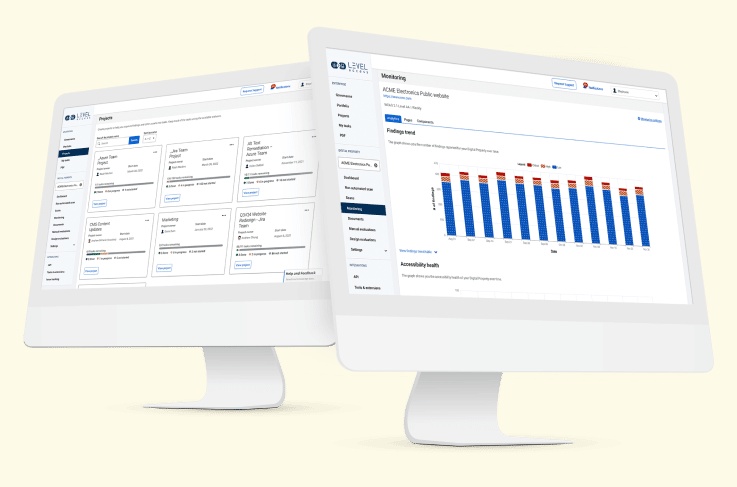
Level CI brings checks into development pipelines, including reports that highlight newly introduced findings. Academy develops internal skills. The platform’s AI capabilities group duplicate findings, summarize monitoring changes, and let users filter issues with natural-language requests. The organizing idea is to shorten the distance between an observation and a useful action.
That breadth defines its market position, although competitors cover overlapping ground. Deque offers developer tools, manual-testing products, monitoring, and training of its own. A buyer with an experienced internal team might begin with an open-source engine such as axe-core. An organization that also needs evaluation, documentation, and program support has a larger purchasing decision.
The human side has a particular pedigree. Level Access says dozens of its accessibility-services colleagues have worked on federal Section 508 compliance teams, as employees or contractors. Its workforce includes engineers, programmers, and consultants with disabilities. That experience gives the service offering a practical basis: evaluating a page also means understanding the different ways a person might need to operate it.
Level Access earns money through subscription software and scoped services. Pricing depends on the package negotiated with the vendor. Its scale is clearer than a standard price: in December 2024, the company reported having exceeded $100 million in annual recurring revenue earlier that year. ARR measures recurring business at a point in time; it is different from annual revenue recognized in accounts.
Some purchases are substantial. Microsoft reported in September 2026 that Level Access had secured two multiyear Marketplace deals with annual contract values of $545,000 and $340,000. These individual agreements do not establish a typical price. They do show why scoping matters: a purchasing team needs to understand exactly which software and services its contract includes before comparing the number with another proposal.
The $98.7 million change of emphasis
Growth also came through combination. JMI Equity invested $40 million in 2017. Level Access merged with eSSENTIAL Accessibility in 2022, with KKR and JMI continuing as investors. In March 2024, it completed the acquisition of UserWay following a $98.7 million cash agreement, adding automated remediation and personalization technology.
There was history behind that purchase. Springer disclosed that Level Access had developed Alchemy, an automated-remediation product, in 2020 and 2021. It struggled to work effectively in the company’s stack, and the pandemic forced a narrower focus. In explaining the UserWay decision, he pointed to maturing technology and companies, while separating useful automation from exaggerated marketing.
The boundary remains consequential. Level Access says overlay technology alone cannot identify or address every accessibility problem or ensure legal compliance. Forrester’s acquisition analysis raised trust and responsible marketing as challenges. Buying faster fixes still leaves an organization responsible for testing what users can actually accomplish.
The component that keeps teaching
CarMax offers a practical example of prevention. Working with Level Access, it embedded accessibility into its Horizon Design System: reusable components, patterns, and documentation. Instead of repeatedly solving the same problem in separate applications, teams could build from shared elements and receive improvements when those elements changed.
“To build our design system, we had to slow down to speed up.”Molly Covert / CarMax
The overlooked ingredient was instruction. CarMax documented how to use components accessibly and reinforced that guidance through training. A component can be accessible in isolation and become inaccessible in the wrong setting. Copy the method by making accessibility part of acceptance criteria, recording how components should behave, and teaching the teams that assemble them.
The next bottleneck
Level Access’s September 2026 survey of 2,530 professionals adds a timely complication. Among respondents using AI, 99% said it accelerated at least one development stage; only 30% reported acceleration in QA and testing. Faster production can leave checking behind. These are survey responses, but they explain the company’s emphasis on catching problems earlier.
For buyers, the questions are concrete. Which experiences will be tested? Who makes the fixes? What training is included? How will changes be checked? A scanner without someone to act on its findings leaves Honeylove’s original predicament intact. The report becomes useful when somebody can turn it into work that gets done.