The case had already slipped away. In Hamid Kohan’s telling, an employee asked him to visit the law firm handling a personal matter. There, Kohan discovered that a filing deadline had been missed. He had spent years in technology. Now he was looking at a different kind of systems failure: a professional service undone by its own operations.
- Dedicated virtual staff for U.S. law firms, from intake through case support.
- Legal assistants start at $2,227 monthly; bilingual roles cost more.
- Legal Soft handles staffing administration. The firm directs the daily work.
That episode, described in his June 2026 interview with Authority Magazine, helps explain Legal Soft. The company occupies the space between knowing what should happen in a legal matter and making sure somebody does it. The phone must be answered. The record must be requested again. The appointment must reach the calendar.
A job for the unfinished jobs
Founded in 2015, Legal Soft supplies dedicated remote professionals to law firms. Its menu includes legal assistants, intake specialists, document collectors, case managers, paralegals, demand writers, bookkeepers, marketing assistants, and remote attorneys. Each title identifies a piece of work that otherwise risks becoming everybody’s responsibility and nobody’s priority.
An intake specialist screens prospects and follows up with leads. A document collector pursues missing records. A case manager tracks progression. These are ordinary tasks with consequential timing. A firm buying more advertising while leaving inquiries unanswered has an operational problem that another advertising campaign may simply enlarge.
The customers span solo practices through larger operations, across areas including personal injury, immigration, employment, and family law. Legal Soft reports serving more than 1,000 U.S. firms and placing over 2,500 virtual staff. Its published testimonials name practices including Sasooness Law Group and Robison Lemon Law Group. Those figures describe the vendor’s reported reach, rather than a guarantee about any individual placement.

The price of a person who follows up
The published offer is unusually easy to picture. An English-language legal assistant starts at $2,227 monthly; a bilingual assistant starts at $2,527. English-language case managers start at $2,525, paralegals at $2,922, and remote attorneys at $3,323. These are advertised starting prices checked in October 2026, with different roles and language requirements carrying different rates.
For the base legal assistant, twelve months comes to $26,724 before any changes or extras. That is straightforward multiplication, not a comparison with a particular local employee. The company’s staffing FAQ specifies a full-time, 40-hour week and month-to-month arrangements. A firm needing occasional overflow should notice the full-time commitment before admiring the monthly number.
Legal Soft supports recruitment, onboarding, HR, payroll, and retention. The client manages daily activities. That sentence is the hinge of the business model. The buyer gets help acquiring and supporting capacity, while retaining the job of deciding what the person should do and whether the result is useful.
The dashboard has a bonus button
Legal Soft’s software follows the employment relationship beyond the interview. Firms can browse candidate experience, review work and timesheets, handle billing, submit support tickets, and recognize staff with bonuses or raises. The platform also advertises real-time collaboration. Recruitment becomes one stage in a longer relationship, with administration attached.
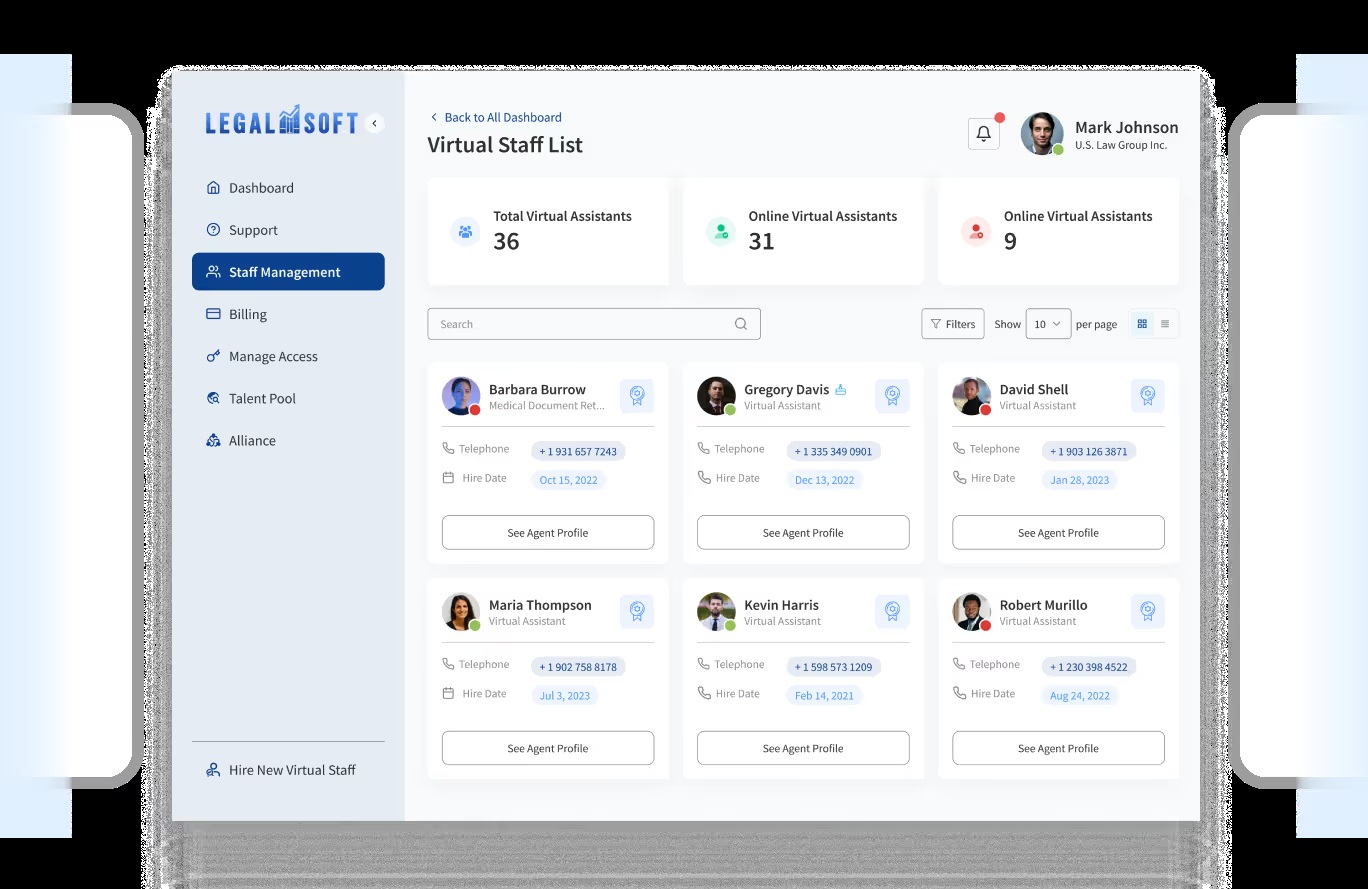
Retention matters because replacing an assistant also replaces accumulated knowledge: how a partner wants a draft, which records are missing, where a client’s history lives. Legal Soft describes continuing training, coaching, regional health benefits, connectivity allowances, and paid leave for virtual staff. These are its stated employment practices. They also reveal how much infrastructure sits behind the apparently simple act of hiring remotely.
Software still needs an owner
There are alternatives. Get Staffed Up also offers law firms dedicated, full-time virtual professionals and month-to-month agreements. In-house recruitment buys another kind of proximity; independent hiring offers another way to build a team. Legal specialization and remote work, by themselves, do not make Legal Soft unique. Its particular proposition bundles a broad role menu, ongoing staffing support, management software, and practice-growth advice.
Clio lists Legal Soft in its certified consultant directory, covering workflows, training, automation, integrations, and virtual staff. The relationship places Legal Soft beside existing practice software rather than requiring a firm to discard its entire system. Its growth program adds a people, processes, and tools audit, plus intake training and strategy calls.
Recruitment, onboarding, payroll, retention.
Daily priorities, assignments, assessment.
Kohan’s newer interest is AI. He describes seeing large case files organized and summarized quickly as a turning point, while acknowledging resistance over confidentiality, accuracy, and adoption. His separate venture, Law Practice AI, pursues legal workflow automation. The practical connection is clear: staffing and software both need to fit the way a matter moves through a firm.
“The biggest opportunity in AI is not replacing professionals.”
Hamid Kohan · Authority Magazine · June 2026
Start with the missing record
The international operation is tangible. In October 2026, Legal Soft announced an office in Tegucigalpa, Honduras, describing it as its sixth worldwide. The stated purpose includes recruitment, placement, client support, and business operations. A service aimed at American law firms depends on work distributed across several countries.
The useful lesson is small enough to copy tomorrow: follow one matter, identify a recurring bottleneck, assign an owner, and define a finished result. That is an inference from the model, not a promised outcome. If work requires physical presence, arrives only sporadically, or has no clear supervisor, this full-time remote arrangement may fit poorly. The revealing question is what happens after the missing record finally arrives. Somebody still has to know what comes next.