There is an awkward moment in the life of a successful bitcoin saver. The balance has become large enough to do something splendid: buy a house, fund a business, pay for a renovation. Unfortunately, the contractor accepts dollars. Selling the bitcoin would solve the immediate problem and undo part of the position the saver spent years accumulating. Wealth, it turns out, can be inconveniently denominated.
Lava has built a business around that moment. Its central product, the Bitcoin Line of Credit, or BLOC, lets a holder pledge BTC and borrow dollars. The borrower keeps exposure to bitcoin while gaining money that can travel through bank accounts, stablecoins or a Visa card. The appeal is easy to understand. The conditions deserve equal attention.
- Keep the position: borrow dollars against bitcoin rather than sell it.
- Count both costs: current published interest is 6.50%-8.50%, plus a 2% annual charge on peak borrowing.
- Use the dollars: transfer, spend with Lava Card, or fund a purchase.
- Watch the collateral: liquidation can consume the entire pledged BTC balance.
01 / The house is real. So is the debt.
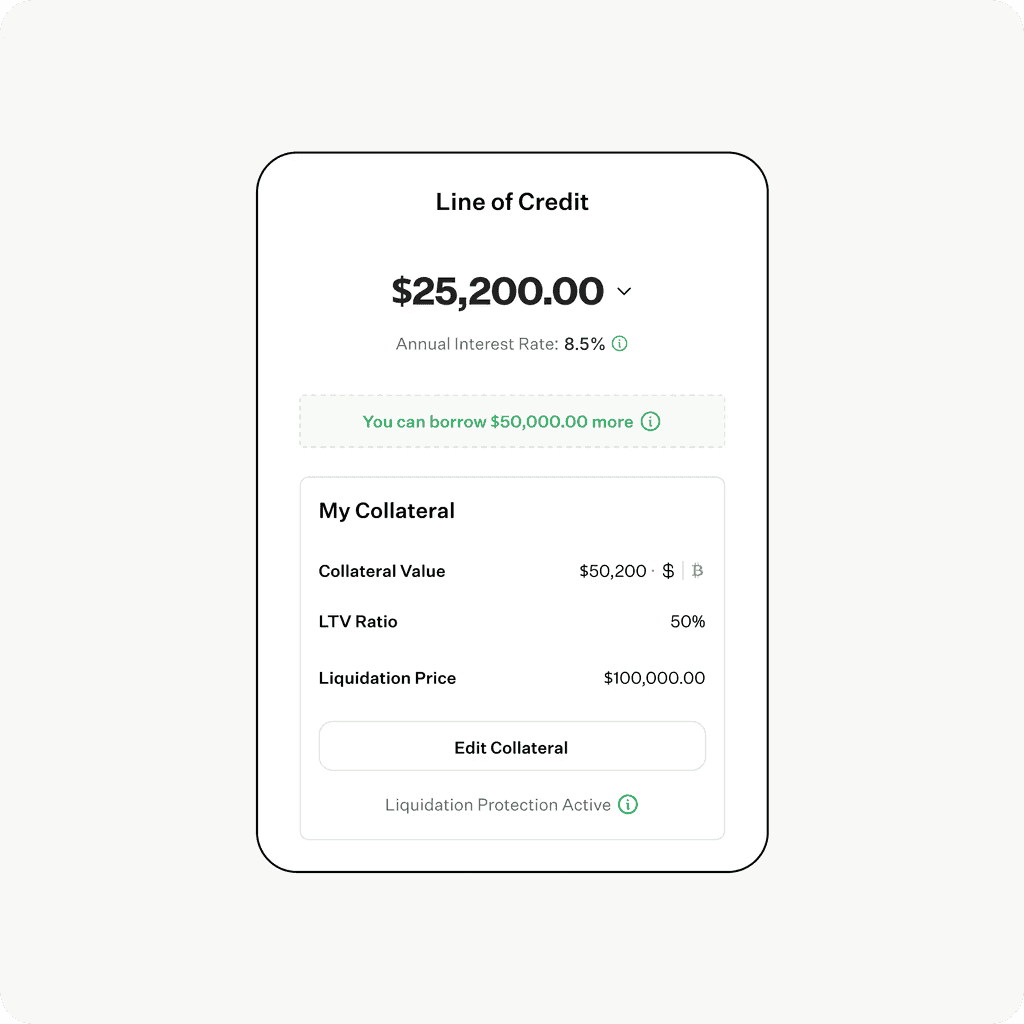
For a holder who expects to own bitcoin for years, selling can feel like leaving the theatre halfway through the play. Lava offers a loan instead. BLOC revolves: draw money, repay some, draw again. There is no fixed maturity and no mandatory monthly payment. Interest accrues into the balance. The rate is fixed for a year, then updates annually.
That structure makes the product useful for spending that arrives in stages. A home project has deposits, deliveries and bills. A business has working-capital needs. A borrower can draw the dollars required rather than borrow the whole credit limit on day one. Lava’s November 2025 launch described borrowing up to 50% of bitcoin’s value; its current liquidation FAQ describes draws starting at up to 60% loan-to-value.
The company made the housing use case unusually concrete in August 2025 by announcing a partnership with Roam, an assumable-mortgage marketplace. The proposed combination is a bitcoin-backed down payment and an existing mortgage taken over from the seller. The attraction is preserving BTC exposure while buying property. The complication is having two debts, with the bitcoin-backed one sensitive to a market that can move while the house stays put.
02 / The fee remembers your biggest day
Lava’s current pricing FAQ assigns rates by outstanding balance. Borrow below $250,000 and the listed annual interest rate is 8.50%. At $2 million or more, it is 6.50%, with tiers between. The lowest advertised rate therefore belongs to a particular borrower. It does not describe everybody who opens the app.
Then comes the capital charge: 2% of the largest outstanding balance during the year. It is assessed after a year or when the line closes, whichever comes first. Paying down the loan does not erase the earlier peak. The charge does not itself accrue interest during the year in which it is applied; if carried into the following year, it becomes part of the new principal.
Consider a hypothetical $10,000 draw held for a year without repayments or further borrowing. At 8.50% with daily compounding, interest is approximately $887. If that rising balance is the annual peak, its 2% charge is about $218. Combined, roughly $1,105 has been added. This is an illustration of the published mechanics, not a formal APR calculation or a loan quote.
One year · 8.50% annual rate · daily compounding · no payments · fee based on modeled peak balance. Rounded figures.
For short borrowing periods, the peak-balance charge deserves particular scrutiny. A person who draws heavily, repays quickly and closes the line still faces a charge tied to the high point. Convenience has a memory. Lava earns money from that credit-line charge; its dollar yield product, meanwhile, channels borrower interest toward lenders. The Block also reported processing-fee revenue on funding and withdrawal rails in October 2025.
03 / A wallet changes its wardrobe
Shehzan Maredia founded Lava in January 2022. Early coverage concentrated on a familiar bitcoin nuisance: recovering a wallet through a seed phrase. In July 2024, Bitcoin Magazine described Lava’s seedless recovery approach and a loan beta using Discreet Log Contracts. The ambition was to make bitcoin useful without asking every customer to become a security technician.
The company’s seed announcement supplied the compact ambition: save in Bitcoin and spend in dollars
. A September 2025 app rebuild brought changes to performance, account access, borrowing and collateral management. BLOC followed in November. In May, Lava had offered loans with selected durations and monthly interest payments for longer terms. The revolving line removed that schedule.
The payment schedule became more forgiving. The collateral still answers to the market.
The sequence follows the customer’s problem through several forms. First came access to the wallet, then a loan with a repayment calendar, then a revolving balance. Each change reduced another task between holding bitcoin and using its value. The early obstacle was practical: a recovery phrase could make managing savings feel like managing a security procedure. Later products put dollar access at the center.
Its security vocabulary also needs a date attached. Current documentation describes segregated cold storage, custodians and distributed keys held across geographically separated entities. Settlement requires a majority of key holders to authorize changes. Lava says resting funds are not traded, lent out or otherwise rehypothecated. An account protected by that arrangement should be assessed on those current terms, rather than assumed to work exactly like its earlier user-key wallet.
04 / Bitcoin goes shopping in a dollar suit
Lava Card takes the borrowed-dollar idea into ordinary commerce. Lava calls it a secured Visa credit card: users can spend only the dollars available in their balance. That balance can be funded through a bank, supported stablecoins or BLOC. A card purchase need not involve taking a bitcoin loan at all.
The reward is bitcoin rather than points. Published terms advertise up to 5% at merchant partners, up to 3% on other eligible US purchases and up to 1% outside the US. The company advertises no annual fee and no foreign-exchange fee or spread. Eligibility and exclusions still apply. “Up to” is doing useful work in those sentences.
On September 30, 2026, Lava added Starlink and Discord to its merchant rewards program, alongside AI tools. Its announcement also specifies a 100,000-satoshi minimum to redeem rewards. That is the sort of detail worth reading before comparing cards by the largest number in the advertisement.
For customers holding digital dollars across chains, another practical improvement arrived in July 2026. Lava added deposits for USDC, USDT and PYUSD across ten networks, including Ethereum, Solana, Base and Stellar. Those deposits appear in a unified USD balance. The product’s appeal here is mundane and useful: fewer separate balances between receiving money and spending it.
05 / The capital, and the people behind it
Lava announced a seed round in July 2024 led by Caffeinated Capital and UTXO Capital, then a $10 million Series A in December led by Founders Fund and Khosla Ventures. In October 2025, it announced $17.5 million in new participation and stated that cumulative financing had reached $30 million.
The larger announcement came on November 3: another $200 million, explicitly a mix of venture and debt, with Anthony Pompliano and Eric Jackson joining as angel investors. Treating that whole sum as equity would misdescribe the business. A lender needs capital to build its product and capital to finance loans; the split in this announcement was not disclosed.
July 2026 brought Lava Prime for institutions, funds, family offices and wealthy individuals who need custom documents, custody arrangements and repayment schedules. Lava for Business followed. These products acknowledge a limit of the self-serve app: a family office may want a conversation before moving a treasury.
The expertise Lava claims is correspondingly specific. Its security FAQ describes team experience in Bitcoin Core, Lightning, DLCs, and infrastructure at companies including Current and Affirm. Maredia’s public hiring challenge emphasized shipping working software and did not require prior crypto experience. The useful organizational lesson is to ask applicants to demonstrate the work the business needs.
06 / The number that moves while you sleep
Lava occupies a busy intersection of bitcoin lending, dollar payments and wealth management. Unchained, for example, also advertises no rehypothecation and on-chain collateral verification, using collaborative custody. Its commercial loans have scheduled interest payments. Lava’s differentiation rests on the revolving structure, the spending account and its range of connected services. Safe collateral handling is not an exclusive slogan.
The decisive number is loan-to-value: debt divided by the current dollar value of pledged bitcoin. If a hypothetical $10,000 debt is backed by $20,000 of BTC, LTV is 50%. Let that collateral fall to $15,000 and the ratio rises to roughly 67%, before additional interest. Neither the purchase nor the original loan amount has changed. The denominator has.
Illustrative ratios, excluding interest and fees. These are not liquidation thresholds.
Lava offers alerts and Liquidation Protection, which automatically adds available BTC to collateral at a specified threshold. That works only while sufficient additional bitcoin remains available. Its current FAQ says that reaching the liquidation price triggers full liquidation and that no pledged collateral is returned. The tradeoff is severe enough to belong in the story’s foreground.
Nor is the advertised 6.5% USD yield a magical property of cash. It comes from funding BTC-backed loans and depends on collateral and liquidation mechanics. A saver has become a lender. The return comes with that job.
What can another business copy? Begin with a precise inconvenience, connect the steps needed to resolve it, and make the price intelligible. What can a borrower copy? The arithmetic, before the enthusiasm. Lava makes a long-held bitcoin position easier to use. Whether that is sensible depends on repayment capacity, the borrowing period and how much falling collateral the holder can withstand. The house may be the prize. The loan remains the bill.