Before Laura Heisman sold anyone on software, she worked in public relations for musical instruments. It is a pleasingly analog beginning for an executive now occupied with artificial intelligence, causal analysis, and the torrents of data emitted by modern companies. Yet the first job contains the whole career in miniature. An instrument does nothing interesting until a person picks it up. A complicated technology also needs a human interpreter. In both businesses, timing matters, attention is scarce, and noise is the enemy.
Heisman has spent more than three decades becoming that interpreter. She moved from consumer marketing into startups and pre-IPO companies, then through Citrix, GitHub, VMware, and Dynatrace. The products became more technical. The audiences expanded from buyers to developers, partners, employees, and entire customer communities. Her working vocabulary stayed disarmingly human: communication, potential, community.
She calls herself a builder. The description reaches further back than her résumé. As a child, she made art, wrote stories, and fashioned tools in woodshop. The adult version substitutes organizations and narratives for timber. There is still a practical test: whatever gets built should be useful in somebody else’s hands.
The apprenticeshipA career built in translation
After the music business came consumer products, agency work, and young technology companies. A 2003 regulatory filing places her at iManage during its planned combination with Interwoven, working on corporate communications while two public companies attempted to explain a complicated union. It was a fitting education. Corporate life supplies facts in heaps; communications asks which ones form a line.
At Citrix, where she spent more than a decade and rose to vice president of communications, the scale changed. She led worldwide communications and brand awareness. Then, in 2017, she joined GitHub. The move put her inside a developer platform whose community was inseparable from its product. As vice president of communications and corporate marketing and a member of the leadership team, she helped define the company’s story for people who are famously resistant to being treated as a segment in a spreadsheet.
Her lesson from that world became a blunt article title: “Marketing at developers doesn’t work. Creating community does.” It is both advice and a small indictment. You may target an audience with exquisite precision and still fail to understand it. Community requires participation. A marketer has to arrive curious, contribute something useful, and tolerate the alarming possibility that the most credible voice belongs to a customer.
VMware hired Heisman as global chief marketing officer in February 2022. She took responsibility for brand, corporate, partner, developer, segment, and field marketing, a list long enough to make “marketing” sound like a small federal government. Then generative AI arrived in ordinary office life. Employees were already experimenting. Executives were already asking what it meant. The sensible response came from inside her team.
The internal inventionThe council before the campaign
A group of VMware marketers had formed an AI council because they were interested in the new tools and alert to their risks. Heisman learned about it after returning from a meeting where chief marketing officers had wondered aloud what they ought to do about generative AI. Her team presented its work. She chose to sponsor and scale it.
This is a revealing leadership anecdote because Heisman is not its lone genius. The employees noticed the change, organized themselves, and built expertise. Her role was to recognize the structure, give it executive air cover, and connect it to the business. She later said the participants’ careers changed. People who already had jobs became “modern marketers” and internal experts by pursuing a question before it had an official department.
When Heisman became Dynatrace’s CMO in January 2024, she brought the council model along. Its purpose was neither indiscriminate enthusiasm nor theatrical caution. A proposed AI tool needed a business case. It had to clear privacy and security review. The company checked whether it duplicated something already installed. Only then did experimentation become adoption.
By 2025, Heisman reported three times the output for content and creative uses, translations running twice as fast, and richer audience targeting. Numbers this neat can tempt a company into declaring victory. Her more interesting point concerned method. Everything could be measured, she said, but measurement was not a row of green lights. The question was what the team learned and how quickly it could correct course.
That distinction separates a dashboard from a management practice. Heisman described five things she wanted Dynatrace marketing to measure: the memorability of its narrative, leadership in observability and application security, pipeline growth and nurturing, partner engagement, and the extent to which customers became heroes. Some measures connected directly to company goals. Others forced the team to define a softer ambition without making it vague. A memorable narrative is an artistic aim until somebody decides how recognition will be tested. A customer hero sounds sentimental until the company counts whose voice reaches the stage.
Her prescription preserves a place for instinct. AI strategy, in her telling, is art and science. Data can disclose patterns, reduce the terror of a blank page, and accelerate repetitive work. It cannot assume responsibility for taste, context, or trust. The council exists partly to keep that distinction visible.
The approach also resists the usual executive fantasy that transformation begins with a purchase order. Heisman has advised vendors to make their business case easier to understand, including the privacy, security, and productivity arguments. But a license is merely admission to the experiment. The harder work is finding a genuine use, comparing the result with what existed before, and sharing the lesson across a team. Her council model gives curiosity a meeting place and gives enthusiasm some paperwork. In enterprise life, both are mercies.
Customer zeroMaking the users the heroes
Dynatrace sells observability software, a category devoted to seeing what complex digital systems are doing. Heisman arrived with a marketer’s version of the same problem: the company had technology and recognition from industry rankings, but too few people could explain it simply. On a listening tour, she heard the need from sales. Her plan included a memorable narrative, market leadership in observability and application security, pipeline, partner engagement, and a fifth measure with warmer blood in it: help customers become heroes inside their own organizations.
At the company’s 2025 customer conference, more than 50 customers appeared on stage. Heisman’s explanation was plain: nobody tells customer value better than customers. Peer testimony carries the scratches and specificity that polished corporate prose tends to buff away. It is community as evidence.
The arrangement changes the marketer’s posture. Instead of writing every line, the team designs a room in which credible lines can be spoken. It chooses the guests, prepares the stage, and listens for the details only practitioners know. This is quieter work than announcing a grand message, though not necessarily easier. A company must be secure enough to let customers describe outcomes in their own accents. The reward is a story with witnesses.
Another customer story arrived at racing speed. In 2025, Dynatrace became the official observability and performance analytics technology partner of the Visa Cash App Racing Bulls Formula 1 team. The fit centered on data, rapid decisions, and the many milliseconds from which victory is assembled. Heisman, an F1 fan, interviewed drivers Liam Lawson and Isack Hadjar while driving them through the Austrian backroads. The CMO became the chauffeur. The phrase “customer journey” briefly acquired horsepower.
The episode was playful, but the analogy held. A racing team and a global company both need to distinguish a meaningful signal from a roaring environment. Both make decisions before certainty feels comfortable. Both discover that speed without sight is merely a more efficient way to find the wall.
The next obligationVisibility before velocity
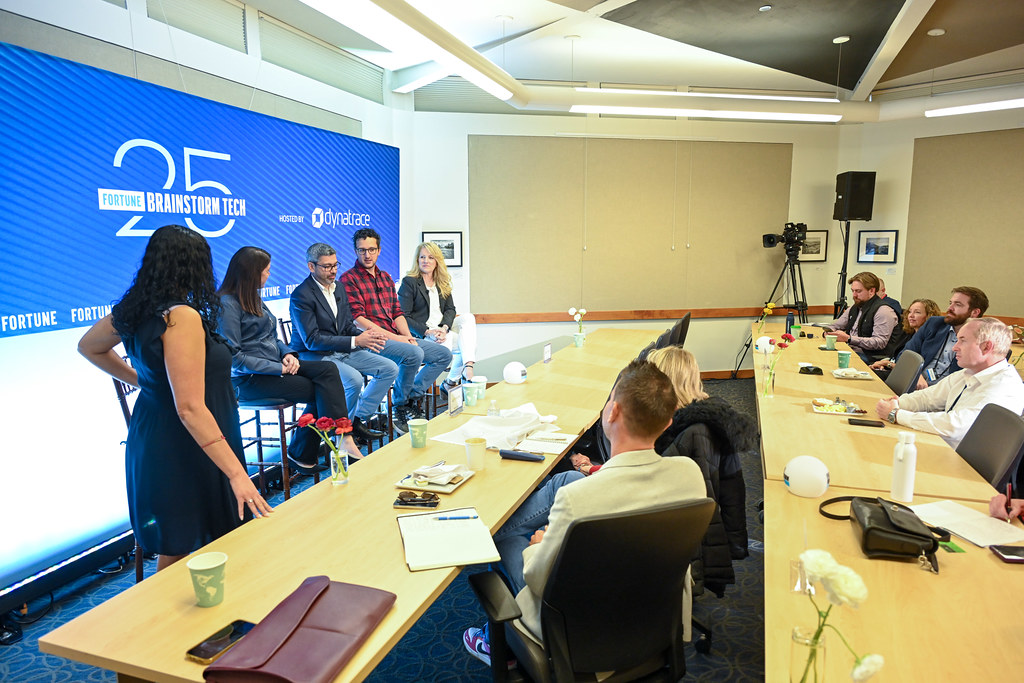
By June 2026, the AI conversation had moved from assistants that drafted text to agents capable of chaining decisions and actions. At Fortune Brainstorm Tech in Aspen, Heisman joined executives from Citi, Ford, and Experian for a roundtable with an excellent title: “You Can’t Trust What You Can’t See.” Her questions were the ones that survive fashion: Is the result right? If it is wrong, can you stop it?
They sound like engineering questions. They are also communications questions. Trust depends on being able to trace an assertion to its grounds, identify who authorized an action, and explain the system to the people affected by it. Marketing may be tempted to treat AI as a factory for more material. Heisman’s career suggests a sterner brief. More is valuable only when a company knows what it is making and why anyone should believe it.
There is continuity here from the musical-instrument trade to enterprise observability. Technology changes the volume; communication supplies the score. At GitHub, that meant respecting a developer community enough to build with it. At VMware and Dynatrace, it meant allowing curious employees to turn an unofficial council into shared infrastructure. At a customer conference, it meant handing over the microphone. On an Austrian road, it meant asking two drivers how decisions feel at speed.
Heisman has said her mission is balanced between building strong businesses and building the next generation of leaders and creators. The balance matters. A tool can extend human potential, but only a person can decide what deserves to be built. A dashboard can reveal the route, but somebody still has to look through the windscreen.