Consider the little checkbox beside “go paperless.” A customer clicks it. A bank records another digital convert. The next statement appears online, and the paper disappears. Everything has worked. Except the customer may never open the statement. In a September 2026 article, Lanvera’s chief revenue officer, Chris Juetten, describes precisely this gap. Enrollment measures permission to stop printing. It says rather less about whether a person can find, recognize or use what replaced the envelope.
- Lanvera handles the whole document journey: design, production, delivery and retrieval.
- It reports over 300 million communication images processed each year.
- Its useful lesson: measure what customers do after a message arrives.
This is an interesting problem for a company whose work includes printing the envelope’s contents. Lanvera sells customer communications management, or CCM, to organizations with documents that must reach people: statements, invoices, tax forms, notices. Its proposition joins software with the people and production systems needed to get those documents out. Banks and credit unions sit squarely in its market; healthcare, insurers, loan servicers, manufacturers, telecom and utility-management businesses also appear among its target industries.
The envelope was an engineering problem
Lanvera began in Dallas in 1985 as a credit union statement processor. It previously operated as Total Mail Systems. A historical account from its technology partner GXA describes early savings from reformatting pages and printing on both sides. The ingenuity was pleasingly physical: change the document, and you could reduce paper, printing and postage together. The customer still received a statement. Producing it consumed fewer resources.
Electronic presentment entered the company’s history in 2002. Lanvera says it expected digital to take over, but adoption moved more slowly than anticipated. Its explanation points to the later spread of connected mobile devices and abundant bandwidth. That is the documented expectation that missed its timing. The company’s present-day response accommodates both channels: software for digital delivery alongside an active print operation.
Lanvera’s reported production and processing volume. Images are not unique customers or mailed envelopes.
Its print-and-mail service page still puts physical delivery at an average of 50% of communications, without specifying a measurement period. Whatever the precise mix at an individual client, the practical implication is clear. A bank’s delivery preferences arrive as a mixture, and its provider has to handle that mixture.
Before the message, fix the record
Follow a statement upstream and you arrive at a less photogenic problem: several systems holding information about the same person. A banking core, payment processor, CRM and customer portal can each contribute something the communication needs. Lanvera offers APIs to synchronize customer and online-user data in near real time. Single sign-on lets people enter its delivery platform through an existing banking or customer portal without another login.
The distinction matters. A beautifully designed notice sent according to an outdated preference remains a poorly executed notice. Lanvera’s design service uses business rules to vary data and personalized content within reusable templates. Its automated production service then applies client-specific workflows, including samples and approvals, before delivery. The work starts well before anyone presses print.
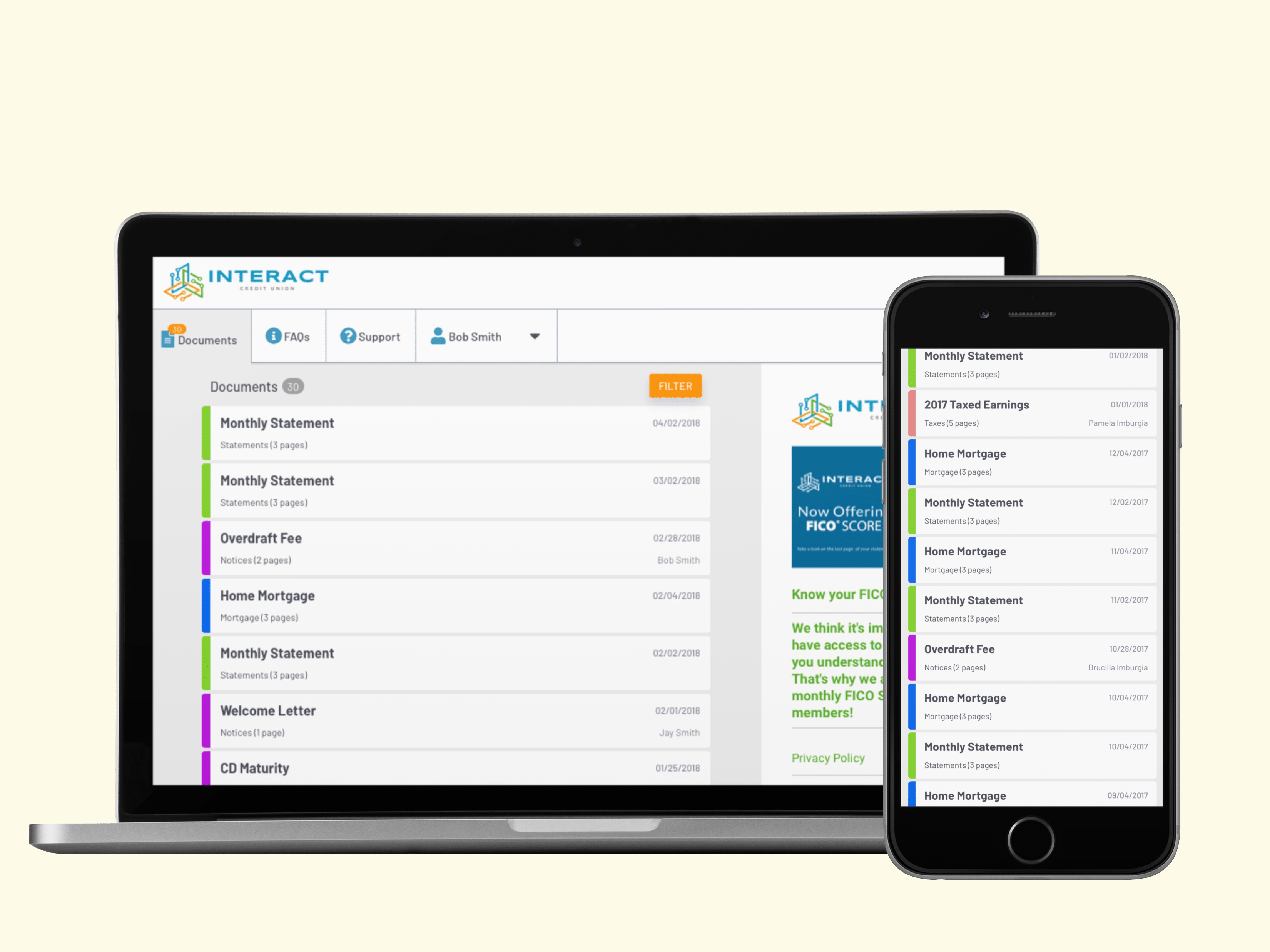
For customers, ePresentment and electronic bill presentment and payment provide document access across devices, with payment-processor integration. Email and SMS handle notifications, reminders and other events. For employees, the communication archive brings documents, emails, texts and marketing content into one record. A service representative can look at the communication history instead of asking the customer to reconstruct it.
- 01SynchronizeCustomer data
- 02ComposeRules + approval
- 03DeliverPrint + digital
- 04RetrieveShared history
A bill for the business of bills
Here is one unusually concrete glimpse of the economics. Veridian Credit Union’s 2022 Form 990 lists Lanvera among its independent contractors and records $2,728,547 for document outsourcing. That is one institution’s historical annual expenditure. It cannot establish a price per statement, an implementation fee or a typical customer budget. It does establish that this category can represent a substantial operating relationship.
Lanvera’s commercial proposition combines its SaaS platforms, outsourced production and professional services. The savings logic spans several activities: fewer document versions, consolidated mailings, address corrections before production and digital delivery where customers use it. A buyer evaluating the arrangement should compare that whole workflow with the cost of operating it internally or coordinating separate vendors.
A backup plan with an audience
GXA’s case study provides another revealing detail. When Lanvera needed to relocate its office and data center, business-critical client work had to continue. GXA helped create a disaster-recovery environment, moved key services onto it during the relocation, then restored them at the new facility. Growth prompted the infrastructure review. The project treated continuity as a condition of the move.
“We honor all commitments.”
Brian Camp, identified as Lanvera’s IT director in GXA’s case study
The same operational emphasis appears in its service model. Project managers guide implementations and changes; the client portal exposes files, production jobs and reporting. Lanvera advertises a family-friendly workplace and profit sharing. Its engineering description emphasizes automation and long-term software quality. These are the company’s stated priorities; the relocation account supplies a concrete example of planning around them.

Count what the customer can do
Lanvera occupies the managed communications end of the market, where software meets production responsibility. FSSI and Doxim offer comparable combinations of transactional communications and delivery. Lanvera’s pitch emphasizes bringing channels, integration and professional services together. Buyers can assess the fit through their own data connections, approval requirements, retrieval needs and change requests. A list of channels alone tells them little.
There are boundaries. Lanvera explicitly says its communication archive does not replace an enterprise content-management system for individually scanned documents. A small business needing occasional mailings may have little use for this machinery. Nor can a connected platform, by itself, make suspicious-looking messages trustworthy or persuade customers to read them.
The practice worth borrowing is modest: test the journey after delivery. Can the person recognize the message, retrieve the document and take the next step? Can an employee see what happened? Lanvera’s September writing applies that reasoning to paperless programs, AI member service and continuity planning. The old envelope carried a document to a doorstep. The harder assignment begins when someone has to use it.