Lander Degrève has a curious ambition for someone who sells software: he would like his customers to spend less time using it. The recruiter should be speaking to a candidate, weighing a difficult decision, or getting home. The database can do its own housekeeping. It is an appealing arrangement, especially if you have ever finished a working day only to discover that the computer still expects a written account of it.
In September 2026, the co-founder and CEO of Spott wrote about a compliment customers were giving the company. They had recovered their evenings. The satisfying part, for him, was that the machinery around recruiting was beginning to consume less of the day. A shortlist still had to be prepared. Records still needed updating. Those chores had a habit of waiting patiently until the conversations were over.
This is the small, human question inside a rather larger business. Degrève and his co-founders are building an applicant tracking system and customer relationship management platform for recruiting firms. Investors have put $24.2 million behind Spott. Yet an earlier finish is a useful way into his story, because it asks what all that software is supposed to accomplish once the demonstration ends.
“It’s that they got their evening back.”
Lander Degrève, on customer feedback
Before the company, there was the investment club
Degrève met Manu Vanderveeren and Samuel Smeys in their second year at KU Leuven, through BRIKS, a student investment club. The connection survived graduation and holidays together. Before the three had a company to run, they had already spent time being friends. That distinction matters when the founding team is later reduced to three job titles in a funding announcement.
Their careers took them into consulting: Degrève to Bain & Company, Vanderveeren to McKinsey, Smeys to BCG. Their eventual roles at Spott follow different lines of work. Degrève became CEO; Vanderveeren took operations; Smeys became chief technology officer. Friendship supplied the continuity while their professional experience supplied different views of the same industry.
Degrève’s own route included a master’s in finance at Bocconi University and an investment banking internship at JPMorgan. His background was in financial statistics. It is a recognisable set of credentials for a career analysing businesses. What makes the sequence interesting is the practical software work that appears alongside it. At Bain he built an AI job-matching tool. Separately, he made a generative AI interviewer for consulting cases.
The side project is a pleasing detail. Consulting interviews, with their elaborate business problems, became material for a tool of his own. Long before the CEO label arrived, he was already finding places where software could perform a piece of the work. His subsequent move into a recruiting product had a technical prehistory, as well as a financial one.
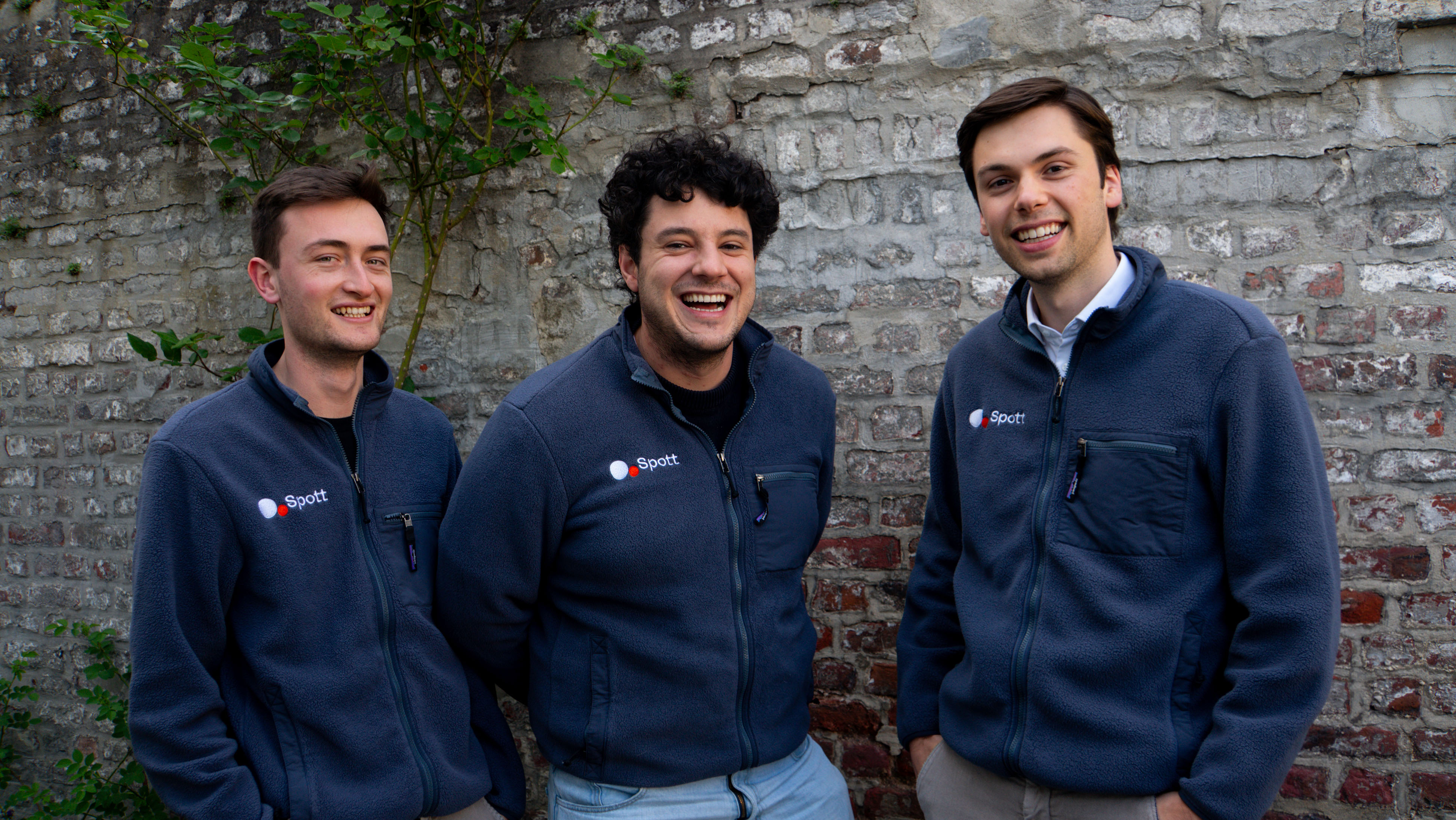
A report writer grows out of its first job
Spott began in 2024. Its early proposition was narrow enough to explain without a diagram: use a candidate’s CV and interview material to produce a presentation report for a recruiter. Executive search firms already needed these documents. Turning the information into a client-ready report was a concrete task, with an obvious place in a working day.
That early product helps explain the distance the founders travelled. A report-writing tool sits at one stage of a recruiter’s process. An applicant tracking system sits underneath much of it. Spott was moving from automating candidate presentations toward a combined ATS, CRM and analytics platform. The company said it had already generated more than 1,000 reports and begun paid trials with firms including Stanton Chase.
For Degrève, the wider opportunity was in how recruiters used the information they already possessed. A conversation produces detail that a rigid record can lose: willingness to move, preferences, experience that does not fit neatly into a job title. Spott’s premise was that these fragments should become usable without requiring the recruiter to perform a second shift as a data-entry clerk.
It was a consequential expansion of the assignment. A helpful document generator can be judged at the moment it delivers a document. A platform has to hold together through the ordinary untidy business of the day. The founders were taking responsibility for more of that day, including all the parts a polished candidate report never sees.
San Francisco, then back to the keyboard
Spott joined Y Combinator’s Winter 2025 batch. For Degrève, San Francisco offered an unusually public enthusiasm for business software. In a later Dutch-language interview, he recalled billboards advertising B2B technology and conversations about what automation might do several years ahead. The scale of the speculation was sometimes difficult even for him to believe.
He also described a specific ambition for the product: recruiters should spend as little time in Spott as possible, leaving them free to talk to people. An unusual sales pitch, perhaps, for a software subscription. But it gives the product a demanding test. Adding another screen does little good if the person at the desk still has to carry the same information between systems.
The founders returned to Belgium to build their team and product. Degrève has written about that sequence himself: San Francisco was where they worked out what Spott should become; Belgium was where they developed it further. The American chapter did not end the Belgian one. By September 2026, a New York office was bringing the company across the Atlantic again, this time to support an operating business.
The candidate hidden in the conversation
Consider the example Spott uses to explain its search: a candidate mentioned six months ago that they would consider relocating. The information exists, but remembering which conversation contained it is another matter. Retrieving that detail is a more useful demonstration of the product’s premise than a cheerful label promising artificial intelligence.
Degrève’s writing for buyers goes into the underlying mechanics. He discusses searching by meaning, structuring information from notes and calls, and applying practical constraints before matching candidates. The telling part is his proposed method of inspection: try the system with information buried in notes, then check what happens when location matters. The claim has to survive an ordinary recruiter’s question.
That emphasis also establishes a boundary. In the platform described alongside Spott’s Series A, recruiters retain approval over consequential steps such as presenting candidates to clients. Degrève’s stated aim is to preserve relationship-building and judgement while reducing the surrounding work. The person making a recommendation still needs to understand why it is a reasonable one.
There is an everyday courtesy in that division of labour. A candidate is more than the contents of a form, and a recruiter’s memory is more than a filing system. The useful machine brings relevant information back into the conversation. It leaves the people involved with something better to do than reconstruct their own notes.
When a Friday release becomes somebody’s Monday
The CEO title has not kept Degrève out of the codebase. He spends close to half his week there, alongside customer conversations. That is a distinctive combination for a founder whose earlier qualifications might have suggested a safer distance from the implementation. At Spott, the argument about what to build is close to the work of building it.
His account of shipping software becomes more interesting as the audience grows. With 50 users, he wrote, an imperfect release could lead to a message and a same-day fix. At 5,000, the same rough edge creates many more interruptions. Users invent workarounds. Confidence in other parts of the product can begin to slip.
In that account, hiring the company’s first product designer, Karen, marks a change in the standard of completion. Features have to be tested inside the workflow and feel at home there. The founder who values quick releases is also describing the moment when speed alone becomes a poor defence. Somebody else has to earn a living inside the thing you shipped.
It is a useful glimpse of Degrève beyond the funding figures: a builder adjusting his definition of a finished job. A recruiting platform asks for the user’s trust every morning. Once it becomes the place where a firm keeps candidates and conversations, a troublesome detail is no longer merely the founder’s interesting problem. It is somebody else’s delay.
“Ship fast until people depend on you. Then ship it right.”
Lander Degrève, on product development
Three cities, and a smaller measure of success
In September 2026, Spott announced a $21 million Series A led by Balderton Capital, with Base10 Partners, Y Combinator and Fortino participating. Degrève said more than 5,000 recruiters were using it daily. The company’s press materials described more than 500 agencies across Europe, the United States and Asia-Pacific. These are company-reported figures, attached to that stage of the business.
The next work is specific: expand internationally, add enterprise capabilities, and develop AI that can suggest useful next steps. New York and Sydney join Leuven in the company’s footprint. Supporting recruiters in their own working hours becomes an operational requirement when customers are spread across time zones. A product intended to save time has to be available when that time is being spent.
The university friendship now sits inside a company with investors, international customers and a growing team. Degrève’s path has carried him from studying finance to building tools, from consulting on businesses to running one. Through those changes, the practical question has become clearer: which parts of a recruiter’s day deserve the recruiter’s attention?
The large numbers will keep arriving in announcements. The smaller measure is easier to picture. Someone finishes their calls, finds the records already in order, and closes the laptop. For a founder selling a place to work, that is a rather good result.
A September 2026 snapshot from company and investor announcements.