Kyle Krause announced his arrival in Italian soccer with a small act of vandalism against his own laptop. Off came a Juventus sticker. On went the crest of Parma. In September 2020, the Iowa businessman had acquired control of Parma Calcio 1913, and an old allegiance suddenly looked unsuitable for office equipment. “Big news: I upgraded my laptop,” he wrote. A takeover has lawyers, financial advisers and signatures. This one also required a fingernail.
The joke was useful. It showed a new owner acknowledging something supporters already understood: you cannot buy a club and casually keep cheering for the opposition. Krause could acquire shares. Belonging would require a different transaction, conducted in public, with an audience that had its own memories and very little obligation to be impressed.
His career had prepared him for customers. Soccer would introduce him to supporters. Both return, both care about what they receive, but a football supporter can inherit a grievance as faithfully as a surname. By 2024, Parma’s players were lifting Krause into the air after winning promotion. Between the sticker and the celebration lay relegation, rebuilding and three seasons in the second division. The laptop upgrade had been the easy part.
A family business with the lights on
The money and operating experience began in a less theatrical setting. Kum & Go was founded in 1959 by Krause’s father, William, and grandfather, Tony Gentle. It was a family convenience-store business, rooted in Iowa and built around the practical needs of people passing through: fuel, food and something to drink before the next stretch of road.
Kyle graduated from the University of Iowa with a business administration degree in 1985. He became Kum & Go’s president in 1997 and served as chairman and CEO from 2004 to 2020. During his leadership, the chain grew to more than 400 stores. That is an education in repetition: choosing sites, staffing them, supplying them and persuading customers that the next visit will be as dependable as the last.
Family ownership gave those decisions a longer horizon than one executive’s tenure. It also created the question that follows a successful inherited business: what do you preserve, and what do you change? Krause’s answer eventually involved putting capital into businesses whose appeal depended heavily on where they were located.
In August 2023, Maverik completed the acquisition of Kum & Go and Solar Transport from Krause Group. The store chain then operated across 13 states. Terms were undisclosed. The sale closed a chapter stretching back more than six decades, while leaving the family’s other interests in place. An Iowa retail inheritance had become the foundation for a rather different working life.
Buying a vineyard means inheriting a history
Italy entered the portfolio before Parma did. Krause bought Enrico Serafino in 2015 and Vietti in 2016. Both are Piedmont wineries, with histories that began long before an American buyer arrived. Their names matter because wine buyers are buying a place, a tradition and an expectation as well as the liquid in the bottle.
Vietti illustrates the responsibility neatly. Carlo Vietti founded the winery in the late nineteenth century in Castiglione Falletto. Subsequent generations developed its wines and reputation. The business produced its Rocche di Castiglione Barolo in 1961 and a pure Arneis in 1967. Ownership here comes with a substantial back catalogue. A new investor cannot simply invent the origin story.
The wine business changed under Krause’s ownership, too. In 2023, Luca Currado Vietti and Elena Penna departed the winery. Currado described turnover rising from €6 million in 2015 to €17.5 million in 2022 and credited the team and its investment. Those figures describe a business that had expanded, while the departure marked a change in the people carrying its history forward.
There is an artistic wrinkle. Vietti began commissioning artist labels in 1974. A 2016 Barolo Riserva Villero released in 2024 carried work by photographer Richard Mosse. The label project ties a particular wine to a particular artwork, and the first 100 labels are signed by the artist. For a collector, even the empty bottle poses a small domestic dilemma.
In June 2021, Krause Group opened Casa di Langa, a 39-room hotel in Piedmont. Italian architects worked on a project designed to sit within the Langhe landscape, with sustainability among its guiding requirements. Wineries and hospitality give Krause several ways to participate in the same region. They also make the location indispensable. Move the experience somewhere else and much of what the guest came for disappears.
The club refuses to follow the spreadsheet
Parma brought that attachment to place into a business with a scoreboard. Krause acquired a 90 percent stake in September 2020. The club had already survived bankruptcy in 2015, restarted in Serie D and climbed back to Serie A through three consecutive promotions. Its supporters had done considerable emotional work before the new owner appeared.
His first season ended with relegation in 2021. In the following campaign, Parma finished twelfth in Serie B. A long-term plan offers little comfort when Saturday supplies another result that nobody wanted. Ownership makes the horizon longer; the fixture list keeps bringing it uncomfortably close.
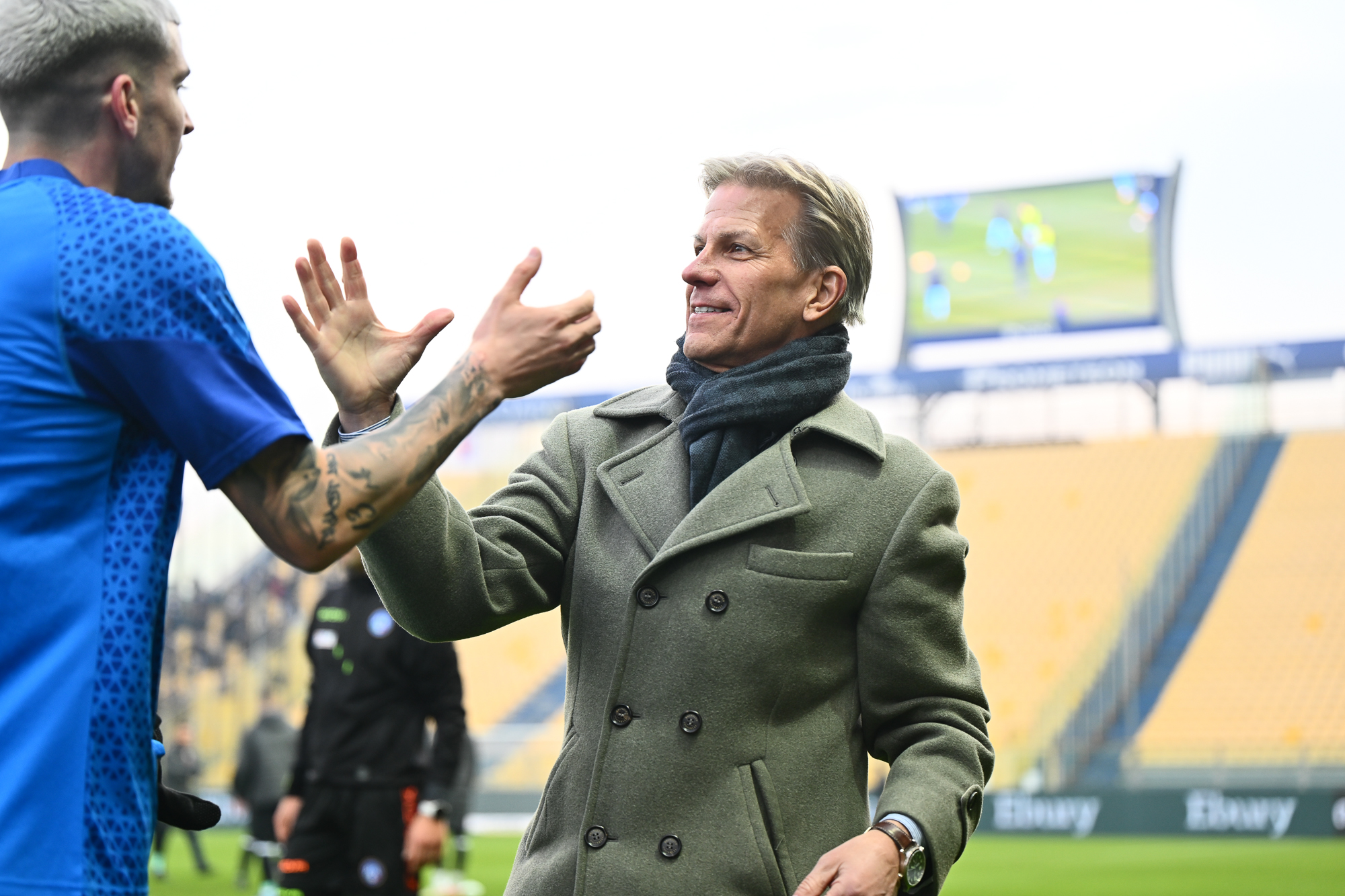
Fabio Pecchia took over as coach in 2022. By January 2024, Parma reported that it had led Serie B while fielding the division’s youngest starting team. That detail gave the development approach something visible to show for itself. Young players were learning inside a team that was winning, rather than waiting indefinitely for a future tense to become present.
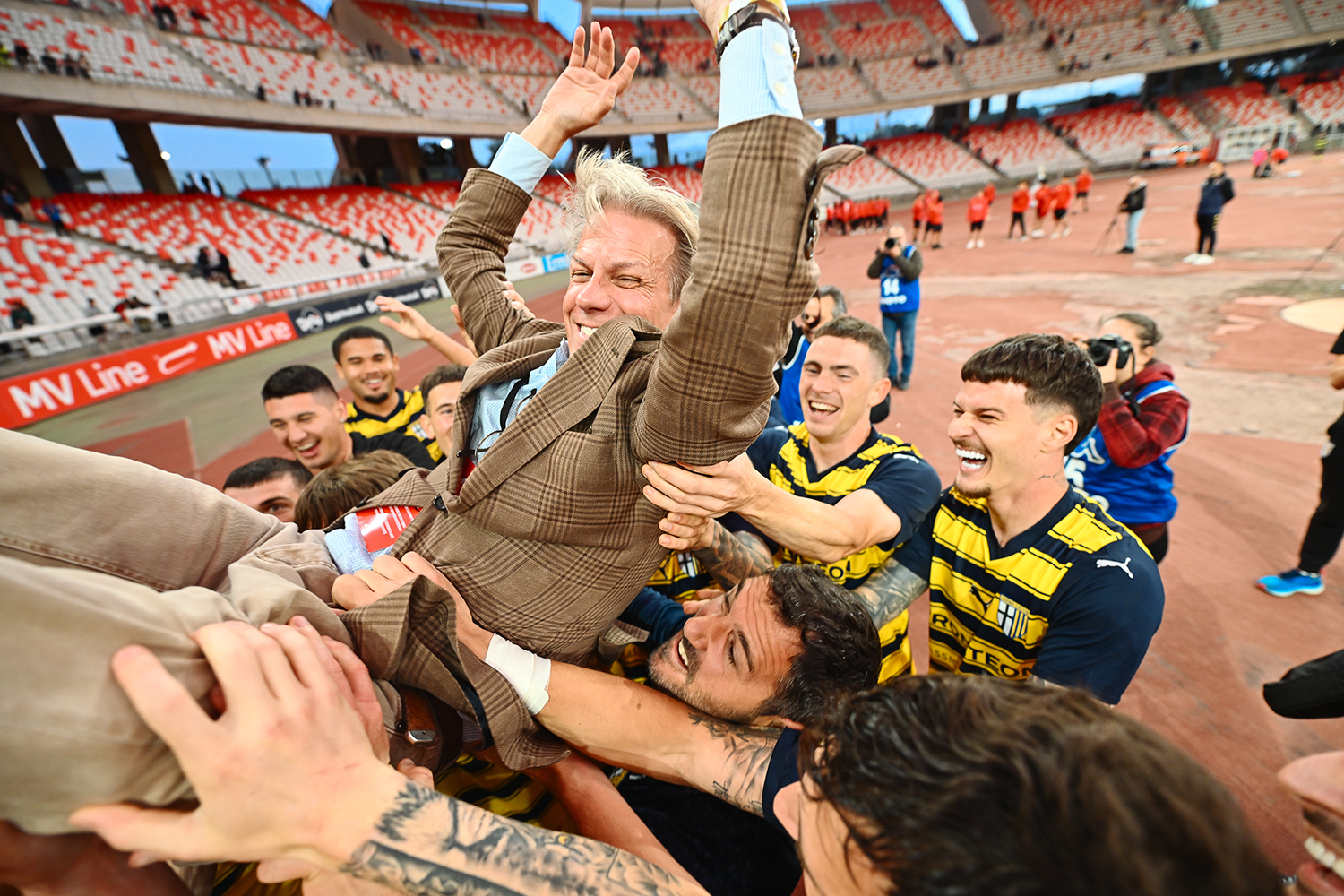
Promotion arrived in May 2024, followed by the Serie B title. At the municipal celebration, Mayor Michele Guerra described the club’s role as a sporting and social asset for the city. The photograph of players hoisting Krause is a less formal version of the same idea: an owner, temporarily deprived of his dignity, included in the joy.
Krause describes his involvement as strategic, with the daily operation entrusted to the club’s leadership. In March 2026, Parma confirmed him as president and chairman, alongside CEO Federico Cherubini and board members Helen Aboah, Oliver Krause and Scott Munn. The family connection continues, but the organization also needs people whose job is to turn an owner’s intention into everyday decisions.
“I’m a passionate yet calm supporter”
Kyle Krause, 2024
His personal attachment is plain enough. He has said his love of soccer grew while watching and coaching his children. He bought the Des Moines Menace in 1998 and entered the United Soccer League Hall of Fame in 2011. He also has Italian ancestry and dual citizenship. His efforts to learn Italian had progressed to short speeches by 2024. A club president’s language lessons come with an unusually attentive audience.
Back home, a stadium meets the city budget
Des Moines presents a more complicated chapter. Krause’s Pro Iowa ambition involves professional soccer and a stadium district on the former DICO industrial site. The proposal joined the sport to redevelopment, public space and the difficult work of making a contaminated site useful again. A stadium rendering can show a finished afternoon. It is less good at showing seven years of negotiations.
On August 26, 2026, the city announced that it had ended those negotiations. Officials cited changed financial circumstances following property-tax legislation, including a projected $12 million budget gap in fiscal 2028 and another $5 million the following year. They said the remaining funding gap was beyond what the city could responsibly commit to.
Krause Group challenged how the decision had been reached and requested the financial modeling behind the new terms. Its response acknowledged the city’s budget difficulties while asking whether the project’s costs and potential revenues had been fully set out. The disagreement remains a practical test of the promise that private investment and public benefit can advance together. Each side still has to make its numbers work.
The city ended talks on the stadium district. Krause Group continues to pursue professional soccer, including a women’s team, for Central Iowa.
The women’s game has a specific place in his plans. Krause Group has reiterated its intention to bring a Division I USL Super League women’s club to Central Iowa alongside a USL Championship men’s club. That is an ambition with a proposed league and a local audience, rather than a completed launch. The distinction matters to the people waiting to buy tickets.
A place at the table, and room for others
Soccer is still spreading through the portfolio. A company announcement dated July 17, 2026 described an agreement to acquire a majority stake in Lisbon’s Casa Pia AC, subject to approvals and closing conditions. It included support for a women’s first team. The pattern is recognizable: established local identity, new capital and a promise to develop the institution without discarding its character.
Krause’s interest in places also appears in the headquarters he commissioned in Des Moines. The Renzo Piano Building Workshop designed Krause Gateway Center with transparency at street level and extensive public space. Completed in 2018, its building occupies only a quarter of the site. Above it, native prairie grasses grow on the roof. Corporate architecture can be remarkably defensive; this project deliberately leaves room around itself.
There is a quieter family contribution at the University of Iowa. The Kyle J. and Sharon Krause Family Foundation supports the Krause Essay Prize, whose winner receives $10,000 and an inscribed walnut letterbox. Graduate students help choose the winning work. An owner who spends part of his life worrying about league tables also helps fund a contest decided by arguments about sentences.
These interests make more sense together than they first appear to. A wine has a landscape. A club has a city. A building decides how an organization meets the street. Krause’s investments repeatedly put him in contact with people who already care about something he has newly acquired or proposed. Their affection is an opportunity, and it is also a claim on his attention.
The Parma celebration shows what that relationship can look like when the result arrives. The Des Moines impasse shows how stubbornly unfinished it can remain. Somewhere between them sits an Iowa businessman whose laptop now wears the appropriate crest. Changing the sticker takes a moment. Earning the next afternoon of applause takes considerably longer.