In the late 1980s, Kristopher Schroeder began doing the sort of thing that later makes a founder biography sound inevitable: he toyed with computers. At the time, there was no consumer cloud to admire, no cybersecurity industry eager to recruit a teenager, and certainly no polite phrase like “secure environments as a service.” There was only the machine, its rules and the private pleasure of discovering that rules could be made to do useful things.
Decades later, Schroeder would return to that same elemental idea. People do consequential work on machines. The machines have rules. If the rules force investigators, engineers or analysts to choose between safety and getting the job done, perhaps the room around the work has been designed badly.
That question sits beneath Replica Cyber, the company he co-founded with Ryan Underwood. It also explains why Schroeder’s story is less about a sudden founder epiphany than a long apprenticeship in how complicated organizations handle risk. He spent 17 years at Booz Allen Hamilton. He taught at Johns Hopkins University. He worked around open-source intelligence and cyber counterintelligence. Then he left the large institution and built a small public benefit corporation whose original name, Grey Market Labs, sounded agreeably like a workshop operating between tidy categories.
“People and organizations shouldn’t need a background in Computer Science to have trust on the Internet.”Kristopher Schroeder
Seventeen years of useful friction
Schroeder studied computer science at the University of Delaware, graduating in 2000, then completed a master’s degree in Information and Telecommunication Systems at Johns Hopkins in 2004. The dates overlap with the opening stretch of his Booz Allen career. Work and study ran together, which feels appropriate for someone whose later business would combine software architecture with the behavior of institutions.
At Booz Allen he grew from technologist into operator. By the end, he was a principal and officer in charge leading a systems-delivery business with roughly $40 million in annual work. His official biography credits him with helping establish the National Open Source Enterprise and building horizon-scanning systems for Fortune 500 companies. The résumé language is sober. The underlying education was lively: large customers, sensitive missions, multiple stakeholders, old infrastructure and the recurring comedy of a person needing to finish a job that the approved system cannot comfortably support.
The conventional response to risky activity is restriction. Lock the browser. Block the application. Add another approval. The work does not politely evaporate. It migrates to a personal device, an improvised virtual machine, an unmonitored account or a colleague’s clever workaround. Risk, having been forbidden, puts on a false moustache and returns through the side door.
Schroeder and Underwood saw another possibility. Instead of treating every component separately, isolate the environment that contains the activity. Give the practitioner the tools and freedom required inside it. Give the organization policy, visibility and an audit trail around it. Their eventual product, Replica, would orchestrate digital spaces spanning hardware, operating systems, applications, networks and data. The interesting unit was no longer the browser tab. It was the room.
The room, not merely the window
A company with a conscience clause
Grey Market Labs was founded in 2017 as a public benefit corporation. Its mission was “protect life online,” three words broad enough to become vapour and specific enough to make uncomfortable demands. In 2022, it announced B Corp certification. The company said it was the first cybersecurity product company in North America to earn that certification.
For Schroeder, civic purpose did not arrive with the corporate paperwork. In 2007, he and his wife founded Uncorked, Inc., a nonprofit supporting the Washington, D.C. community through service, fundraising and education. Its signature event was a charity wine tasting and dinner, held on the Thursday before Thanksgiving in Washington and New York. It is an endearingly analogue footnote in a digital-security career: gather people, open bottles, direct attention and money toward a local need.
The same sensibility appears in how he talks about business. Protecting people and creating shareholder value, he has said, are compatible. The claim is easier to frame than to maintain. Incorporating it into the legal form and submitting the company to outside certification at least turns the claim into something testable. A mission statement may be décor. A governance choice can become an argument with consequences.
When a value matters, give it machinery. Put it in the company form, the product architecture, the hiring decisions and the measurements. A framed sentence has very little leverage.
Bootstrapped first, funded later
Schroeder and Underwood bootstrapped the business for more than six years. During that time Grey Market Labs built products, accumulated patents, served government and enterprise customers, and collected external signals that the little laboratory was becoming a company. The University of Delaware repeatedly recognized it in its Blue Hen 17&43 entrepreneurship awards. Inc. included it in regional growth rankings and workplace lists.
In November 2024, the company announced its first institutional financing: an $8 million Series A led by Capri Ventures, with participation from Blu Ventures and AFG. By then Replica was not a pitch-deck sketch. It was being used for protected research, cyber and fraud investigations, malware analysis, secure development and other work that becomes expensive when improvised.
There is a useful tension in that sequence. Venture capital celebrates speed, while cybersecurity punishes haste. Schroeder’s company took time to develop the thing before taking money to accelerate it. The route lacks the glamour of an overnight launch. It has the sturdier appeal of knowing why the capital is needed.
When the product became the name
In March 2025, Grey Market Labs became Replica Cyber in public. Grey Market Labs remained the legal entity, but the operating brand moved to the name customers already associated with the platform. It was a rebrand with unusually little amnesia. The B Corp commitment stayed. The founding mission stayed. The work simply acquired a clearer label.
Replica had also expanded the company’s vocabulary. Schroeder started speaking about “high-stakes work,” a phrase that joins the danger and the necessity in one tidy package. At Infosecurity Europe in June 2025, he presented on using intelligence tradecraft to create preventative security. In interviews, he and Underwood described the journey from defending against intelligence threats to building a SaaS platform for enterprises working in untrusted digital territory.
The company’s patent count grew with the pitch. Replica now reports more than 20 patents covering areas such as digital identity protection, data-exposure controls and secure-environment automation. Patents are no guarantee of customer love, but they make one part of the story legible: the founders treated isolation as an engineering field, not a decorative security setting.
“The work security teams need to do has outpaced the environments they have to do it in.”Kristopher Schroeder, 2026
The exception economy
By 2026, Schroeder’s focus had widened to what Replica calls the “Exception Economy.” The company surveyed 200 cybersecurity leaders and reported that security exceptions had become routine. AI raised the pressure: teams wanted to test models and agents against meaningful data, while existing infrastructure forced security leaders toward delay, denial or improvised permission.
Schroeder’s answer remained architectural. Policy alone cannot reveal what an AI agent accesses, spends or sends. Control and visibility have to live in the system. It is the old lesson from high-risk human activity, translated to software that may act on a person’s behalf. The cast has changed; the room still matters.
His public language has changed along with the market. Early descriptions centered on trust and privacy. Later ones spoke of secure environments, high-stakes work and the permission to say yes to risk. The progression is less a collection of slogans than a founder getting more exact about the customer’s predicament. An investigator is not asking for “cybersecurity” in the abstract. She is asking to open the suspicious file, follow the criminal trail or test the unfamiliar model without turning the rest of the organization into collateral.
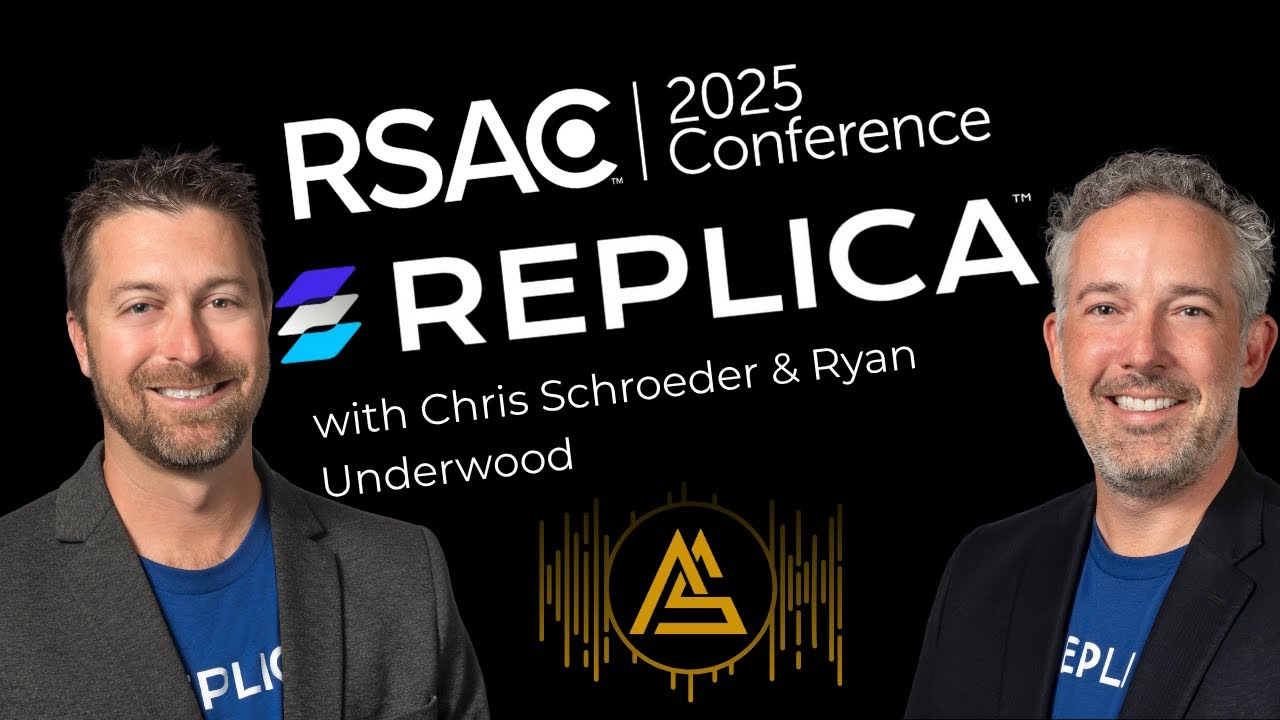
This is also where Schroeder’s partnership with Underwood becomes important. The public biographies divide their jobs conventionally - Schroeder as CEO, Underwood as CTO - but their shared history gives the company two views of the same room. One concerns missions, markets and organizations. The other concerns how the system must behave. Their 2025 CyberBytes conversation makes the pairing visible: a founder story told in stereo, with culture and architecture occupying the same discussion. For a company selling controlled collaboration, the symmetry is almost suspiciously neat.
Replica collected a cluster of 2026 recognitions, including two Global InfoSec Awards at RSAC and three Globee cybersecurity awards. Inc. also named it a Best Workplace. Schroeder’s response to the workplace recognition was revealing. He wrote that the company’s values were authored and reviewed by the team, then used in decisions from benefits to security policy. Culture, in this telling, is another environment: designed collectively, inspected regularly and expected to help people do difficult work.
Schroeder began with computers because their rules could be understood. His adult work has unfolded inside institutions, where rules are murkier and the side effects are human. Replica Cyber is his attempt to reconcile those worlds. Make the boundary clear. Put freedom inside it. Watch what matters. Let the necessary work continue.
The internet will keep producing dangerous places, unfamiliar tools and urgent reasons to visit both. Telling people to be careful is cheap. Building them a better room is harder. Schroeder has chosen the carpentry.