How Do You Work the Dark Web Without Getting Burned? Build a Throwaway Computer Every Single Time.
Grey Market Labs spent a decade turning intelligence tradecraft into a button. Now Fortune 100 banks and the US Army rent disposable, fully isolated workspaces that appear in minutes and leave no trail.
The pitch most cybersecurity companies make is that they will build you a taller wall. Grey Market Labs makes a stranger one: it will build you a computer you throw away. Spin one up, do your most dangerous work of the day - trawl a dark web forum, detonate a suspicious file, poke at a fraud ring targeting retirees - and when you are done, the whole machine disappears. No trace back to your network. No trace back to you.
That idea has a name the company had to invent for itself: Secure Environments-as-a-Service. Grey Market Labs, a public benefit corporation headquartered in McLean, Virginia, sells it through a platform called Replica. In March 2025 the company started operating publicly under the Replica Cyber name, though the legal entity remains Grey Market Labs, PBC. The rebrand was less a fresh coat of paint than an admission of what it had quietly been building for close to a decade.
The premise is worth sitting with, because it inverts a habit the whole industry is stuck in. Perimeter security assumes your identity and your infrastructure are assets to be defended. Grey Market Labs treats them as liabilities to be hidden. If the safest file is the one an attacker never sees, the safest computer might be the one that does not exist tomorrow morning.
A full computer, isolated top to bottom, gone in minutes
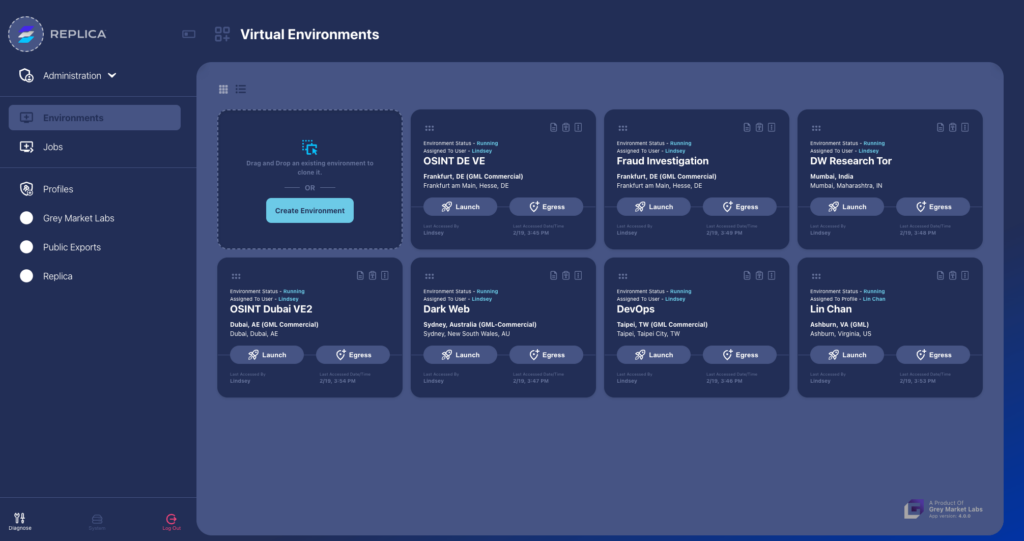
Most security tools that promise "isolation" isolate the browser tab. Replica isolates the full stack - operating system, network, applications and data - and wraps it in a Zero Trust architecture. The environment is realistic enough to do real work in, and disposable enough that nothing that happens inside it reaches back to the organization that launched it. The company says an environment can be stood up in minutes rather than the weeks or months a hardened workstation traditionally takes.
How Replica isolates a session
A second feature does the hiding: managed attribution. It lets an investigator appear on the internet as someone - and somewhere - other than who and where they are. For an analyst reading a criminal marketplace, that difference is the difference between gathering evidence and getting made. Every session is fully audited underneath, so the anonymity outward does not cost the organization its chain of custody inward.
CTO and co-founder Ryan Underwood frames the environments not as sandboxes but as real machines: "These are complete computing systems, delivering essential functionality, trusted observability, and control." That is the tension the product is built around - it has to be a fully usable computer and a cage at the same time.
Twenty years of tradecraft, compressed into a button
CEO and founder Kristopher Schroeder came out of Booz Allen Hamilton, where he worked in intelligence and cyber operations before starting the company in 2017. His description of Replica is not about features; it is about lineage. "Replica is the culmination of over 20 years of experience in embedded tradecraft, intelligence operations, and cutting edge software," he has said. The engineering team, by the company's account, includes people with backgrounds on both the offensive and defensive sides of cyber warfare.
That heritage is the moat. Anyone can rent a virtual machine; the hard part is the tradecraft that keeps a virtual machine from quietly leaking who is behind it. Grey Market Labs has filed and won 18 issued patents on the technology, and describes the platform as the product of more than a decade of development.
Banks, hospitals, and the Defense Innovation Unit
The customer list runs from Fortune 100 financial, healthcare and business institutions to federal agencies including the US Army and the Defense Innovation Unit. What links them is not an industry but a problem: they all have people who need to touch the untrusted internet as part of their job, and none of them can afford to let that contact reach their production systems.
The uses Grey Market Labs points to are concrete, and occasionally sobering: countering disinformation abroad, disrupting financial fraud aimed at seniors, detonating malware safely, running due diligence during mergers, and hunting insider threats. The same disposable environment that lets a bank's fraud team follow a scammer is the one that lets a security researcher open a file that would wreck a normal laptop.
Fraud & financial crime
Gather evidence and follow bad actors while staying compliant and auditable.
Dark web operations
Anonymous, unattributable access to restricted platforms with chain of custody intact.
Malware analysis
Detonate and reverse-engineer hostile code in a machine you can throw away.
AI & R&D
Experiment with new tools and proprietary data without exposing the real network.
M&A & due diligence
Evaluate and integrate outside technology inside an isolated, observed space.
Intelligence & research
OSINT and open-source collection without tipping off the target.
Not a taller wall - a room that self-destructs
Grey Market Labs sits near a cluster of browser-isolation and virtual-workspace vendors - names like Authentic8, Ntrepid, Island and Menlo Security - and it is quick to draw a line between itself and them. Browser isolation protects the tab. Replica's argument is that the tab is not where the risk lives; the risk lives in the whole machine and, more importantly, in the identity operating it. So it isolates everything and makes the operator unattributable by default.
The company backs the case with numbers about how leaky the status quo is. In its telling, essentially every organization grants a security exception at some point in a given year, most breaches now involve cloud assets, and a large share of employees quietly adopt tools their IT department never sanctioned. Each of those is a door. Replica's pitch is that it is cheaper to give people a disposable room than to keep pretending the doors are locked.
Why exceptions keep happening
Figures the company cites to frame the problem it sells against. Directional, not audited.
There is a claim that deserves a raised eyebrow, and the company makes it anyway: a 99.73% reduction in the IT burden of standing up a secure environment. It is a marketing figure, not an audited one, and the honest read is that it measures the gap between "provision a hardened workstation over weeks" and "click a button." Even discounted heavily, the direction is the whole point - the friction of doing secure work is the thing Replica is trying to delete.
A B-Corp selling to the Fortune 100
The business model is B2B SaaS with a hosted-service option, sold as a subscription and rounded out with hardware and advisory tradecraft services. The team is small - around eight people - which makes the customer list and patent count more striking than they would be at a company ten times the size. In November 2024 it raised an $8M Series A led by Capri Ventures, with Blu Ventures and AFG participating.
The round bought more than runway; it bought a Rolodex. Andy Brown, former CTO of UBS and a board member at Zscaler and Pure Storage, joined the board alongside Capri's Dennis Shaya. The advisory bench added Don Duet, formerly head of technology at Goldman Sachs, Nick Donofrio, a former EVP of innovation at IBM, and others - the kind of names that open doors in exactly the regulated industries Replica is selling into.
Underneath the commercial machinery is a governance choice that is easy to miss and hard to reverse: Grey Market Labs is a Certified B Corporation and a public benefit corporation, with the mission to "protect life online" written into its legal charter rather than just its homepage. The company's stated tagline - "Preventing Data Exploitation. For Good." - is doing double duty as a values statement and a market position.
From Grey Market Labs to Replica Cyber
Kristopher Schroeder starts the company in McLean, Virginia as a public benefit corporation, later joined by co-founder and CTO Ryan Underwood.
Full-stack isolation and unattributable access come together, aimed at OSINT, malware analysis and secure DevOps.
Capri Ventures leads the round; a heavyweight board and advisory bench sign on to scale the Replica platform.
With 18 issued patents, the company rebrands its public identity to Replica Cyber, keeping Grey Market Labs, PBC as the legal entity.
What is copyable here is not the patents - those are locked up - but the framing. Grey Market Labs found a category the incumbents had left half-named, planted a flag in it, and told a story simple enough to repeat: the safest computer is the one you throw away. Whether "Secure Environments-as-a-Service" becomes a durable market or gets absorbed into the broader isolation space is the open question. For now, a team of eight has convinced banks, hospitals and the Army that it is worth renting a machine that disappears.
Follow Grey Market Labs
Grey Market Labs, PBC · McLean, Virginia · Founded 2017